
Home

Photographs and how they were made

A gallery of motion studies, portraits, space images and altered scenes, with the methods and limits beside each photograph.

About 45 minutes for the gallery text · 55 minutes with notes and sources · Take more time with the images

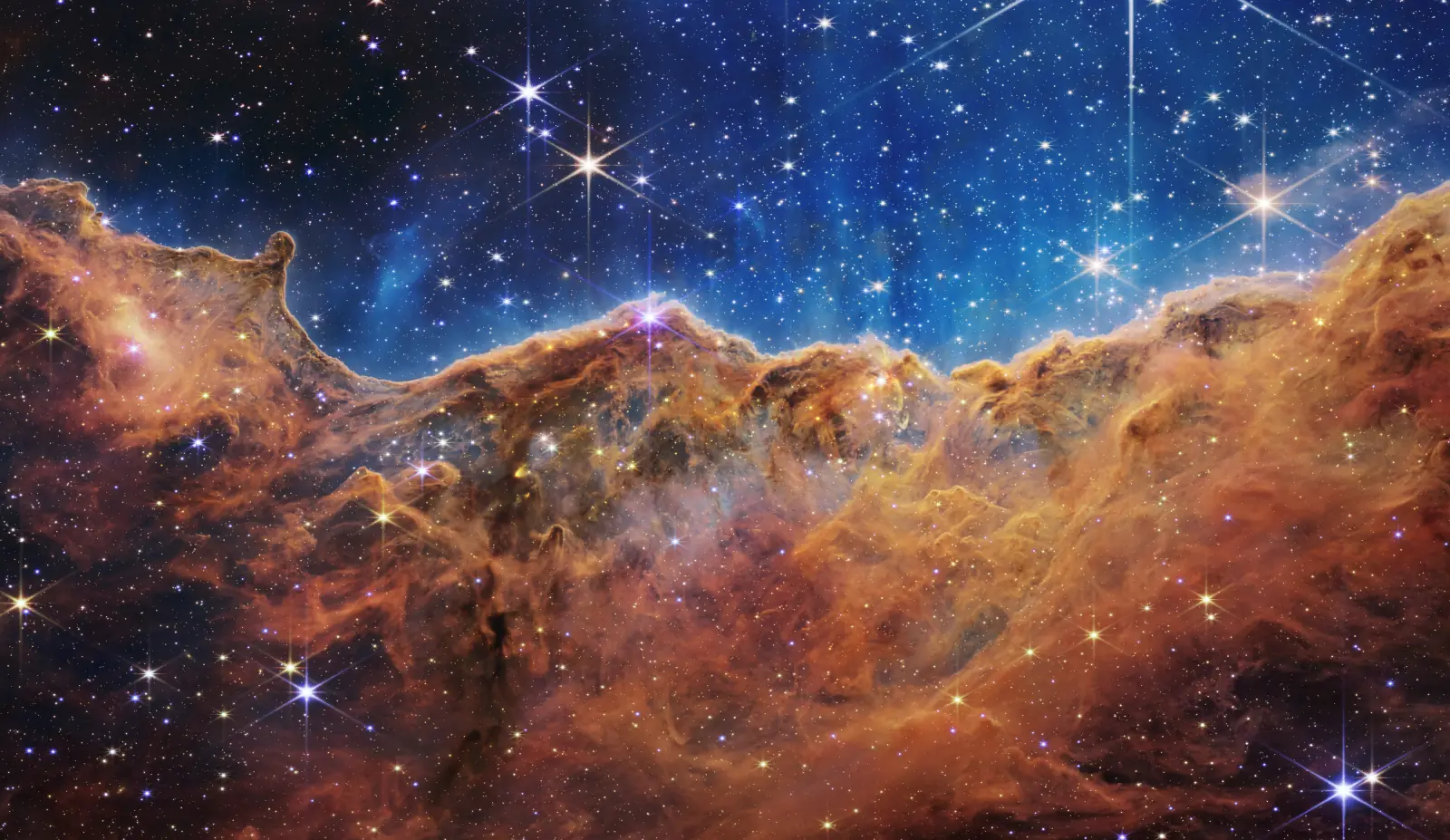
The Cosmic Cliffs of the Carina Nebula photographed by the James Webb Space Telescope: glowing amber mountains of gas under a deep blue starfield.
The Cosmic Cliffs, Carina Nebula. NASA, ESA, CSA, STScI (CC BY 4.0)

A photograph records light, but the finished picture can contain several exposures, a reconstructed color image or a retouched negative. This gallery follows those choices through sixty-three examples, from a running horse to Earth seen by Voyager. It explains what each picture can show and where its evidence stops.

The eleven rooms group pictures by method and subject. Open the side notes for related stories. Selected photographs open in a larger viewer; the horse flipbook, comparison sliders, panoramas and tone strip let you inspect particular techniques.

Credits identify the source of every reproduced photograph. The gallery uses public-domain, CC0 and Creative Commons files, together with archives' stated rights advisories. Some rights vary by country. Copyrighted images discussed without reproduction are linked to their owners or collections. Numbered references lead to the source notes.

ROLL 01 · 1878 to 2020

Stopping time

Short exposures separate movements that the eye combines.

FR 01 / 11
SALLIE GARDNER · PLAYBACK 14 FPS

Eadweard Muybridge, "Sallie Gardner at a Gallop," June 19, 1878, Palo Alto. Animated here from the original cabinet card. Wikimedia Commons / Library of Congress, public domain.

No. 001 · A gallop in separate exposures

The horse is airborne, with its legs tucked in.

Muybridge's 1878 sequence catches something hard to separate by eye: the instant a galloping horse has all four feet off the ground. Leland Stanford commissioned the motion studies; twelve cameras beside the track recorded successive positions of Sallie Gardner.1 The airborne phase looks different from the stretched-out horse common in older paintings. This flipbook crops eleven running poses from the published cabinet card and omits its final standing portrait. It plays at 14 frames per second for comparison, rather than reconstructing the original timing. Scrub it to examine individual positions.

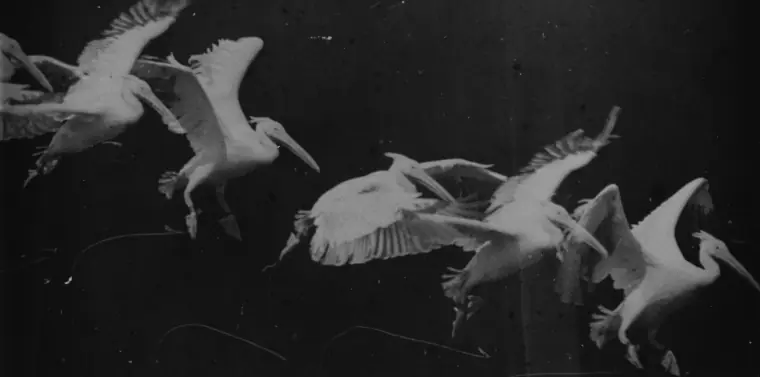
Etienne-Jules Marey chronophotograph: five overlapping ghostly positions of a pelican in flight on one dark plate.
Étienne-Jules Marey, a pelican's wingbeats on a single plate, circa 1882. Wikimedia Commons, public domain.

No. 002 · Marey’s motion studies

Several moments share one plate.

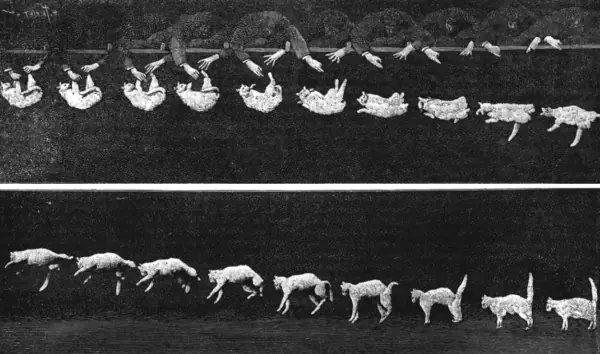
Étienne-Jules Marey wanted to measure movements too fast for an observer to follow. His photographic gun of 1882 exposed a rotating plate twelve times a second, with exposures of about 1/720 second. He also developed methods that recorded successive positions on a stationary plate, as in this bird study.2 The overlapping wings trace a flight path across the plate. The falling-cat sequence below dates from 1894 and uses a different apparatus. Its separated frames show the animal turning its body during a fall, a movement that would otherwise pass in a fraction of a second.

Marey's 1894 chronophotograph strip of a cat falling and twisting upright frame by frame.
Marey’s falling-cat sequence, 1894. The successive frames record the animal turning during a fall. Wikimedia Commons, public domain.
An 1888 shadowgraph of a supersonic bullet: the dark projectile trailing a visible cone-shaped shock wave through the air.
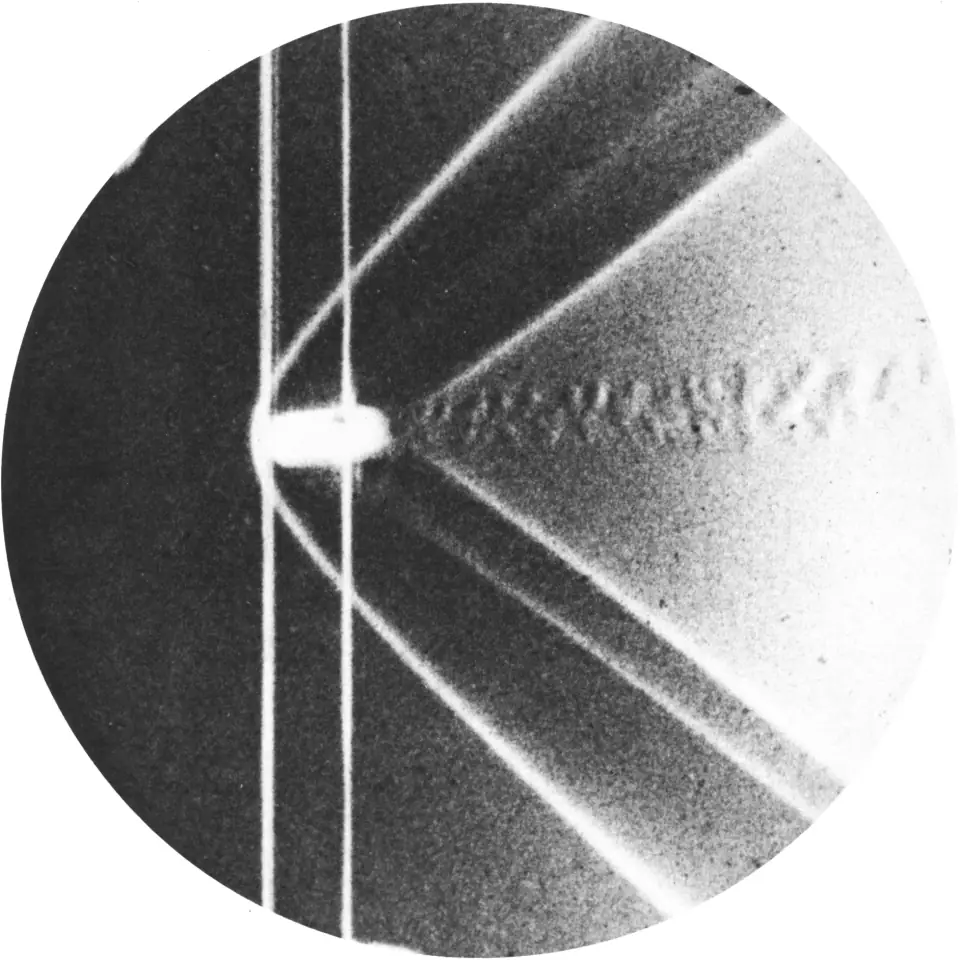
Ernst Mach, brass bullet and its shock pattern, 1888. Wikimedia Commons, public domain.

No. 003 · A shock wave made visible

The air around the bullet changes the light.

This 1888 image associated with Ernst Mach shows the shock pattern around a supersonic projectile. Mach and Peter Salcher published their studies of such disturbances in 1887.3 The air itself is transparent. An optical arrangement makes changes in its density visible by detecting the way they bend light, while a brief electrical spark freezes the motion. The dark lines record the pressure disturbance around the moving bullet. The image belongs to the experimental work that established the geometry of supersonic flow.

An F/A-18 flying above the sea, with a white condensation cone around its rear fuselage.
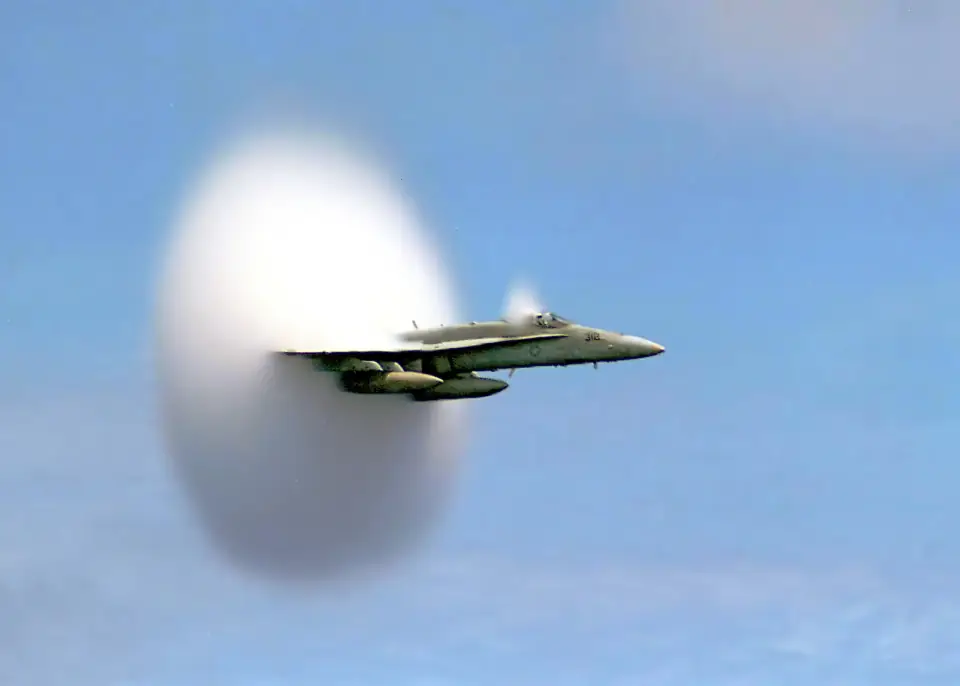
Ensign John Gay, US Navy, F/A-18 Hornet at transonic speed over the Pacific, July 7, 1999. Wikimedia Commons, public domain (US Navy).

No. 004 · A condensation cloud

The cloud forms where humid air cools.

Navy photographer John Gay caught this F/A-18 over the Pacific on July 7, 1999. The white cone is condensed water. As air accelerates around parts of the aircraft, its pressure and temperature can fall enough for water vapor to condense; the droplets disappear again as conditions change.4 Shock waves can bound such flow, but the cloud itself records condensation. Its presence alone does not identify the instant the aircraft crosses the speed of sound. Humidity helps determine whether a fast pass leaves anything visible.

Worthington’s splash-study plate showing successive forms of liquid impact.
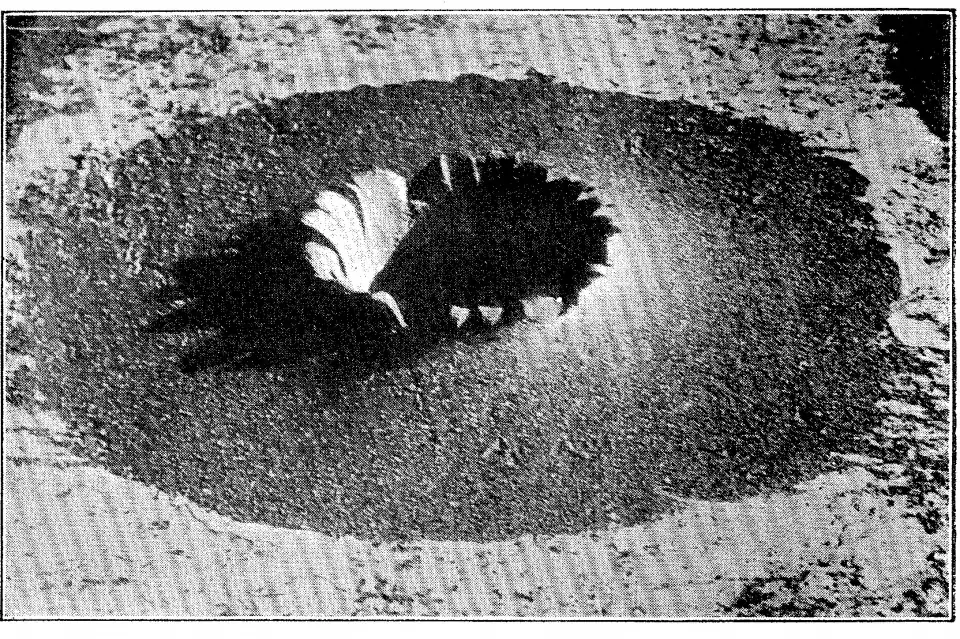
A. M. Worthington, splash study, 1900, from his spark-flash series. Wikimedia Commons / Biodiversity Heritage Library, no known restrictions.

No. 005 · Worthington’s splash studies

The photographs were less symmetrical than the drawings.

Arthur Worthington first studied splashes by observing them under brief flashes and drawing what he saw. Later photographs recorded irregular features that his earlier, tidier drawings had suppressed. In A Study of Splashes, he compared those drawings with the photographic evidence and revised his account.5 An electrical spark supplies the short exposure: the useful duration is the light pulse, even if the camera remains open in a dark room. This plate shows several stages of impact. It is a sequence of separate observations, not one crown held in place.

Notes on strobes and ultrafast imaging

Edgerton’s short flashes

A brief light pulse freezes a fast event.

Harold Edgerton's stroboscopic photographs include Milk Drop Coronet and a bullet passing through an apple. A brief flash can provide the useful exposure time when the surrounding room is dark. His apparatus made events too fast for ordinary observation available for careful comparison.6 The MIT Museum preserves the equipment and images. The photographs linked there are discussed here without reproducing the copyrighted prints.

Reconstructing very fast events

The imaging rate depends on how the measurement works.

MIT’s 2011 demonstration reconstructed a laser pulse passing through a bottle at an effective rate of about a trillion frames per second. It assembled data from repeated events and changing camera positions; acquiring a complete sequence took about an hour.7 The 2020 CUSP paper reported 70-trillion-frame-per-second imaging without event repetition, using specially structured laser illumination, a streak camera and mathematical reconstruction.8 These methods recover short sequences of fast events under controlled conditions.

ROLL 02 · 1843 to 1913

Making color and revealing hidden light

Filters, sensitized paper and radiation change what a photograph records.

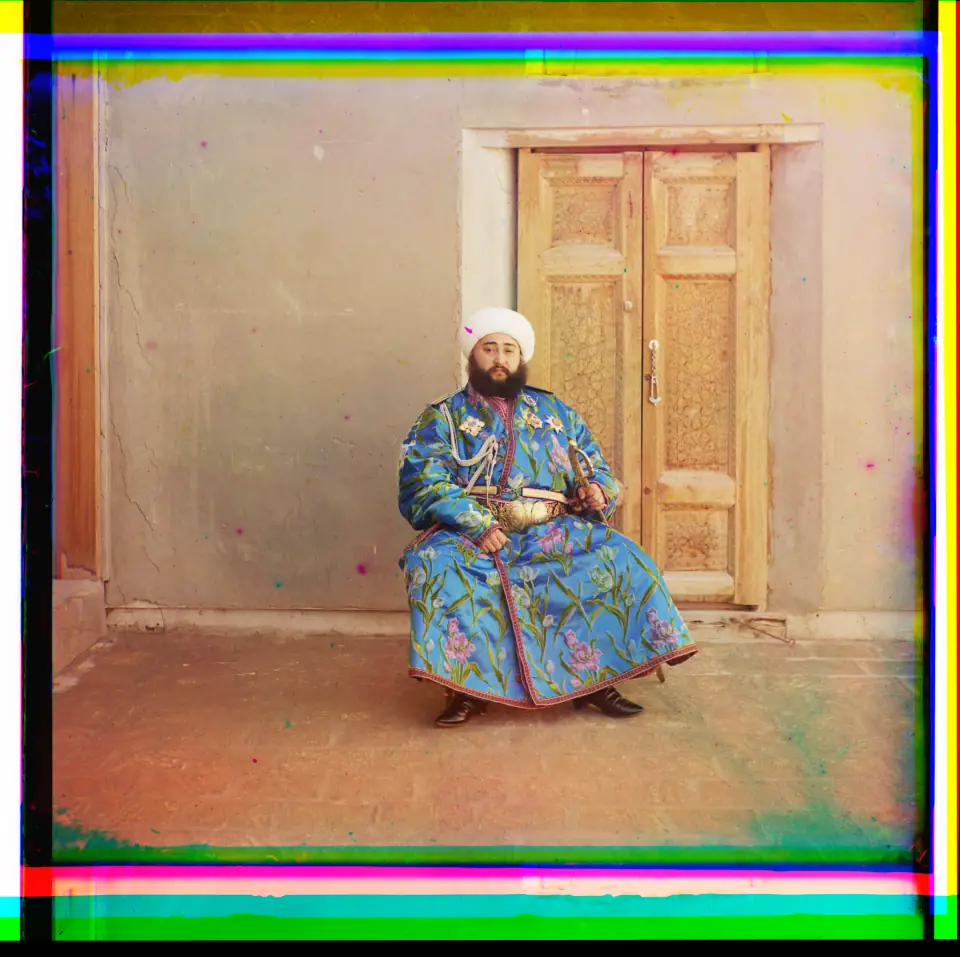
The Emir of Bukhara in 1911, in full color: a bearded man in a brilliant blue silk robe with a gold belt, rainbow fringes at the photo's edges.
Sergei Prokudin-Gorskii, Emir Alim Khan of Bukhara, 1911. Digital color composite by the Library of Congress. LOC, no known restrictions.

No. 006 · Three records become color

One glass plate carries three filtered views.

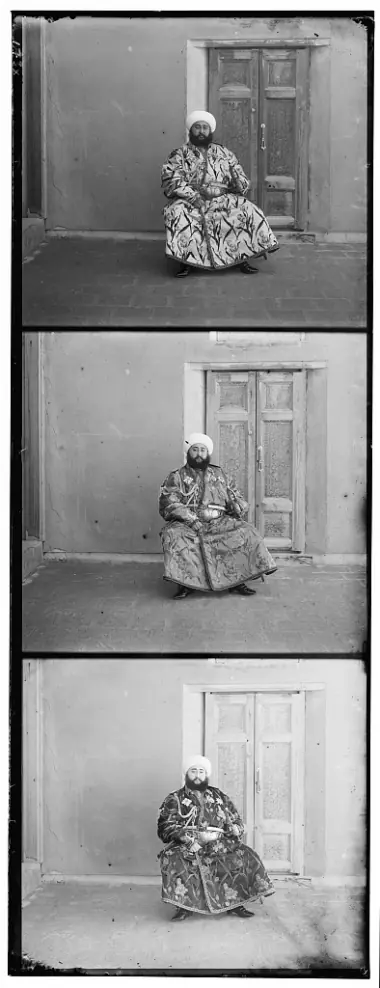
Prokudin-Gorskii made this portrait of Emir Alim Khan of Bukhara in 1911. His method recorded three black-and-white images in succession through red, green and blue filters, usually on different areas of one glass plate. The Library of Congress combines those records digitally to produce the color image shown here.9 Compare it with the plate below. Each frame measures different wavelengths; aligned and assigned to the appropriate color channel, they restore much of the scene's color. Colored fringes can reveal imperfect registration or movement between exposures. This is a modern reconstruction from historical measurements.

The raw glass plate: three vertical black-and-white frames of the same Emir, one per color filter.
The actual plate: same Emir, three times, one frame per color. LOC, no known restrictions.
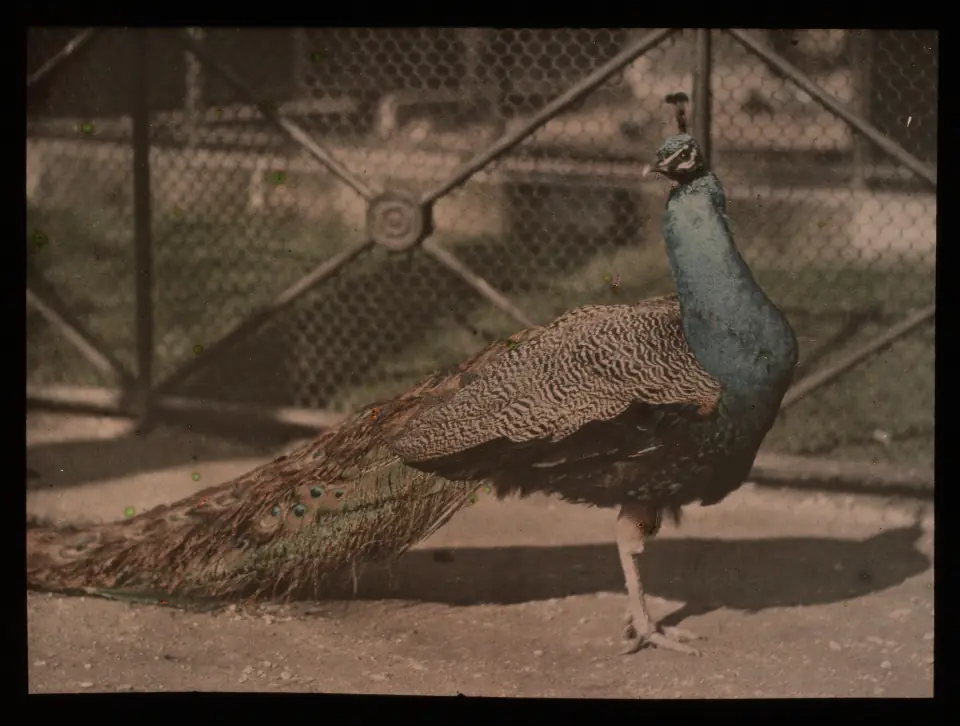
A Lumiere autochrome of a peacock, its blue-green plumage shimmering in soft pointillist grain.
Auguste and Louis Lumière, "Peacock," autochrome, circa 1907. The Met. Via Wikimedia Commons, CC0 (Met Open Access).

No. 007 · The autochrome plate

Dyed starch filters the color.

Commercially introduced in 1907, the Lumières’ autochrome offered color photography on a single glass plate. Microscopic potato-starch grains dyed red-orange, green and blue-violet formed a random mosaic of filters. Light passed through them before reaching the photographic emulsion; the developed positive was viewed with light passing through the plate again.10 The grains account for its texture and softened color. The plate needed substantially more exposure than contemporary monochrome materials. In this peacock study, fine feathers share the image with the grain of the color screen itself.

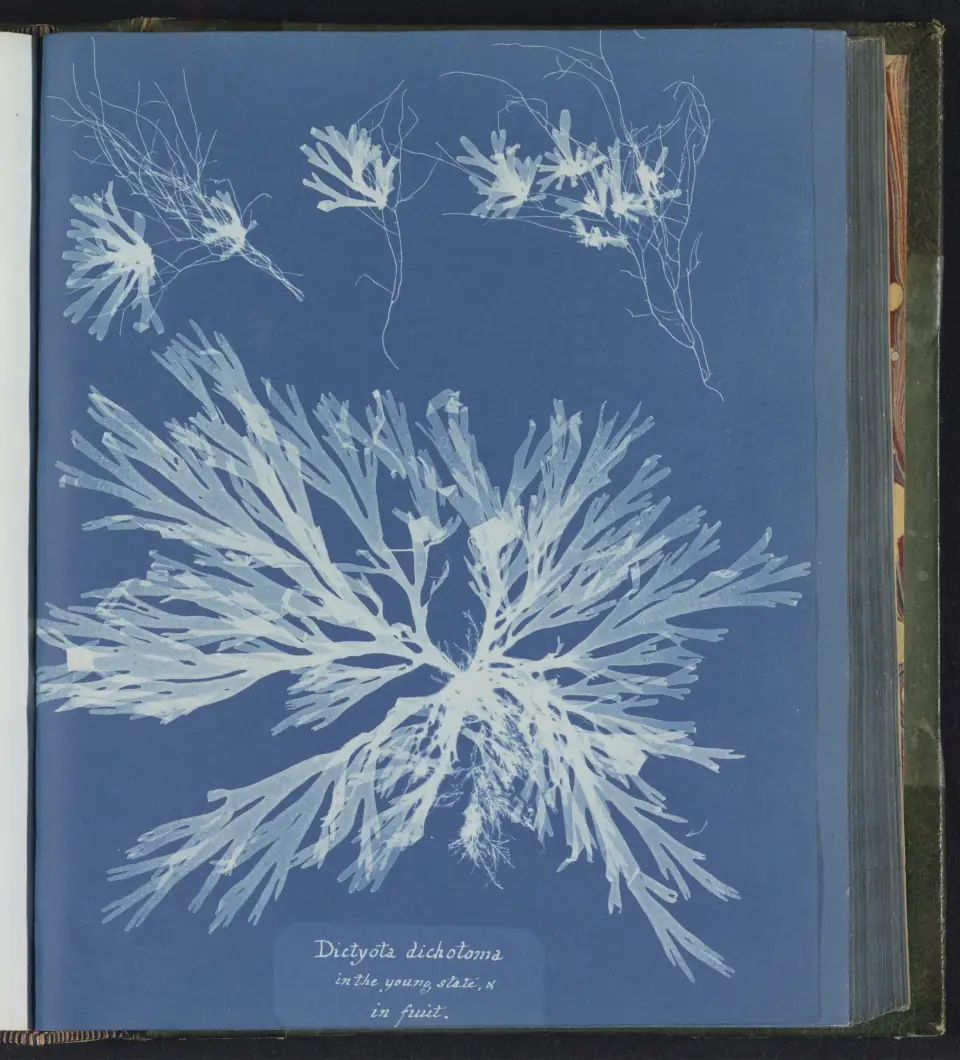
An 1843 cyanotype by Anna Atkins: pale ghostly seaweed fronds glowing white against deep Prussian blue.
Anna Atkins, Dictyota dichotoma, from "Photographs of British Algae," 1843 to 1853. Rijksmuseum. Wikimedia Commons, CC0.

No. 008 · Atkins’s photographic book

Seaweed leaves its outline on sensitized paper.

Anna Atkins began issuing Photographs of British Algae in 1843, the first book illustrated with photographs. These are cyanotype photograms: images made by placing specimens directly on light-sensitive paper, without a camera. Exposed areas develop a blue color, while the seaweed shields the paper beneath it.11 The method preserves an outline and some internal detail, useful for identifying fragile specimens that can be difficult to draw. Her handwriting also appears photographically on the pages. The process later served technical copying as the familiar blueprint; here it serves a botanical catalogue.

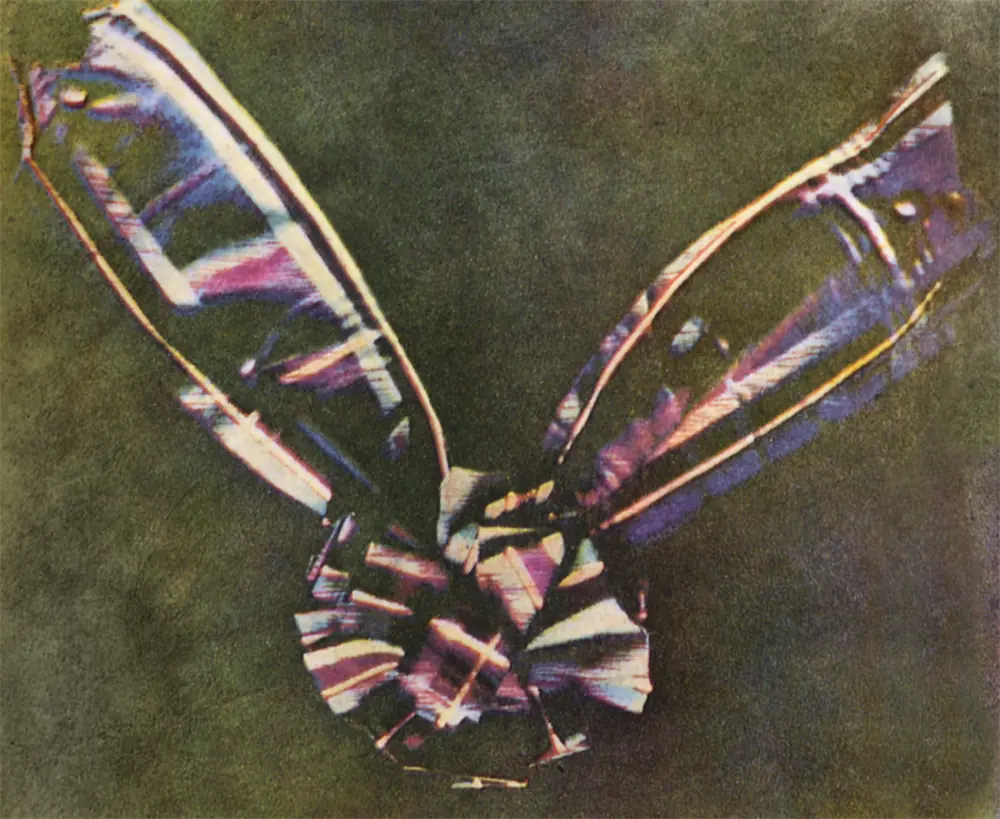
The tartan ribbon from Maxwell and Sutton’s 1861 additive-color experiment.
James Clerk Maxwell and Thomas Sutton, the tartan ribbon, May 17, 1861. Wikimedia Commons, public domain.

No. 009 · An additive-color experiment

Three projected images make one color image.

In 1861 James Clerk Maxwell asked photographer Thomas Sutton to make three filtered photographs of a tartan ribbon. Projected through corresponding red, green and blue filters and superimposed, they demonstrated additive color: different amounts of colored light combine to produce a wider range of colors.12 Modern RGB screens use that principle, though their hardware is very different. The photographic materials were poorly sensitive to red. A later explanation proposed that ultraviolet reflected by the ribbon's red dye supplied the apparent red record. That historical explanation concerns this experiment's imperfect materials, not the validity of additive mixing.

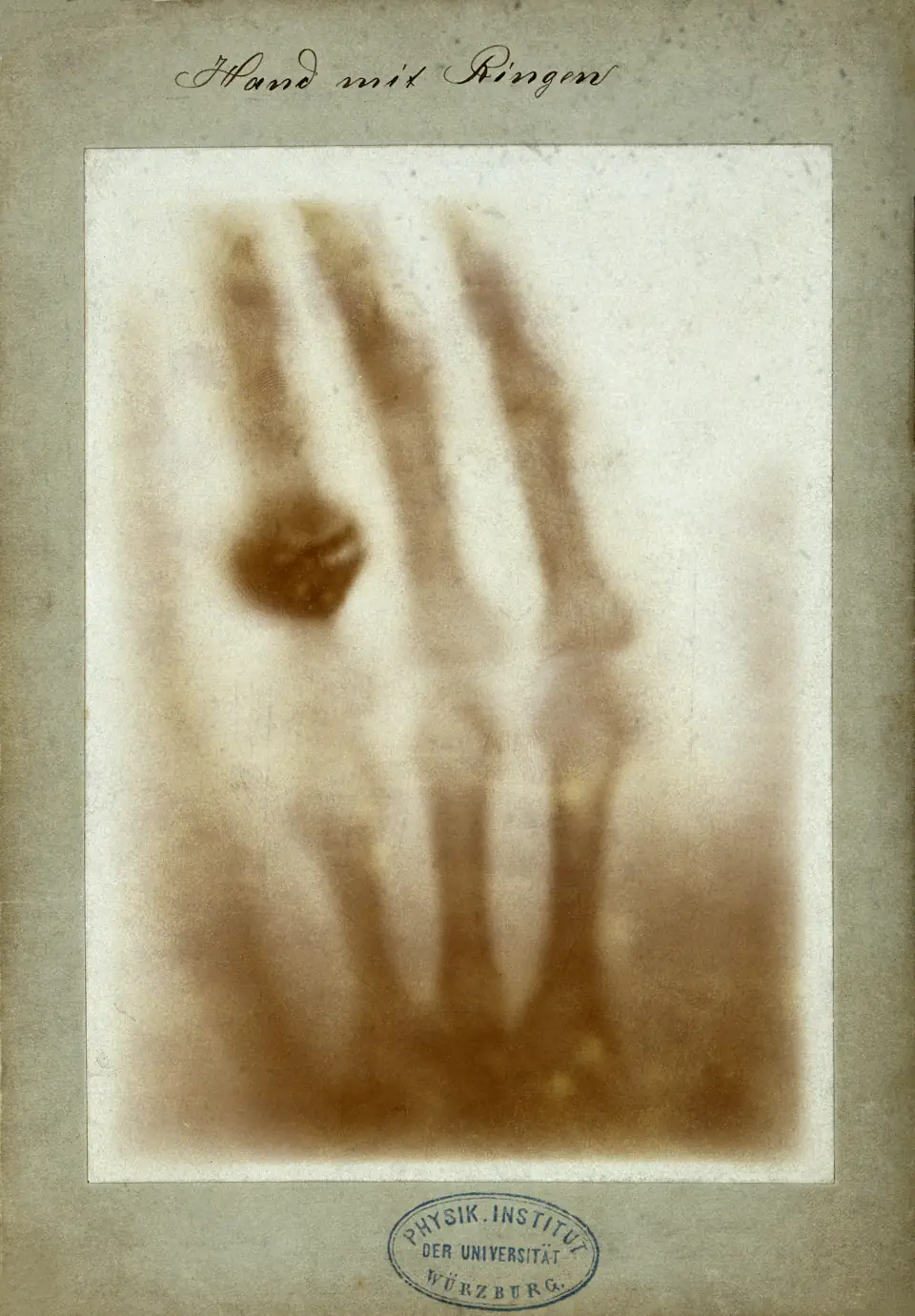
Röntgen’s 1895 X-ray image of Anna Bertha’s hand, with finger bones and two rings visible.
Wilhelm Röntgen, the hand of Anna Bertha Ludwig, December 22, 1895. Wikimedia Commons, public domain.

No. 010 · Röntgen’s X-ray image

Bones and rings absorb more of the radiation.

On December 22, 1895, Wilhelm Röntgen made this X-ray image of his wife Anna Bertha’s hand. X-rays passed through the hand to a photographic plate. Bones and metal rings attenuated more of the radiation than the surrounding soft tissue, so the developed image separated structures ordinarily hidden from sight.13 The dark rings sit beside the paler outlines of the fingers. This contrast records transmission through the body rather than light reflected from its surface. Röntgen’s discovery rapidly opened a new kind of medical imaging.

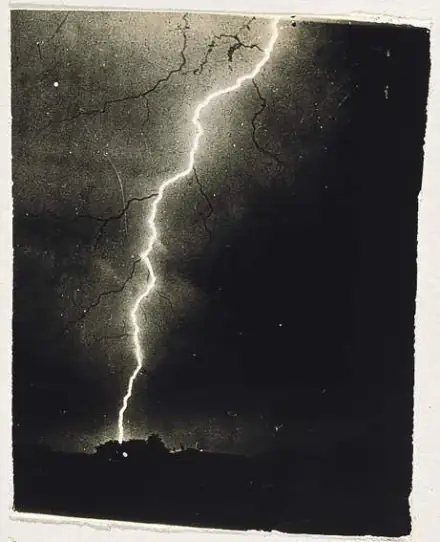
An 1882 photograph of a branching lightning bolt over Philadelphia rooftops.
William Jennings, lightning, 1882. The branching bolt is visible against the dark sky. Wikimedia Commons, public domain.14
ROLL 03 · 1946 to 2022

Cameras beyond Earth

Film, transmitted signals and many-exposure mosaics give different views.

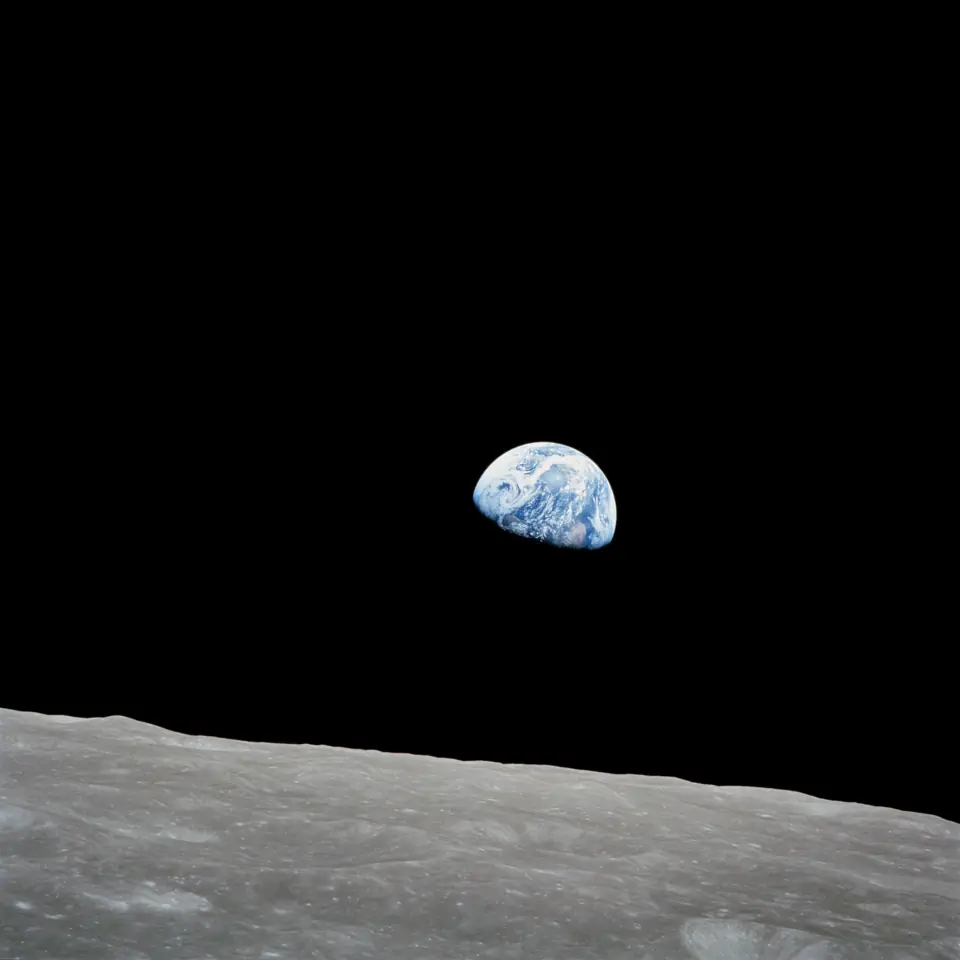
Earthrise: the blue and white Earth rising over the gray lunar horizon, photographed from Apollo 8.
Bill Anders, "Earthrise," Apollo 8, December 24, 1968 (AS08-14-2383). NASA, public domain.

No. 011 · Apollo 8, 1968

Anders photographed Earth above the lunar horizon.

Bill Anders made this color photograph during Apollo 8’s fourth lunar orbit on December 24, 1968. The crew saw Earth entering a window as the spacecraft’s orientation changed, and Anders asked Jim Lovell for color film. Their recorded conversation preserves the hurried exchange.15 Earth appears to rise because the spacecraft is moving around the Moon; from most fixed locations on the near side, Earth stays in roughly the same part of the sky. Anders’s framing sets a bright, cloud-covered Earth above a gray lunar foreground, with black space separating them.

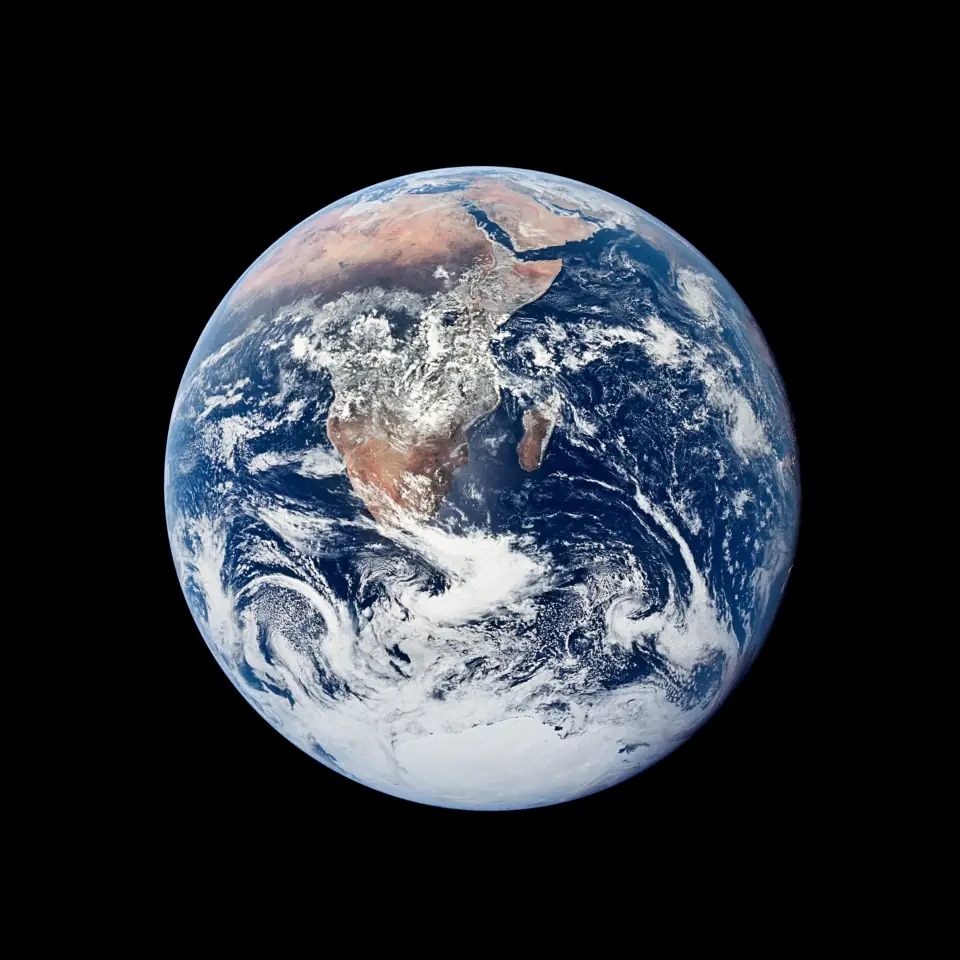
The Blue Marble: the full sunlit disk of Earth showing Africa, Arabia and Antarctica against black space.
The Blue Marble, Apollo 17, December 7, 1972 (AS17-148-22727). NASA, public domain.

No. 012 · Apollo 17, 1972

Sunlight reaches almost the entire visible disk.

The Apollo 17 crew photographed this nearly fully illuminated Earth on December 7, 1972, while traveling toward the Moon. Antarctica, Africa and the Arabian Peninsula are visible in one film exposure. NASA credits the crew collectively.16 The view depends on distance and geometry: the camera must be far enough away to include the disk, with the Sun largely behind it. Later full-Earth images include both separate disk exposures and composites. Artemis II flew around the Moon in April 2026, ending the long interval in crewed lunar travel that followed Apollo 17.94

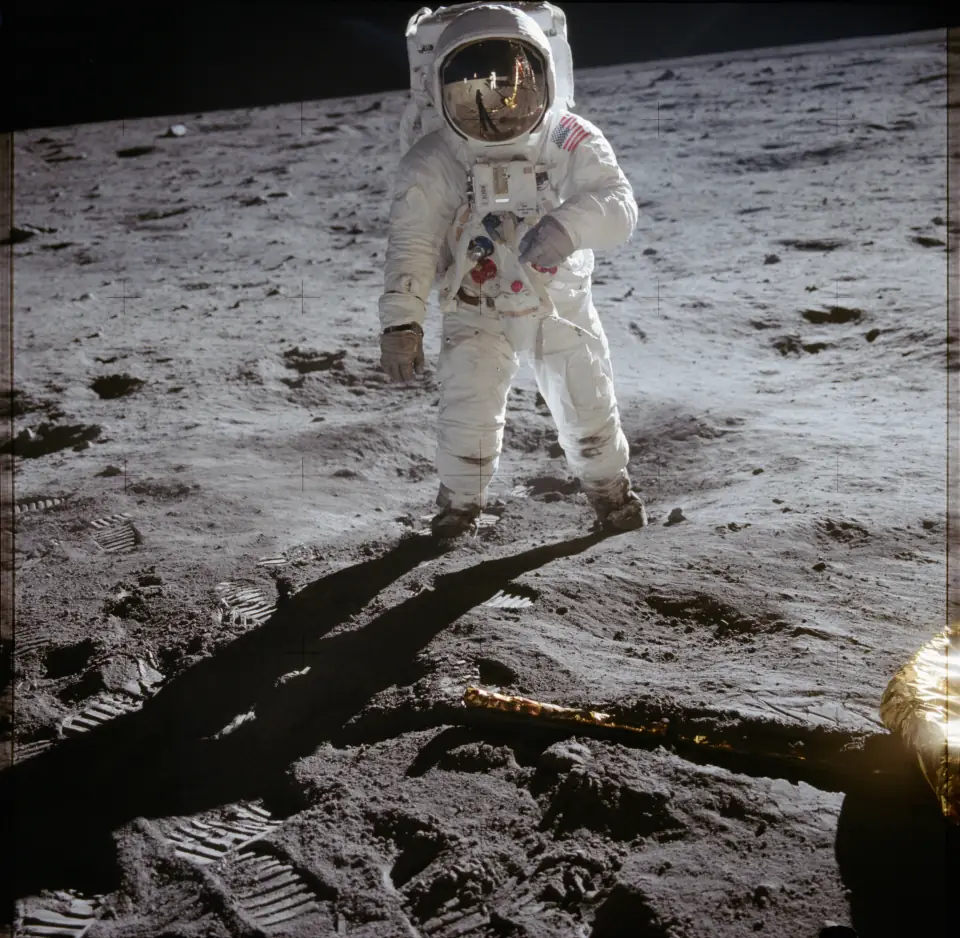
Buzz Aldrin standing on the Moon, Neil Armstrong and the lunar module reflected in his gold visor.
Neil Armstrong, Buzz Aldrin on the Sea of Tranquility, July 1969 (AS11-40-5903). NASA, public domain.

No. 013 · Armstrong photographs Aldrin

The visor reflects the person behind the camera.

Neil Armstrong took this portrait of Buzz Aldrin on the lunar surface in July 1969. In Aldrin's curved visor, you can see Armstrong, parts of the lunar module and the surrounding terrain. The reflection is a wide view, distorted by the visor, rather than a complete 360-degree record.17 Armstrong's camera was chest-mounted and had no conventional viewfinder. The small crosses are marks from a réseau plate, a calibrated grid used to help measure the image. These details make the photograph useful as a technical record as well as a portrait.

The lunar-surface Hasselblad

Body
A modified Hasselblad electric camera, silver-finished for use on the lunar surface.17
Aiming
Chest-mounted, with no conventional viewfinder. Astronauts practiced framing before flight.
Weight
Hasselblad records twelve bodies left on the Moon across the Apollo landings to save weight for samples. Film magazines returned to Earth.17
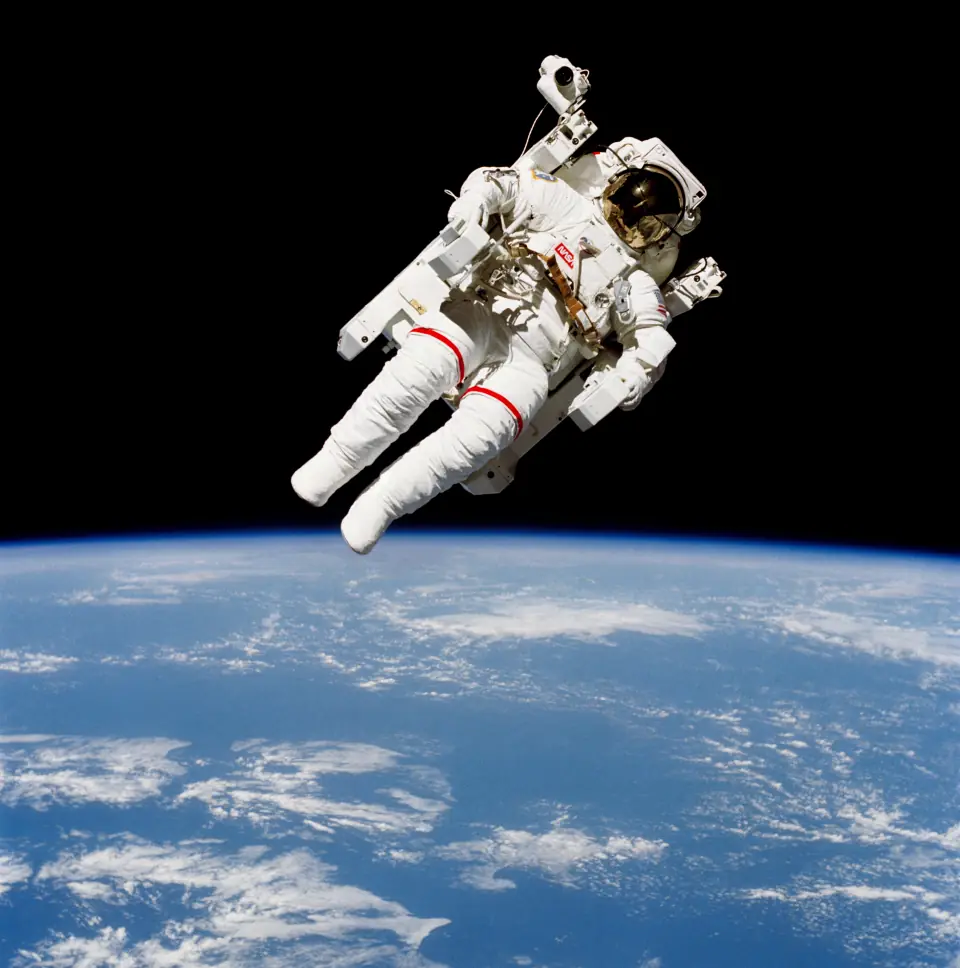
Bruce McCandless in a white spacesuit and maneuvering unit above Earth, photographed from the nearby shuttle.
Robert “Hoot” Gibson, Bruce McCandless II during the first untethered spacewalk, STS-41-B, February 7, 1984. NASA, public domain.

No. 014 · An untethered spacewalk

The maneuvering unit replaces the tether.

Bruce McCandless became the first astronaut to make an untethered spacewalk on February 7, 1984. Nitrogen thrusters in the Manned Maneuvering Unit let him control his movement relative to Challenger. Robert “Hoot” Gibson photographed him from the shuttle with a Hasselblad.18 Gibson’s framing leaves the shuttle outside the picture. McCandless and his maneuvering unit occupy a small part of the view, surrounded by black space and the blue Earth. The nearby spacecraft, which supplied the photographer’s position and the astronaut’s return point, is implied by the exposure rather than shown.

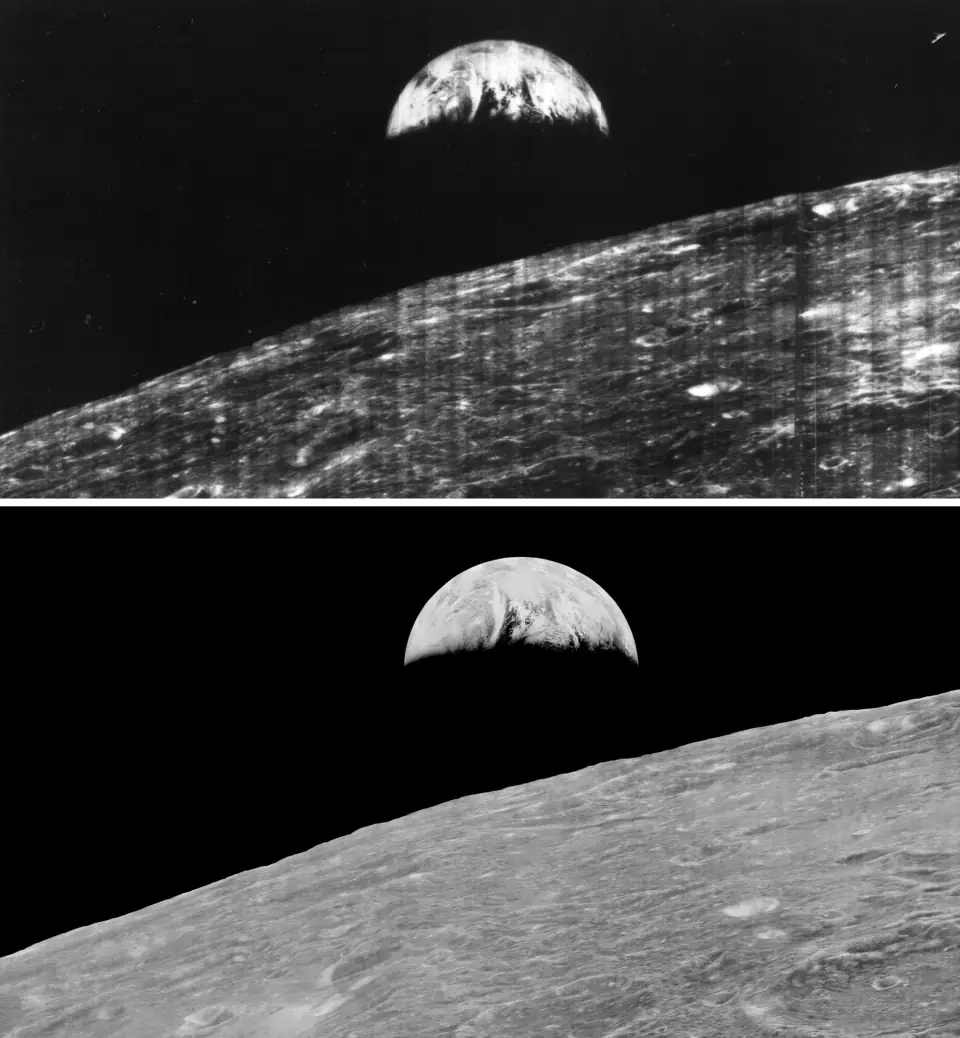
Two versions of the 1966 first Earth-from-Moon photo stacked: the blurry stripey 1966 reconstruction above, the crisp 2008 restored version below.
Lunar Orbiter 1's Earth, August 23, 1966: the 1966 reconstruction (top) versus the 2008 tape-recovery restoration (bottom). NASA / LOIRP, public domain.

No. 015 · Lunar Orbiter’s recovered data

The same signal yields a more detailed reconstruction.

Lunar Orbiter 1 photographed Earth above the Moon's horizon on August 23, 1966. It developed film on board, scanned it and transmitted the image to Earth. The original ground reconstruction and the 2008 restoration below come from that recording, not from two different visits.19 The Lunar Orbiter Image Recovery Project recovered the analog signals from surviving magnetic tapes using restored equipment at NASA Ames. Better digitization and processing extracted detail that had been lost in the commonly reproduced version. Restoration changes the presentation of the data; it doesn't add a new observation of Earth.

The Hubble eXtreme Deep Field: thousands of galaxies of every color and shape scattered across blackness.
The Hubble eXtreme Deep Field, 2012. NASA, ESA, G. Illingworth, D. Magee, and P. Oesch (UCSC), R. Bouwens (Leiden) and the HUDF09 Team, CC BY 4.0.

No. 016 · Hubble’s eXtreme Deep Field

A small field contains thousands of galaxies.

Released in 2012, the Hubble eXtreme Deep Field combines roughly two million seconds of exposure accumulated over years, about 23 days of actual exposure time. Approximately 5,500 galaxies appear in this small patch of sky.20 Combining many exposures makes faint objects more distinguishable from noise. The galaxies occupy different distances and stages of development; their light has traveled for different lengths of time. Webb’s First Deep Field below uses near-infrared wavelengths and a foreground cluster’s gravitational lensing, which magnifies and distorts some galaxies behind it.

Webb's First Deep Field: a dense cluster of galaxies with gravitationally lensed arcs of light bent around it.
Webb’s First Deep Field, 2022. This near-infrared composite required 12.5 hours of exposure; the arcs include background galaxies magnified and distorted by the cluster’s gravity. NASA, ESA, CSA, STScI, CC BY 4.0.21
The Pillars of Creation seen by the James Webb Space Telescope: sharp rust-red columns of gas crowded with stars. The Pillars of Creation seen by Hubble: towering green-brown columns of gas against a teal glow. Hubble · visible light JWST · infrared
The Pillars of Creation, Eagle Nebula. Left of the handle: Hubble's 2014 visible-light view (NASA, ESA/Hubble and the Hubble Heritage Team). Right: JWST's 2022 infrared view (NASA, ESA, CSA, STScI; J. DePasquale, A. Koekemoer, A. Pagan). Both CC BY 4.0, framed to match by STScI.

No. 017 · Two telescopes, different wavelengths

Infrared reveals stars behind some of the dust.

These columns of gas and dust are in the Eagle Nebula, about 6,500 light-years away. The slider compares Hubble’s 2014 visible-light view with Webb’s 2022 near-infrared view, registered to similar framing. Some dust that blocks visible light transmits more infrared, making many stars easier to see.22 The difference largely comes from wavelength and instrument, rather than eight years of visible change in the pillars. Processors assign the measurements visible colors. In Webb’s view, small red features near some pillar tips include jets from young stars colliding with surrounding material.

Andromeda, star by star

Drag to pan

A long strip of the Andromeda galaxy from Hubble's gigapixel mosaic: the bright core, dust lanes, and millions of individual stars, with stair-stepped mosaic edges.

Hubble’s full Andromeda mosaic, released in 2025, contains 2.5 billion pixels assembled from roughly 600 fields observed over more than ten years. It resolves about 200 million stars brighter than the Sun in a galaxy about 2.5 million light-years away.23 This strip is a reduced crop, 8,400 by 875 pixels, about 7.4 megapixels. Its stepped outline follows the mosaic’s coverage. Dense regions contain blended light from many stars as well as individually resolved points.

NASA, ESA, B. Williams and Z. Chen (UWashington), L. C. Johnson (Northwestern); processing J. DePasquale (STScI). NASA, public domain.

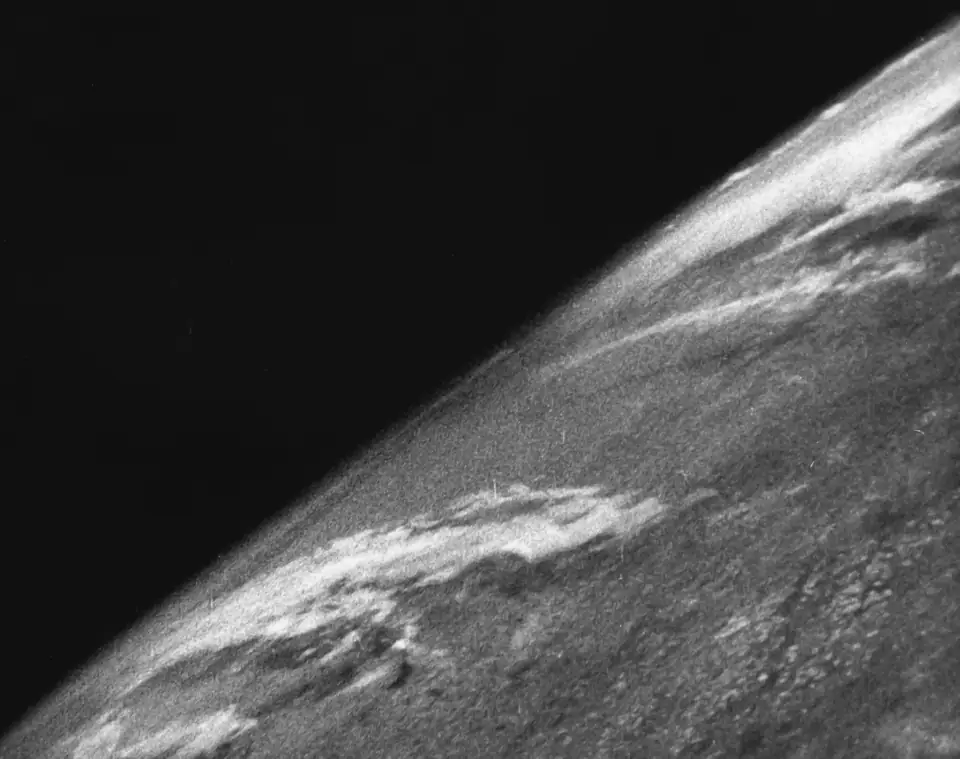
The first photograph from space, 1946: a grainy black-and-white curve of Earth under the black of space.
V-2 rocket No. 13, White Sands, October 24, 1946, from the first sequence of photographs taken from space. White Sands Missile Range / Applied Physics Laboratory. Wikimedia Commons, public domain.

No. 018 · A camera above the atmosphere

The film survived the rocket’s return.

On October 24, 1946, a camera aboard a captured German V-2 launched from White Sands, New Mexico, reached roughly 65 miles above Earth. Its 35mm film recorded views of the curved horizon against dark space. The camera was damaged on impact, but the film cassette survived recovery.24 These are generally identified as the first photographs taken from space. The film recorded a frame about every second and a half during the flight. Recovering the cassette let the researchers inspect a sequence of changing views, even though the camera itself did not survive intact.

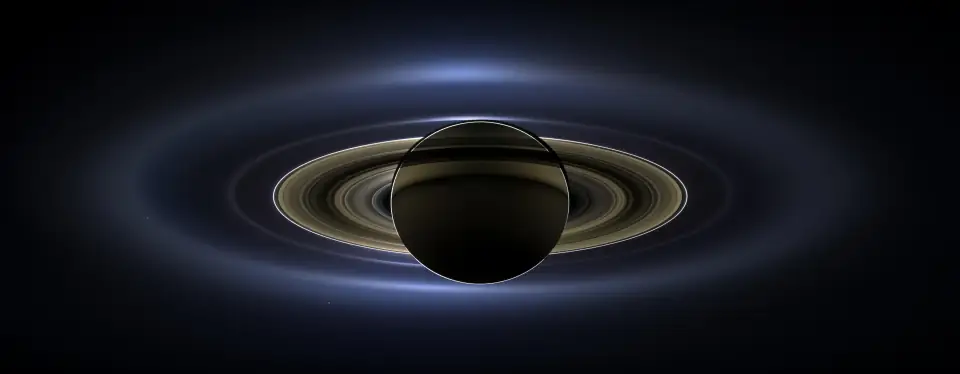
Saturn backlit by the Sun, its rings glowing, with Earth visible as a tiny pale blue dot below the rings.
"The Day the Earth Smiled," Cassini at Saturn, July 19, 2013. NASA/JPL-Caltech/Space Science Institute, public domain.

No. 019 · Cassini at Saturn

Earth is a point inside a 141-image mosaic.

Cassini photographed this backlit view of Saturn and its rings on July 19, 2013. The published mosaic combines 141 wide-angle images taken while the spacecraft was in Saturn’s shadow. Earth is visible from about 898 million miles away, alongside other planets.25 The mission announced the timing in advance and invited people to wave. In the finished mosaic, Earth and several other small objects were brightened relative to Saturn to make them easier to see. The broad view combines separate filtered exposures, with processing that balances the bright main rings against much fainter features.

ROLL 04 · 1976 to 2025

Digital measurements

Sensors and software contribute to the finished image.

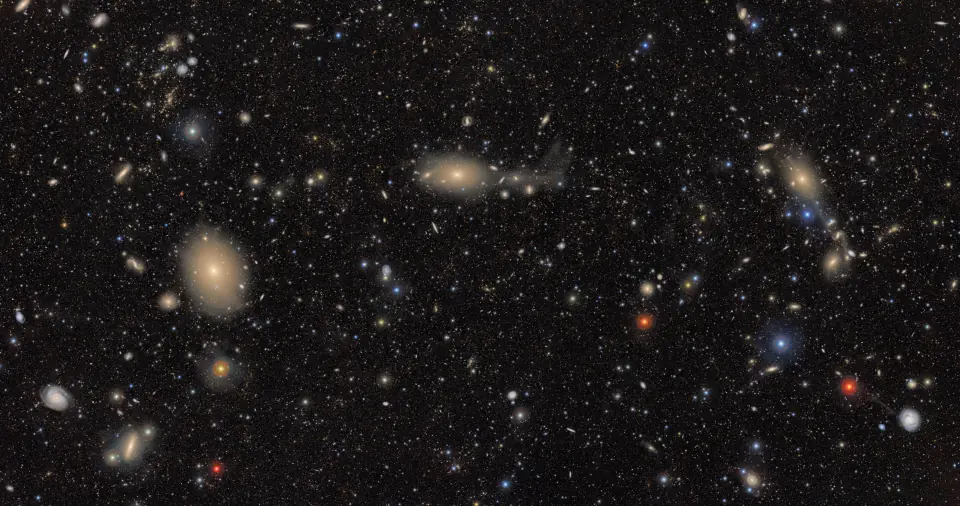
The Cosmic Treasure Chest: a vast field of thousands of galaxies and stars from the Rubin Observatory's first public image release.
"The Cosmic Treasure Chest," the Virgo cluster region, from the Rubin Observatory's first public release, June 2025. NSF-DOE Vera C. Rubin Observatory, CC BY 4.0.

No. 020 · Rubin’s 3.2-gigapixel camera

The camera frame and the finished mosaic have different scales.

Rubin Observatory's LSST Camera has 3,200 megapixels across 189 science sensors. SLAC describes it as the largest digital camera built for astronomy.26 The Cosmic Treasure Chest, released on June 23, 2025, combines more than 1,100 images and contains about ten million galaxies. That count describes the full mosaic, not this reduced web reproduction. The same release reported 2,104 newly discovered asteroids from about ten hours of test observations.27 Rubin’s ten-year survey is designed to repeatedly measure the sky to find changes. Its 2020 romanesco test used the assembled focal plane and a pinhole, before the completed camera reached the telescope.

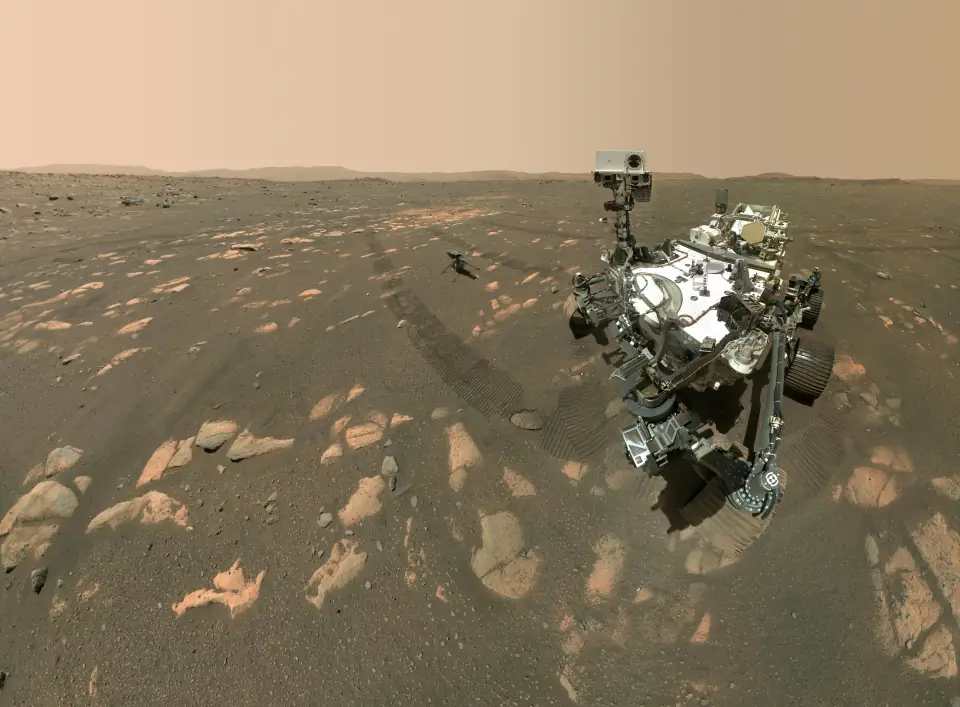
The Perseverance rover's selfie on Mars: the rover looking at the camera on rocky orange ground, with the small Ingenuity helicopter sitting a few meters behind it.
Perseverance and the Ingenuity helicopter, Jezero Crater, Mars, April 6, 2021 (PIA24542). NASA/JPL-Caltech/MSSS, public domain.

No. 021 · A rover’s assembled portrait

The robotic arm moves the camera between exposures.

Perseverance made this selfie on April 6, 2021, using WATSON, the camera at the end of its robotic arm. The published image combines 62 exposures. Ingenuity sits about 13 feet behind the rover, before its first powered flight on April 19.28 The arm is absent from the assembled view because the selected frames cover its positions with other views of the scene. The rover didn't take one exposure of itself with an invisible arm. Like a terrestrial panorama, the selfie uses an overlapping sequence to build a view that no single frame supplies.

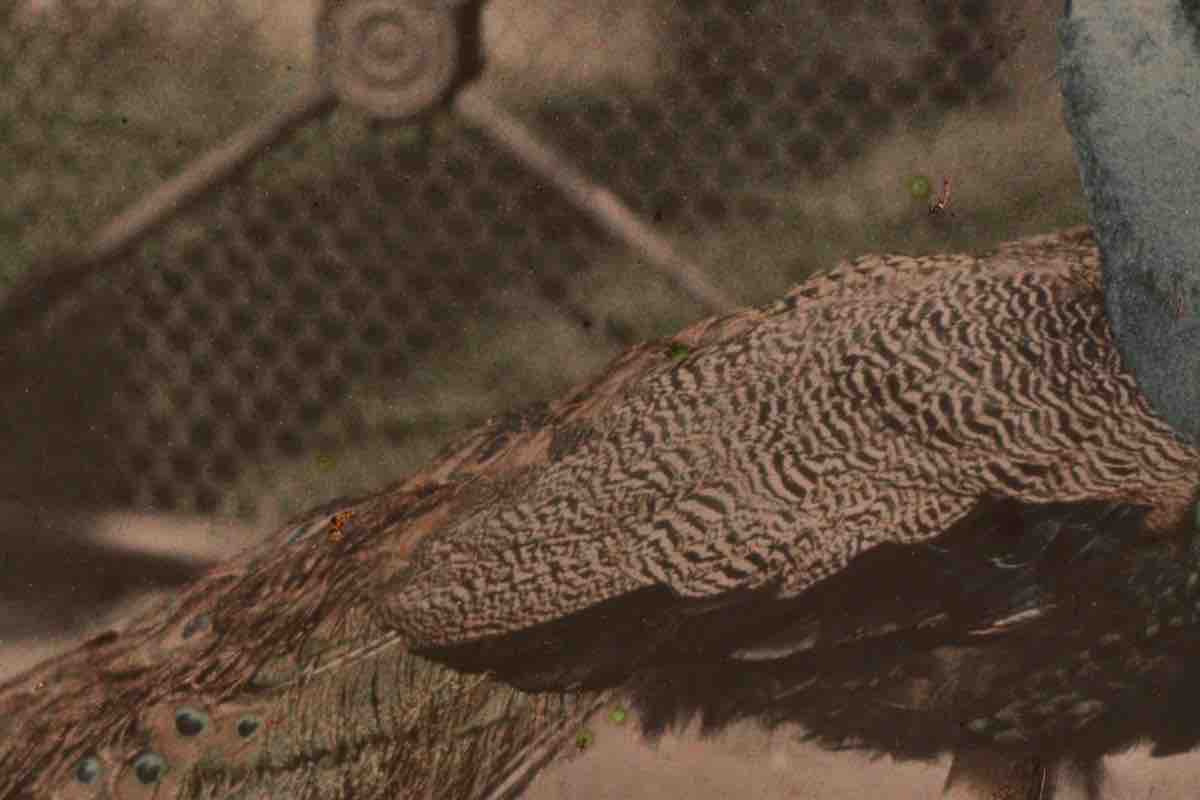
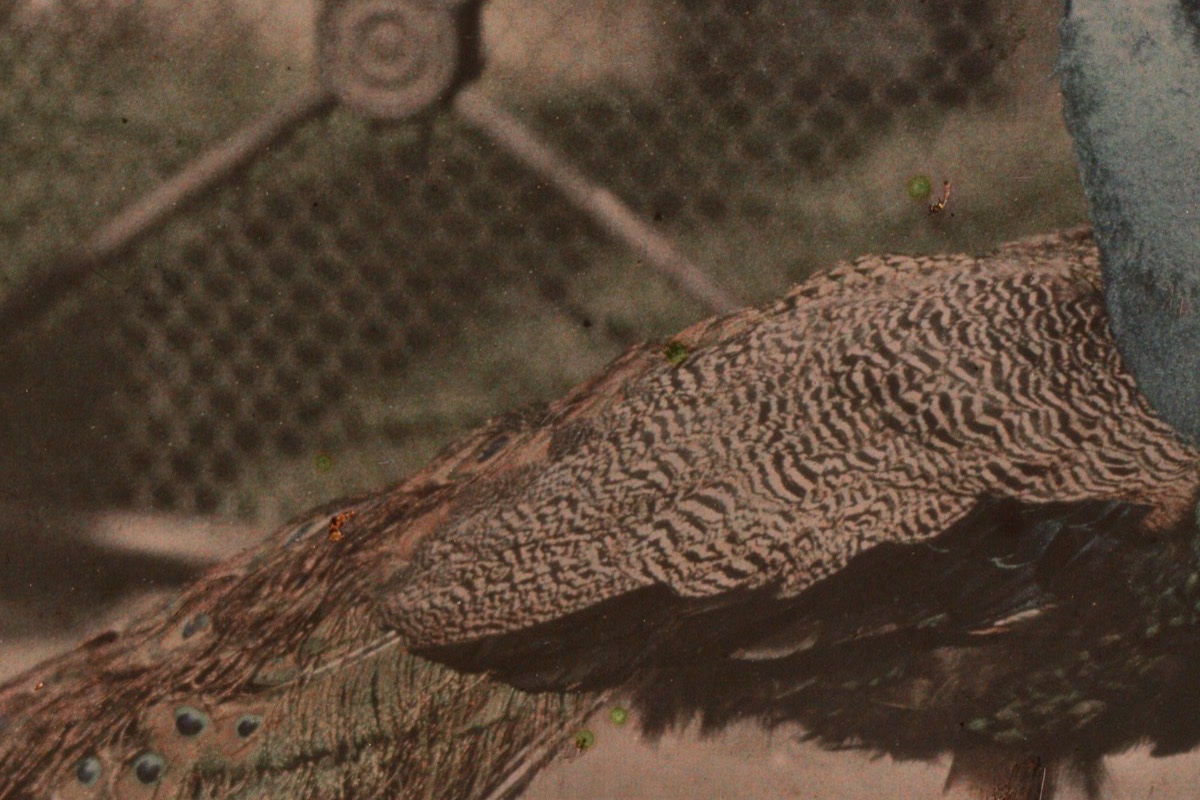
A detail of the Lumiere peacock autochrome compressed to extremely low JPEG quality, showing blocky artifacts. The peacock detail with higher-quality JPEG encoding. higher quality · 327 kB stronger compression · 50 kB
Two JPEG encodings of the same autochrome reproduction. Higher quality: 327 kB. Stronger compression: 50 kB. Move the handle to compare feather detail, edges and smooth color transitions. File sizes are rounded decimal kilobytes.

No. 022 · Lossy compression

Smaller files can lose detail and acquire artifacts.

Baseline JPEG works in eight-by-eight blocks of image samples. A mathematical transform separates the information into spatial frequencies; quantization rounds those values, discarding some information. Stronger compression can leave block boundaries, ringing near edges and smeared texture.29 The slider uses two JPEG encodings of the same peacock image to make those effects visible. The files are about 327 and 50 kilobytes. PNG supplies a different option when exact recovery of the encoded pixels matters: it uses lossless compression and emerged partly in response to patent restrictions surrounding GIF.30

THE BAYER MOSAIC · ONE COMMON COLOR-FILTER ARRAY one color filter per pixel · Bryce Bayer, Kodak, 1976 one full-color pixel two channels guessed per 2x2 tile: 1 red · 2 green · 1 blue (eyes favor green) BAYER EXAMPLE: TWO COLOR VALUES ARE ESTIMATED AT EACH SITE
A Bayer example: each sensor site measures one filtered value. The displayed RGB values are reconstructed from neighboring samples. Diagram by this site.

No. 023 · A Bayer color-filter array

Each sensor location measures one filtered sample.

Many digital cameras place a Bayer mosaic over the sensor: a repeating block of two green filters, one red and one blue. Each location records light through its own filter. Demosaicing uses neighboring samples to estimate the other two color values at that output location.31 Fine repeating detail can challenge that reconstruction, producing false colors or patterns. The diagram follows one common arrangement from measurement to output. Monochrome sensors, other filter mosaics, layered sensors and cameras with separate color sensors use different methods.

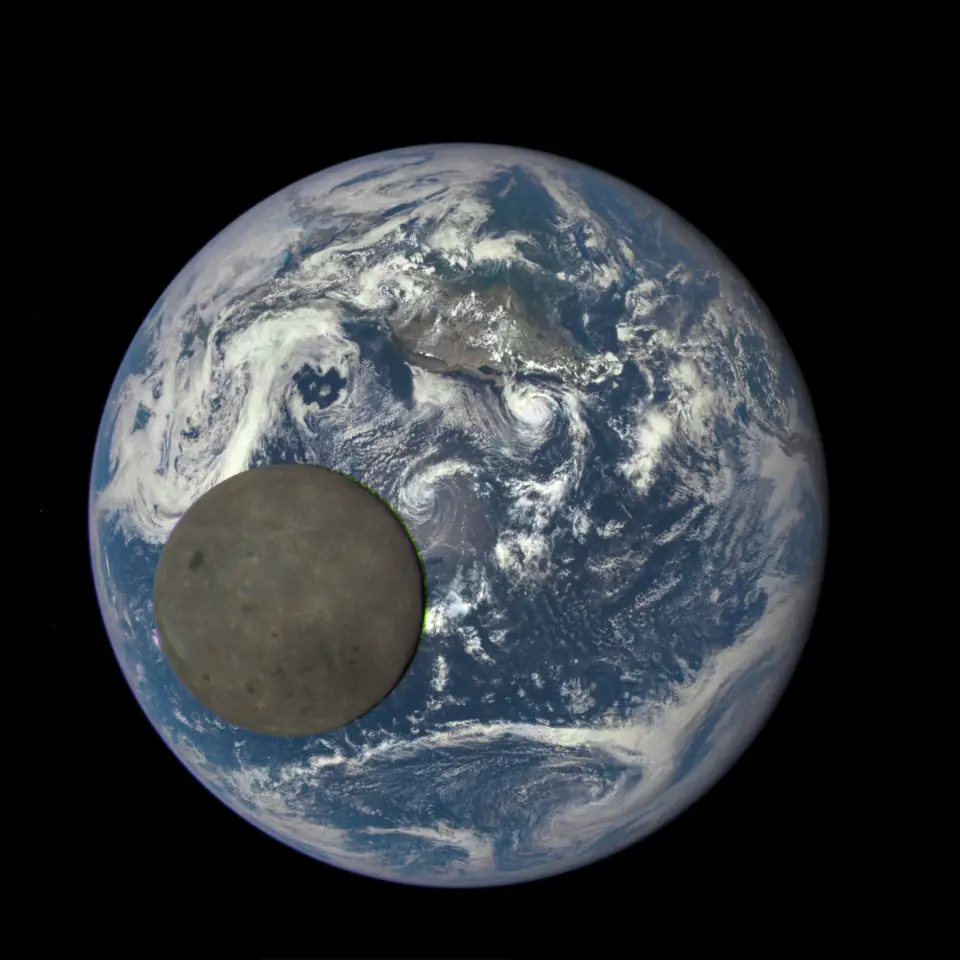
The far side of the Moon, fully lit, crossing in front of the blue sunlit Earth, photographed from a million miles away.
The Moon's far side crossing Earth, DSCOVR's EPIC camera, one million miles out, July 16, 2015. NASA/EPIC, public domain.

No. 024 · DSCOVR’s lunar transit

The Moon’s far side passes across the sunlit Earth.

NASA's EPIC instrument observes Earth from DSCOVR, which orbits around the Sun-Earth L1 region, roughly a million miles from Earth. It records the sunlit disk through different filters. This July 16, 2015 view combines red, green and blue exposures while the Moon crosses the line of sight.32 The exposures are taken in sequence, so motion between them can leave colored fringes near the lunar edge. The face shown is the Moon's far side, largely turned away from Earth. It isn't a permanently dark hemisphere: both sides experience daylight and night.

Notes on phone processing and social-media records

Google’s Night Sight

Several measurements contribute to one night photograph.

Google's 2018 Night Sight method aligned and merged short exposures to reduce noise and motion blur. Its 2019 Pixel 4 astrophotography mode allowed up to fifteen 16-second exposures, four minutes in total, with the phone held still.33 These are capabilities of particular implementations, not every modern phone. Processing can also adjust brightness and distinguish sky from foreground. The finished image may show more detail and color than the photographer could see directly.

A dated social-media record

The egg’s record lasted until 2022.

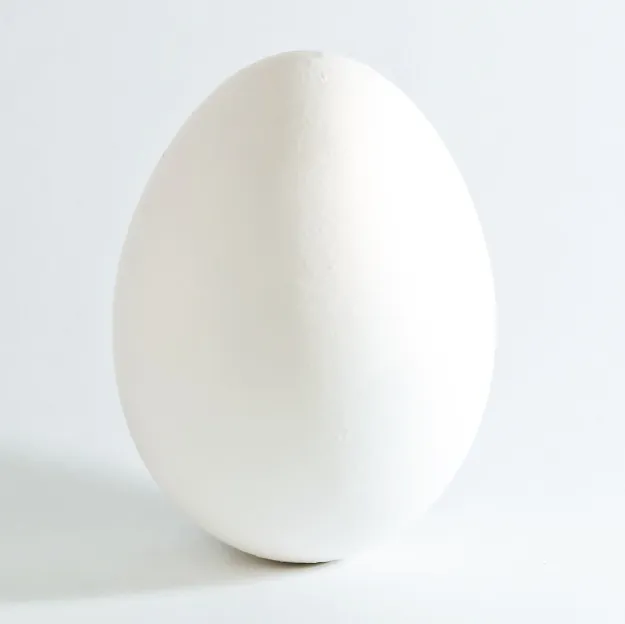
A single plain white chicken egg on a white background.

A plain egg posted in January 2019 became Instagram’s most-liked image at the time, surpassing a post by Kylie Jenner. Lionel Messi’s World Cup post overtook it in December 2022.34 The egg pictured here is a separate photograph by Ren West, licensed CC BY 2.0. It illustrates the subject rather than reproducing the record-setting file.

ROLL 05 · The wild stuff

Prices, scale and deception

A print’s size, a sale price and a convincing illusion measure different things.

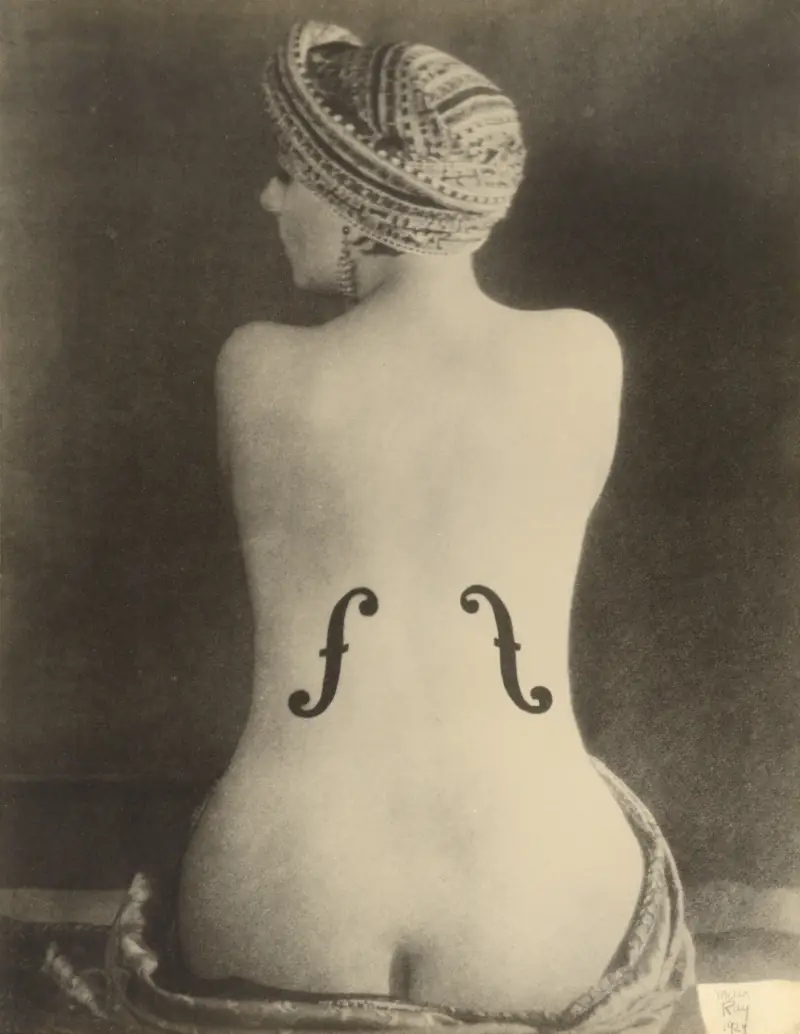
Le Violon d'Ingres, 1924: a woman's bare back in a turban, with two violin f-holes printed onto her skin.
Man Ray, "Le Violon d'Ingres," 1924. Public domain in the United States (published before 1930); still under copyright in France. Via Wikipedia.

No. 025 · Man Ray’s altered portrait

The violin markings were added to a photograph.

Kiki de Montparnasse’s pose refers to paintings by Ingres; the added f-holes turn her back into a violin. Man Ray made different versions using photographic and hand-worked techniques. Christie’s describes masking and rephotography in the history of the enlarged print sold in 2022.35 That print fetched $12,412,500 on May 14, 2022, setting a photograph auction record at the time.36 The sale was for a particular print with its own size, provenance and history. The small reproduction here preserves the altered pose and markings, while the auction catalogue records the object the buyer acquired.

A schematic of the horizontal bands in Rhein II (1999). This drawing is not the photograph; the original is © Andreas Gursky.

No. 026 · Gursky’s digitally simplified river

The finished print is almost twelve feet wide.

Andreas Gursky removed distracting features from his 1999 Rhine view to produce the bands of sky, grass, water and path in Rhein II. The work deliberately simplifies a real landscape. The print sold at Christie’s in 2011 measures about 12 feet wide and fetched $4,338,500, then an auction record for a photograph.37 Its size matters: the parallel bands extend across a surface wider than an ordinary room’s doorway. The six rectangles beside this text are a schematic of the composition. They show the arrangement of bands while leaving out the photograph’s texture and detail.

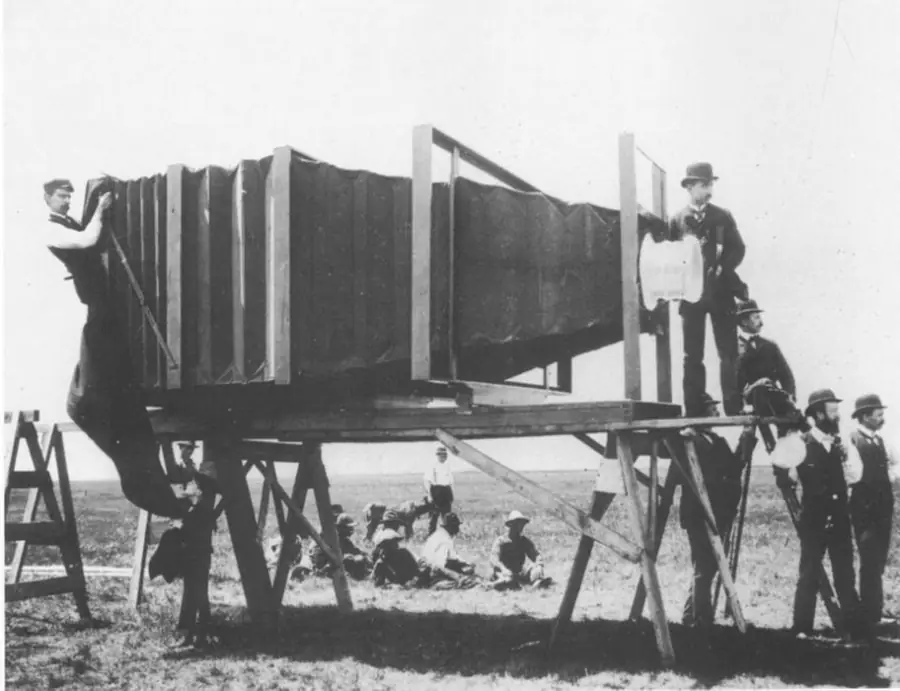
The 1900 Mammoth camera: a camera the size of a garden shed with its bellows extended, posed with the crew of men needed to run it.
George R. Lawrence's "Mammoth" camera, 1900, with some of the 15 men it took to run it. Wikimedia Commons, public domain.

No. 027 · Lawrence’s mammoth camera

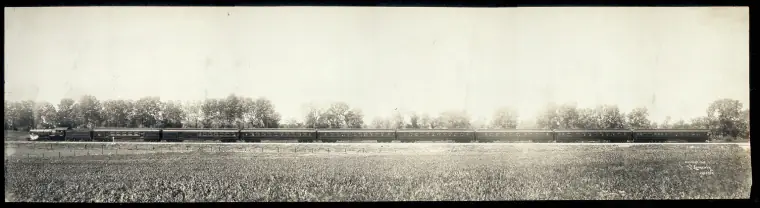
One large plate recorded the entire train.

George R. Lawrence built this camera in 1900 to photograph the Alton Limited train on a single plate. The loaded apparatus weighed about 1,400 pounds; its glass plate measured roughly four and a half by eight feet. Fifteen men were needed to load and carry it.38 The size mattered because the railway wanted a large print with clear detail along the train. Enlarging from an ordinary small negative would have sacrificed some of that detail. The surviving photograph records the equipment and crew; the companion image shows the train photograph it was built to make.

The Alton Limited train photographed in one exposure on the eight-foot plate, the whole train sharp from end to end.
The photograph itself: the Alton Limited, one exposure, one very large piece of glass. Commons, public domain.
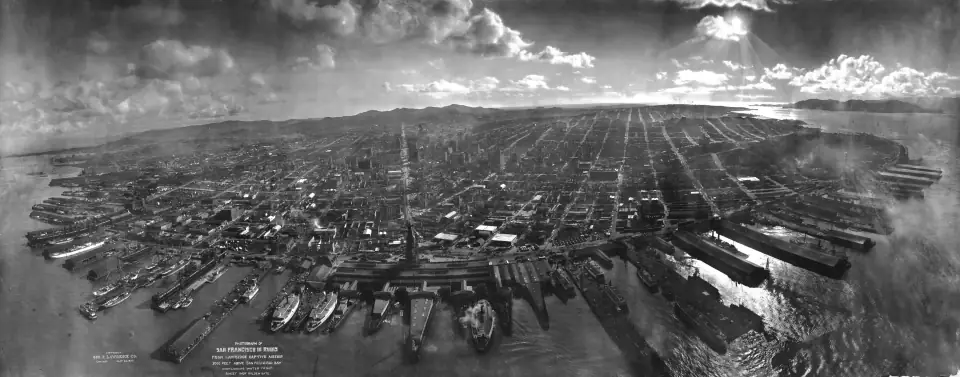
San Francisco in Ruins, May 1906: a sweeping aerial panorama of the burned city from two thousand feet over the bay, sun glinting on the water.
George R. Lawrence, "San Francisco in Ruins," May 28, 1906, from a camera lifted by a train of kites. Library of Congress, no known restrictions.

No. 028 · A panorama suspended from kites

The shutter was operated from the ground.

On May 28, 1906, George R. Lawrence photographed earthquake-damaged San Francisco with a panoramic camera lifted by a train of kites. An electrical connection allowed him to release the shutter from below. The camera recorded a broad sweep of the city in one exposure.39 From this high viewpoint, streets remain legible amid the destruction. Lawrence had developed the kite apparatus after dangerous balloon ascents, so he could make aerial photographs while remaining on the ground. The long view follows the waterfront and the ruined city behind it.

pinhole, 6 mm control tower image: upside down, 31 x 107 ft of muslin THE GREAT PICTURE, 2006 · a jet hangar as the camera
A diagram of the hangar camera used for The Great Picture (2006), with the photograph’s approximate dimensions. Drawing is not to scale. The photograph is © The Legacy Project.

No. 029 · A hangar becomes a pinhole camera

The photograph is about 31 by 107 feet.

For The Great Picture in 2006, the Legacy Project turned an aircraft hangar at California’s former El Toro air station into a camera obscura. A quarter-inch pinhole projected the scene onto sensitized muslin during a 35-minute exposure. The result measures about 31 by 107 feet, a single gelatin-silver negative image on fabric.40 Development required a shallow tray approximately 114 by 35 feet and 600 gallons of developer. Both the exposure and processing depended on treating the building as photographic equipment. The diagram explains the optical principle; the building and photograph are not drawn to one consistent scale.

Selected measurements and dated records

Painting scan
Rijksmuseum’s 2022 Night Watch image: 717 gigapixels from 8,439 photographs, with five-micrometer sampling.41
Ultrafast imaging
CUSP’s 2020 active-mode demonstration: 70 trillion reconstructed frames per second using specialized laser illumination.8
Deep field
Hubble XDF, released 2012: about 23 days of accumulated exposure in a small field.20
Camera auction
Leica 0-series No. 105: EUR 14.4 million including buyer’s premium, June 2022.42
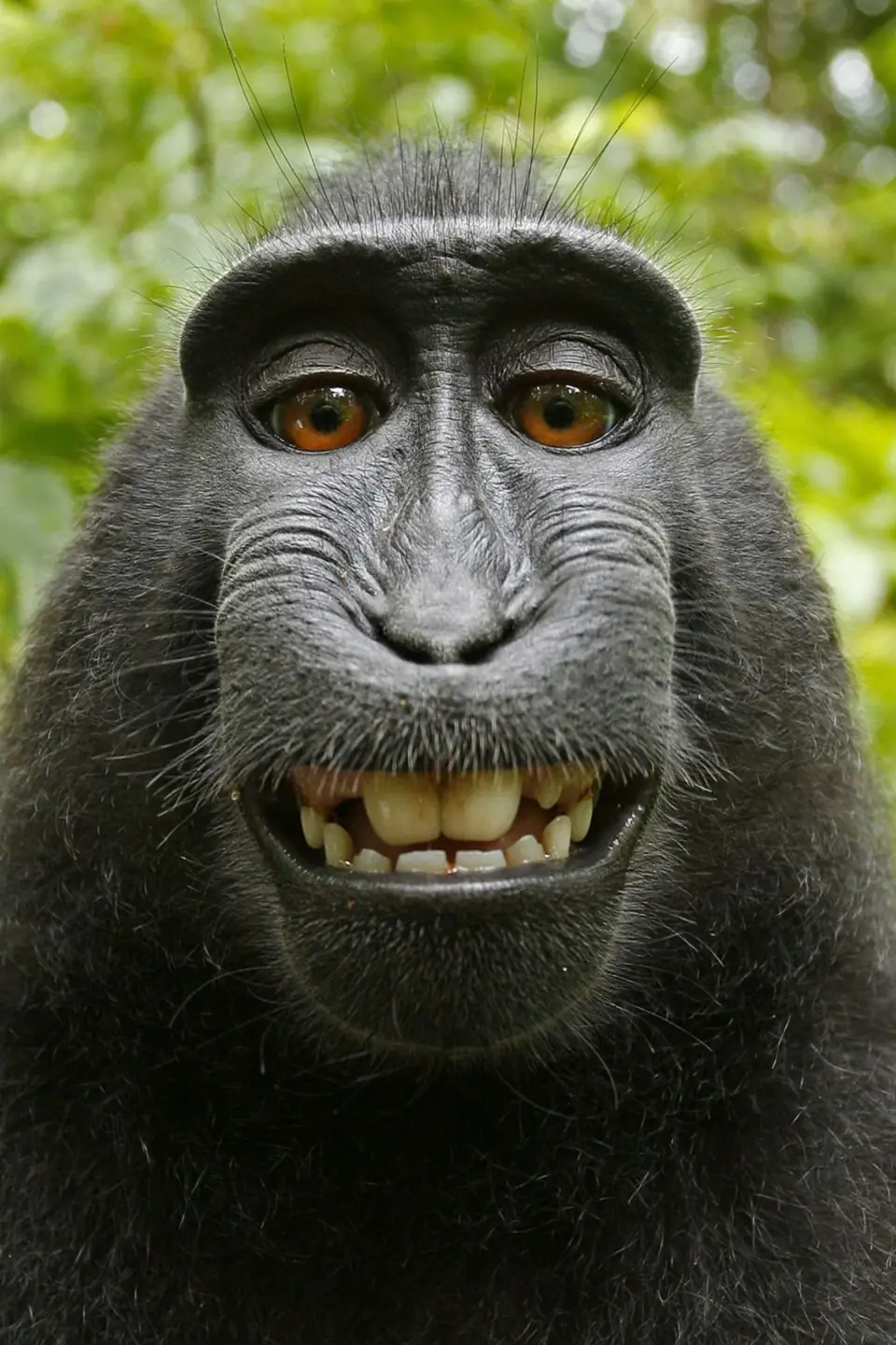
A crested macaque looking into the camera in the monkey-selfie photograph.
A crested black macaque, self-portrait, Sulawesi, 2011, with equipment by David Slater. Public domain in the US: works without a human author cannot hold copyright. Wikimedia Commons.

No. 030 · Human authorship and copyright

The legal questions were narrower than “who owns the camera?”

A macaque released the shutter of equipment supplied by photographer David Slater in Indonesia in 2011. The US Copyright Office's registration guidance requires human authorship and expressly gives a monkey-made photograph as an example of a work it will not register.43 In the separate 2018 Naruto v. Slater decision, the Ninth Circuit held that animals cannot sue for copyright infringement under the Copyright Act. That decision concerns statutory standing. It isn't a worldwide ruling on every ownership claim involving the image. The reproduction is hosted by Commons under its stated US public-domain rationale.

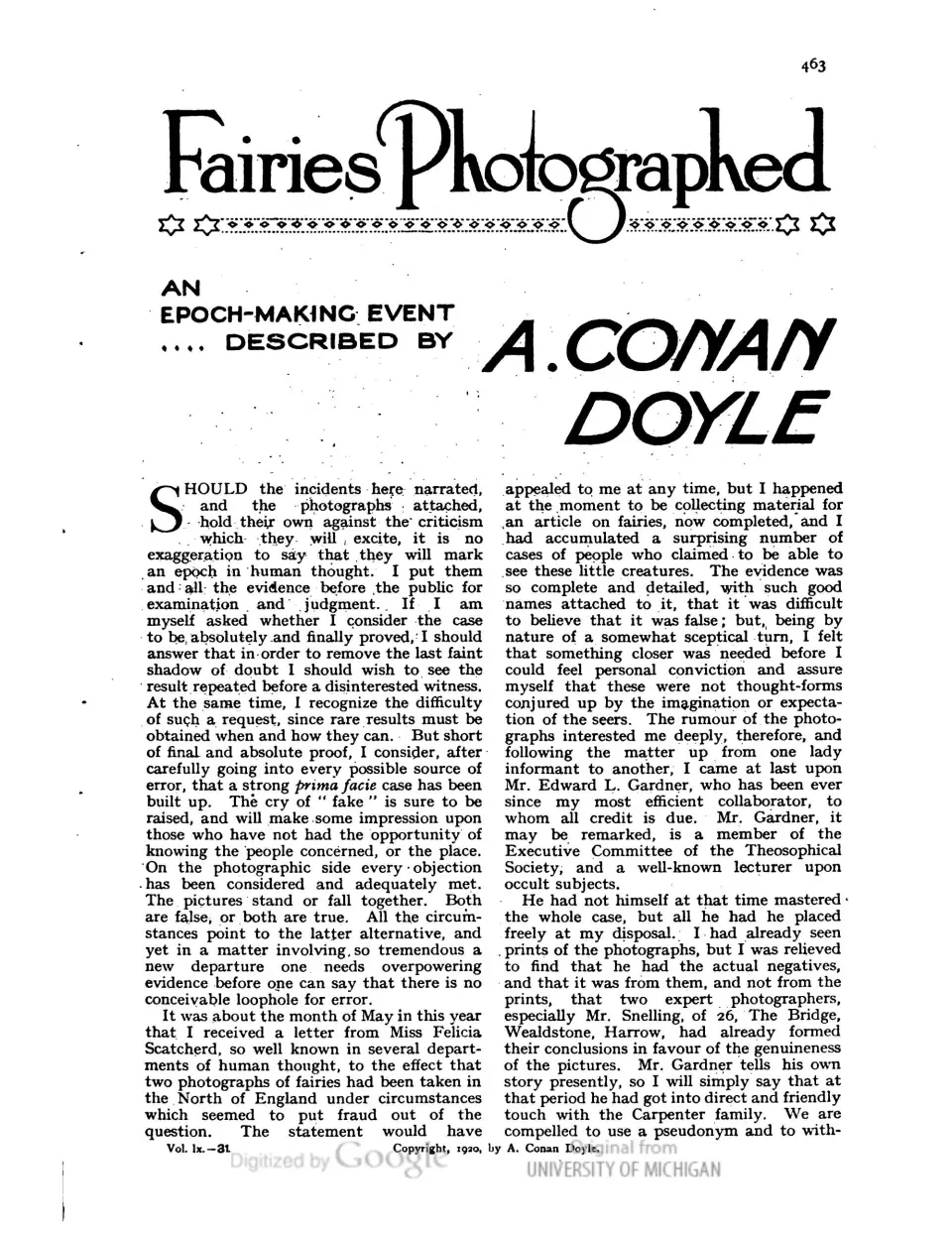
The Strand Magazine page from 1920 showing the first Cottingley fairy photograph: a girl with paper fairies dancing in front of her.
Cottingley photographs by Elsie Wright and Frances Griffiths, reproduced with Arthur Conan Doyle’s article in The Strand Magazine, December 1920. Wikimedia Commons, public domain.

No. 031 · The Cottingley fairies

The camera recorded real paper cutouts.

Elsie Wright and Frances Griffiths made the first Cottingley photographs in 1917. The fairies were copied illustrations cut from paper and supported with hatpins. Arthur Conan Doyle published the images as evidence in 1920 and later wrote a book defending them.44 In 1983 the cousins acknowledged faking the first four photographs, while differing about the fifth. These pictures need no darkroom manipulation to mislead: the staged objects stood in front of the lens. The magazine page also shows how an editorial claim can lend a photograph authority that the exposure itself cannot provide.

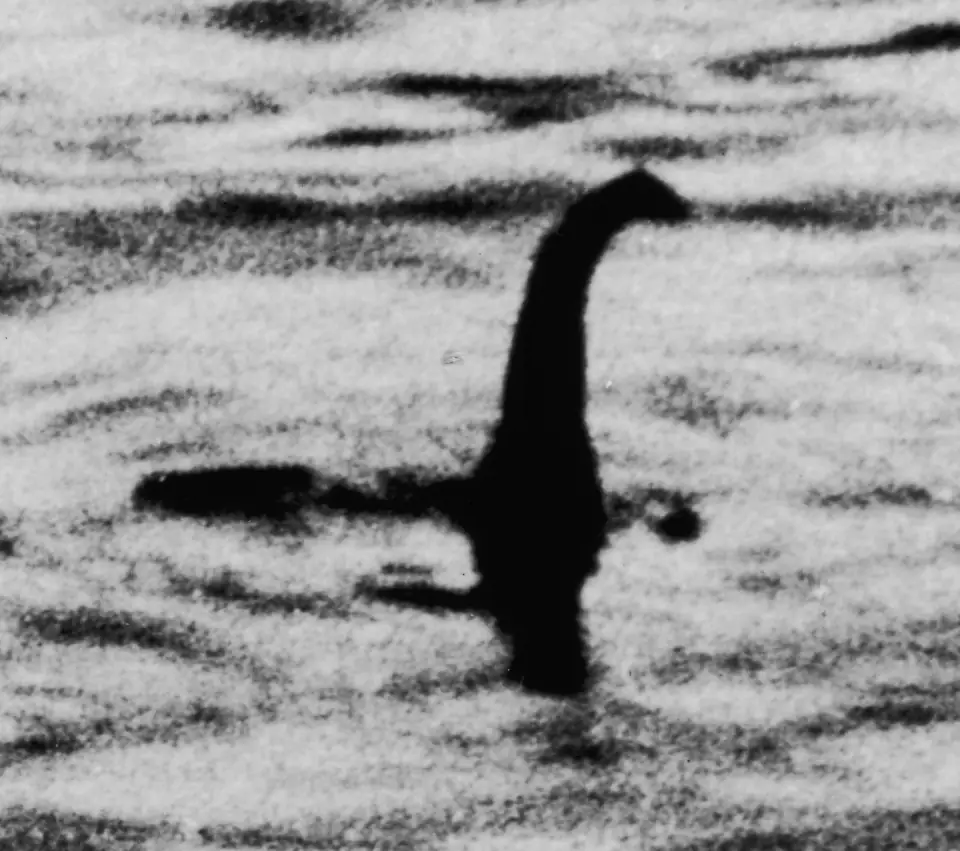
The 1934 Surgeon's Photograph: a grainy long neck and small head rising from the rippled water of Loch Ness.
The “Surgeon’s Photograph,” Loch Ness, 1934, published under Robert Kenneth Wilson’s name. Wikimedia Commons hosts this file as public domain; see its rights notes.

No. 032 · The surgeon’s photograph

The later confession describes a model on a toy submarine.

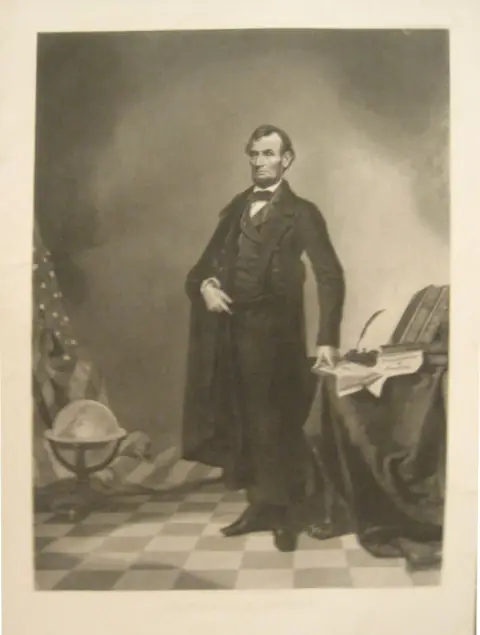
Published in 1934 under physician Robert Kenneth Wilson’s name, this Loch Ness photograph became evidence for a supposed large animal. The Natural History Museum identifies it as a hoax.45 The dark silhouette and its reflection are clear, but there is little else to establish scale. Water extends beyond the frame, and the cropped image offers no shoreline or familiar object for comparison. Its apparent size depends heavily on the story supplied with it. The Lincoln composite below uses a different construction: a recognizable head placed on the body from another portrait.

An 1860s heroic full-length portrait print of Abraham Lincoln that is secretly Lincoln's head on John C. Calhoun's body.
A nineteenth-century composite portrait: Lincoln’s head placed on a portrait of John C. Calhoun. Maker unidentified. Wikimedia Commons, public domain.46
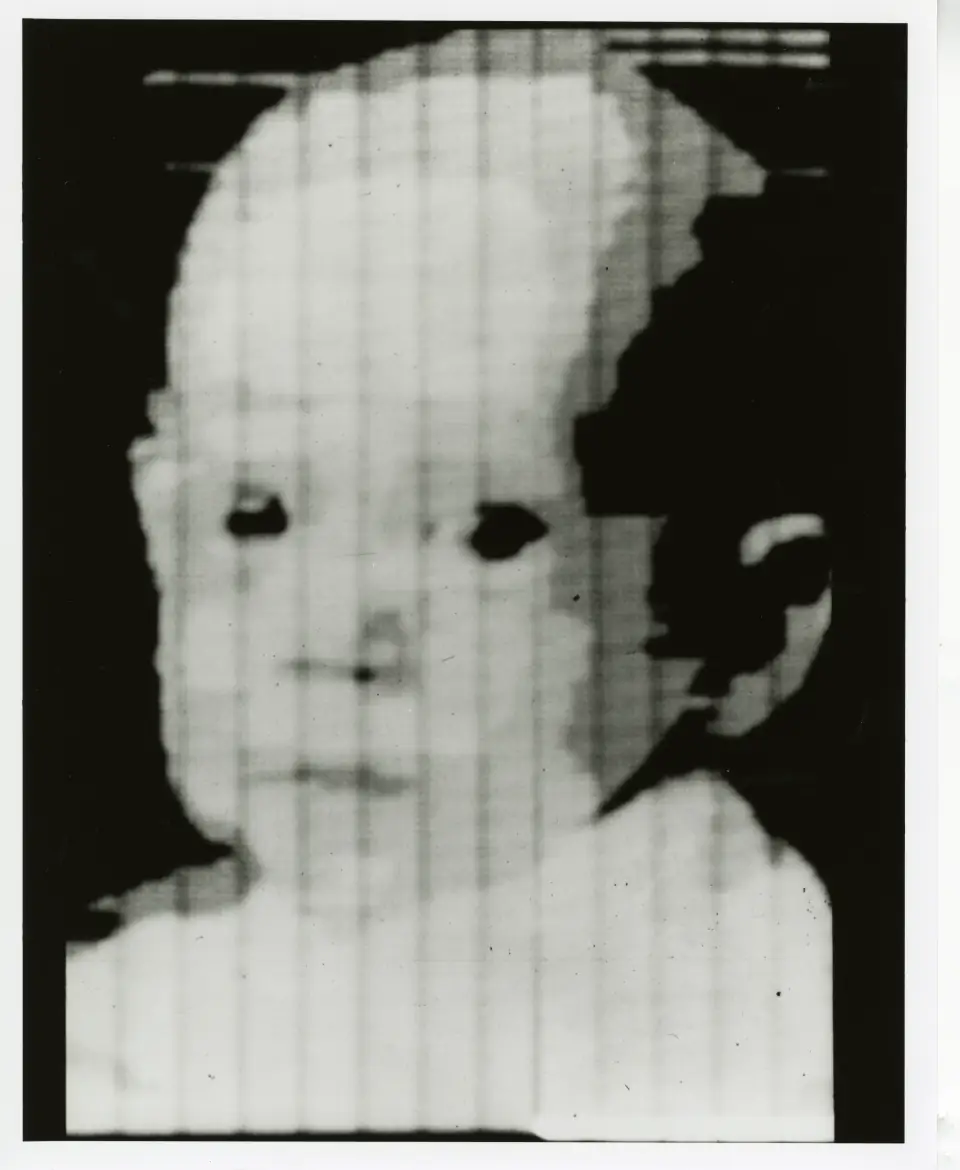
The first digital image, 1957: a coarse 176 by 176 pixel scan of a baby's face.
Russell Kirsch, scan of his son Walden, NBS (now NIST), 1957. The first digital image. Wikimedia Commons, public domain.

No. 033 · Kirsch’s scanned portrait

The original digital grid contains 30,976 samples.

In 1957 Russell Kirsch and colleagues at the US National Bureau of Standards scanned a photograph of his infant son Walden for the SEAC computer. The scan was 176 by 176 pixels, or 30,976 samples, and is widely identified as the first digital image.47 It was a digitized existing photograph, rather than a scene captured by a digital camera. The large image shown here enlarges that small grid; its extra display pixels don't add original detail. The experiment helped establish ways for computers to represent and analyze pictures.

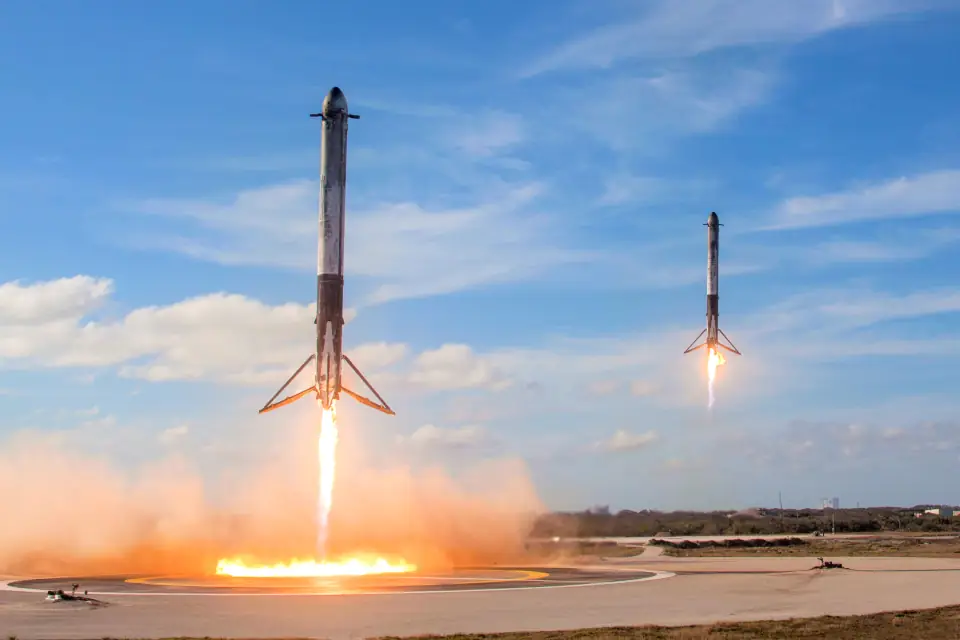
Two Falcon Heavy side boosters descending onto adjacent landing pads, with flame and exhaust beneath them.
Falcon Heavy's side boosters landing in unison, Cape Canaveral, February 6, 2018. SpaceX, dedicated to the public domain (CC0).

No. 034 · Falcon Heavy’s first flight

The two side boosters returned to adjacent landing pads.

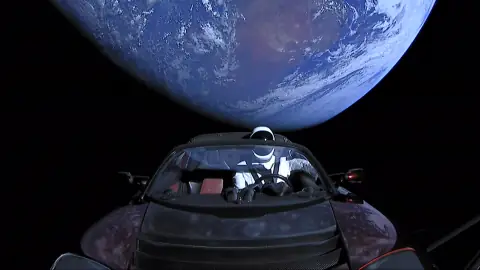
SpaceX’s Falcon Heavy test flight launched on February 6, 2018. Its two side boosters returned to Cape Canaveral and landed within seconds of each other. The center core did not complete its intended landing.48 Here, the side boosters stand nearly parallel above adjacent pads, their engine exhaust marking the last part of the descent. The payload was a Tesla Roadster with a suited mannequin, shown in the companion image. SpaceX released these particular photographs with a CC0 dedication, recorded in the credited file pages.

Starman: a spacesuited mannequin at the wheel of a red Tesla Roadster in space, Earth glowing behind the open car.
The Tesla Roadster payload and suited mannequin, Falcon Heavy test flight, February 2018. SpaceX, CC0.
Notes on photographs on the early Web

The Trojan Room camera

A local camera became a public webcam.

Cambridge researchers aimed a camera at a shared coffee pot in 1991 so colleagues could check whether coffee was available without walking to the room. The original system served pictures over the local network. Daniel Gordon and Martyn Johnson made it accessible through the Web in 1993; it was switched off in 2001.49 The camera’s usefulness came from seeing one modest piece of shared equipment remotely.

A band photograph on the early Web

CERN’s musical colleagues supplied an early Web image.

Les Horribles Cernettes, a band of CERN-associated performers, supplied an early photograph for the Web in 1992. Silvano de Gennaro made the picture. Their own account calls it the first photograph of a band on the Web.50 It describes an informal route from a band’s publicity photograph to a GIF on the CERN website.

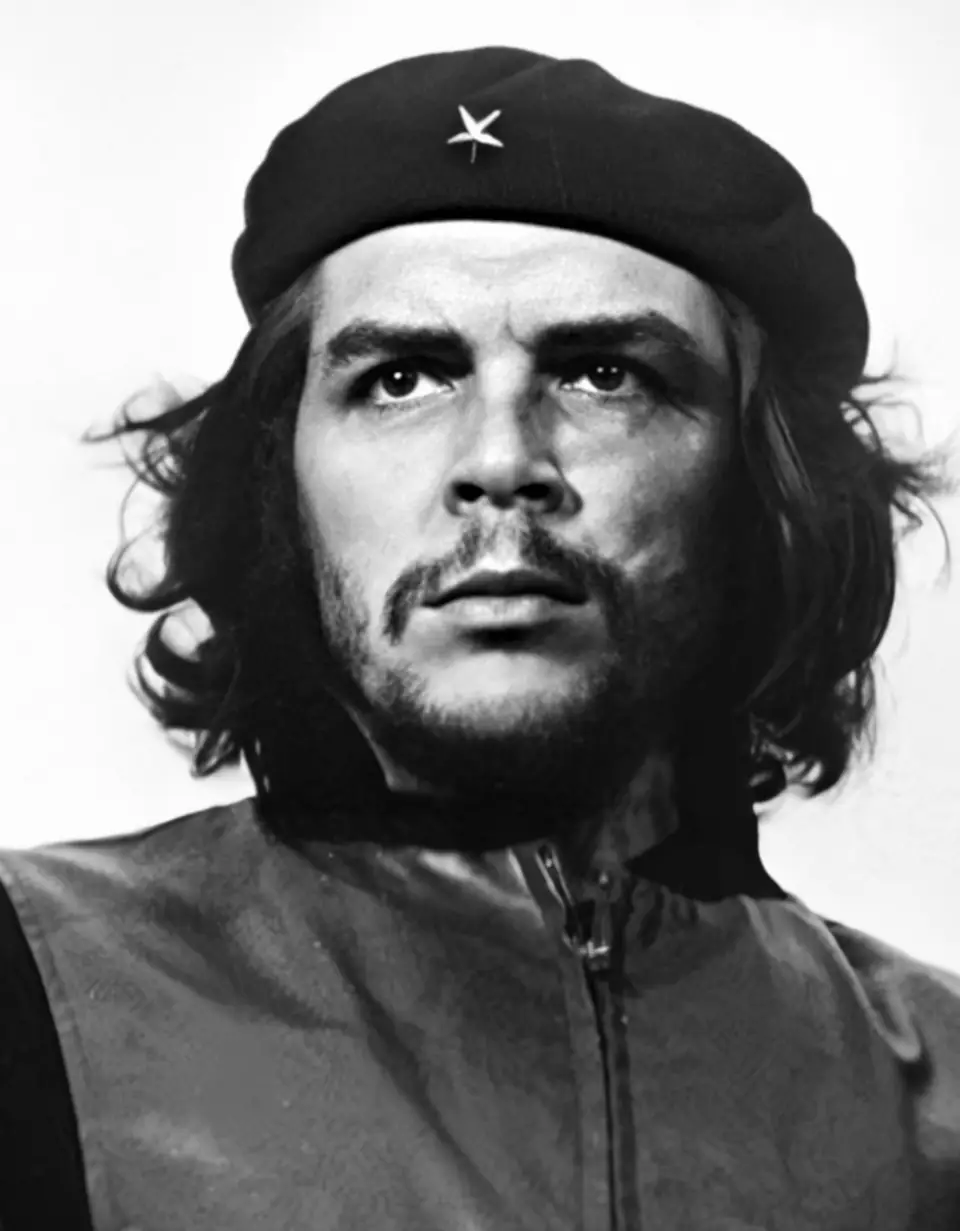
Guerrillero Heroico, 1960: Che Guevara in a beret looking past the camera into the distance.
Alberto Korda, "Guerrillero Heroico," Havana, March 5, 1960. Public domain under Cuban law (hosted as PD by Wikimedia Commons). Commons.

No. 035 · Korda’s portrait of Che Guevara

The tight crop helped the face travel.

Alberto Korda photographed Che Guevara at a memorial gathering in Havana on March 5, 1960. The familiar crop isolates his face from the wider scene, giving the beret, eyes and hair a strong outline. Reproductions carried it onto posters, clothing and political banners.51 The photograph’s later uses extended far beyond the circumstances of the exposure. A tightly cropped portrait can travel independently of the surrounding event, especially when the face is recognizable at small sizes. Commons hosts this reproduction under its stated Cuban public-domain rationale; the linked file page gives that rights history.

Notes on reproduction and familiar images

The Windows XP background

The familiar hill began as a film photograph.

Charles O’Rear made the California landscape used for Windows XP’s Bliss background in 1996. In a photographer interview reported by TIME, he describes shooting the green hill on film. Distribution with Windows gave the picture an unusually large audience.52 The original remains under copyright and is linked through that account.

Reproductions and permissions

A source credit applies to the particular file.

Some photographs discussed here are linked instead of reproduced. Rights can differ between an old image, a later print, a scan and the jurisdiction where it is used. The credit under each reproduced photograph identifies the source and its stated permission or rights advisory. 'No known restrictions' is an archive's description of what it knows, rather than a universal guarantee. The drawings of Rhein II, the hangar camera and the Ur-Leica are illustrations, not photographic substitutes.

ROLL 06 · The peaks

Six ways of looking

Close subjects, distant stars, submerged cameras and elevated viewpoints.

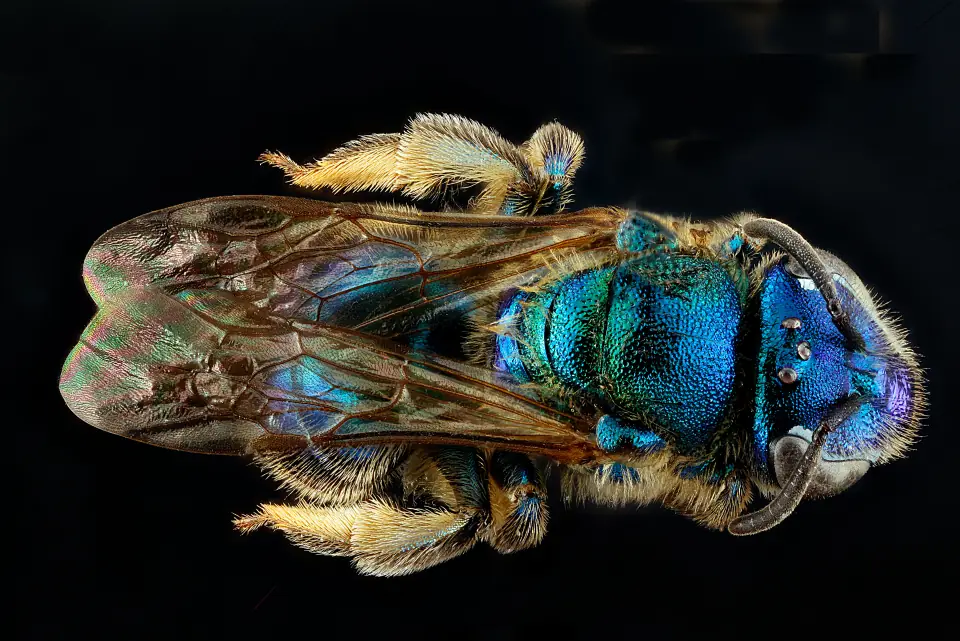
A focus-stacked view of a prepared metallic green bee, showing fine hairs and body structure.
Augochloropsis anonyma, a metallic green sweat bee. USGS Bee Inventory and Monitoring Lab (Sam Droege's team). Wikimedia Commons, public domain (US government work).

No. 036 · Focus stacking a bee specimen

Several focus planes become one detailed view.

The USGS Bee Inventory and Monitoring Lab photographs specimens using close-up lenses and focus stacking. At high magnification, only a shallow slice is sharply focused. The camera moves through a sequence of focus planes, and software combines selected sharp areas.53 The result gives identification details across more of the insect than one exposure can keep sharp. It is a prepared specimen, not a living bee caught holding still for a single photograph. The laboratory also cleans backgrounds and some stacking artifacts. The composite is useful evidence of anatomy, but it shouldn't be read as an untouched instant in the field.

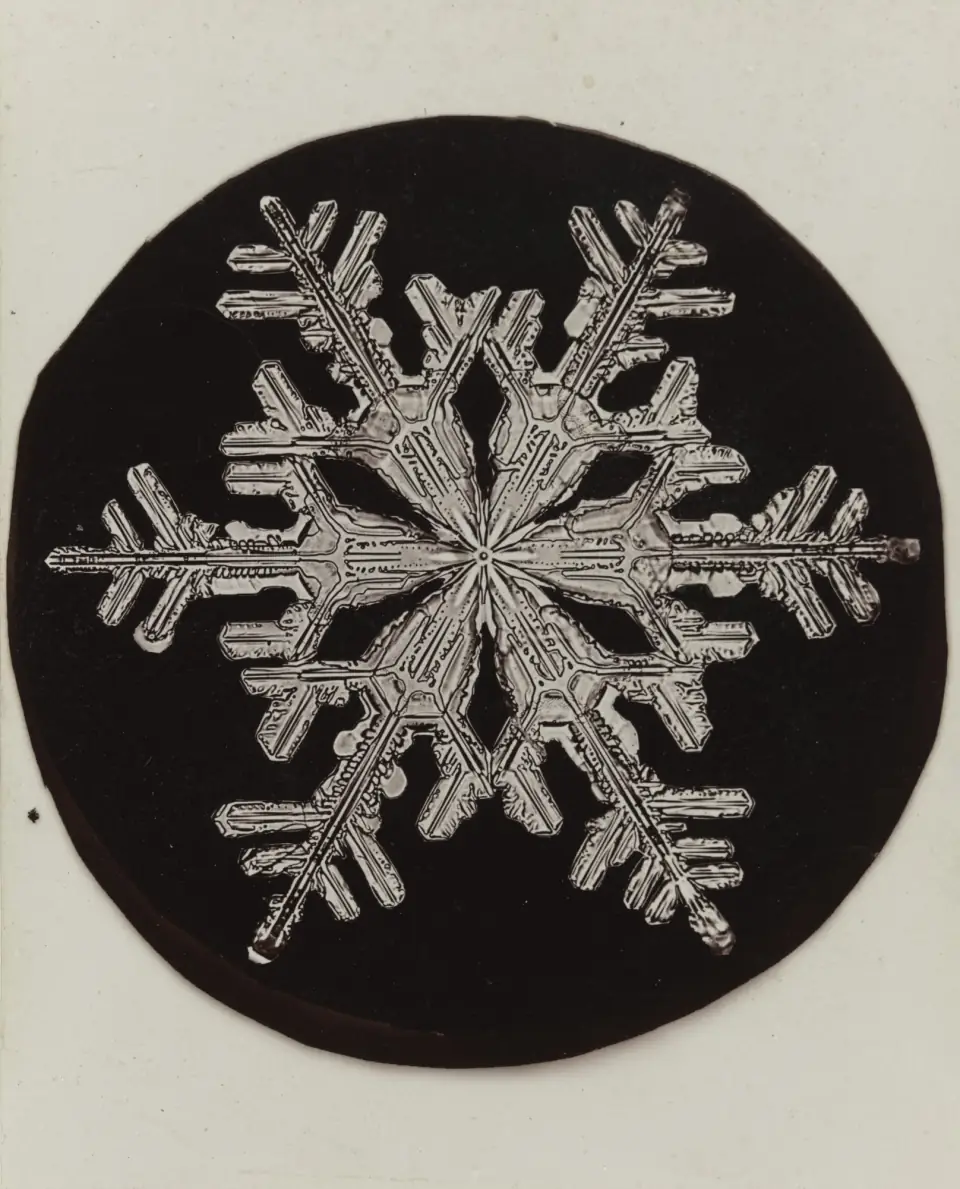
Wilson Bentley’s photomicrograph of a six-armed snow crystal against a dark background.
Wilson Bentley, snow crystal, circa 1905. MoMA / Wikimedia Commons, public domain.

No. 037 · Bentley’s snow crystals

A camera and microscope reveal their structure.

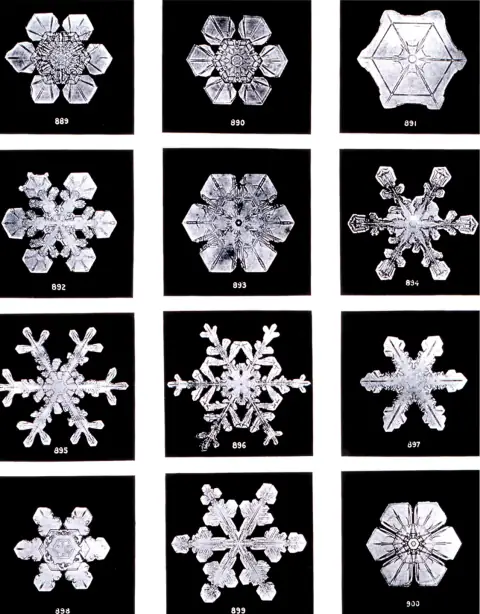
Wilson Bentley successfully photographed individual snow crystals in 1885 by coupling a camera to a microscope. He continued for decades, making more than five thousand photographs. Cold working conditions limited how long each crystal remained intact.54 The photographs show branching patterns and differences between the crystals he sampled. Bentley’s dark backgrounds and careful placement make those structures easy to compare. The grid below gathers separate exposures onto one sheet: broad plates, fine branching arms and irregular forms can be studied beside each other rather than disappearing as the snow melts.

A grid plate of many different Bentley snowflake photographs.
A sheet of Bentley’s snow-crystal photographs, arranged for comparison. Wikimedia Commons, public domain.
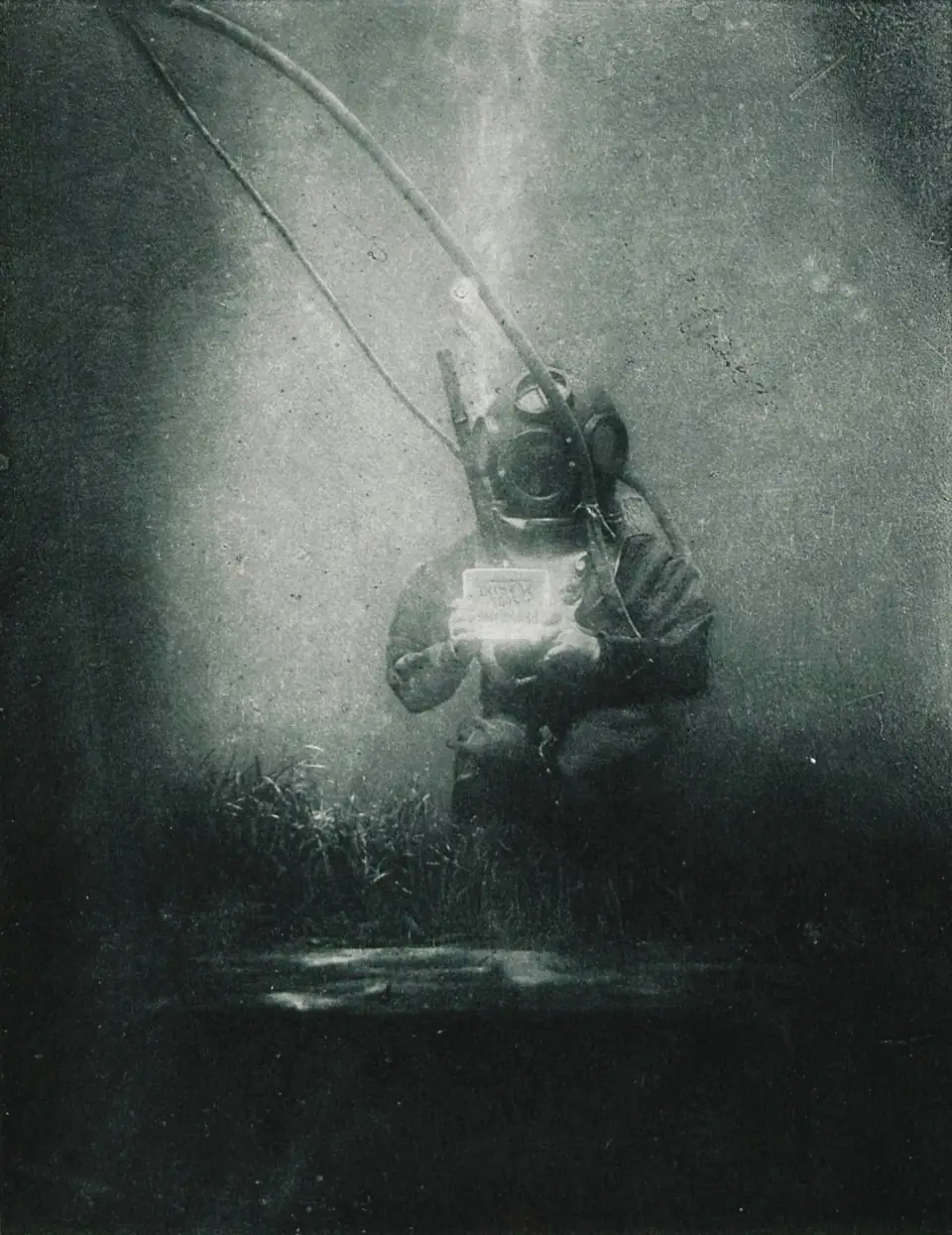
Boutan’s 1898 underwater portrait of the mechanic David in a diving suit, holding a slate.
Louis Boutan, laboratory mechanic David in a diving suit, Banyuls-sur-Mer, 1898. Boutan identifies the sitter in his 1900 book. Wikimedia Commons, public domain.55

No. 038 · Boutan’s underwater apparatus

The camera had to work inside a watertight housing.

Louis Boutan began underwater photographic experiments at Banyuls-sur-Mer in 1893. A watertight enclosure protected the camera, and he later tested artificial illumination. His own 1900 book identifies the sitter in this 1898 portrait as David, the laboratory mechanic, and describes an exposure made in sunlight at three meters’ depth, with the shutter operated from the boat.55 The diving suit, air hose and sign make the photographic experiment visible within the picture. The NOAA image below was recorded by a remotely operated vehicle in 2016, which carries its camera and illumination down together.

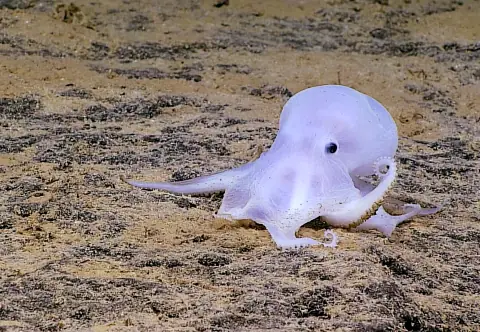
Casper the ghost octopus: a pale, almost translucent octopod sitting on the deep seafloor, photographed by a NOAA robot.
The octopus nicknamed “Casper,” recorded by NOAA’s Deep Discoverer remotely operated vehicle at 4,290 meters off Hawaiʻi in 2016. NOAA / Wikimedia Commons, public domain.56
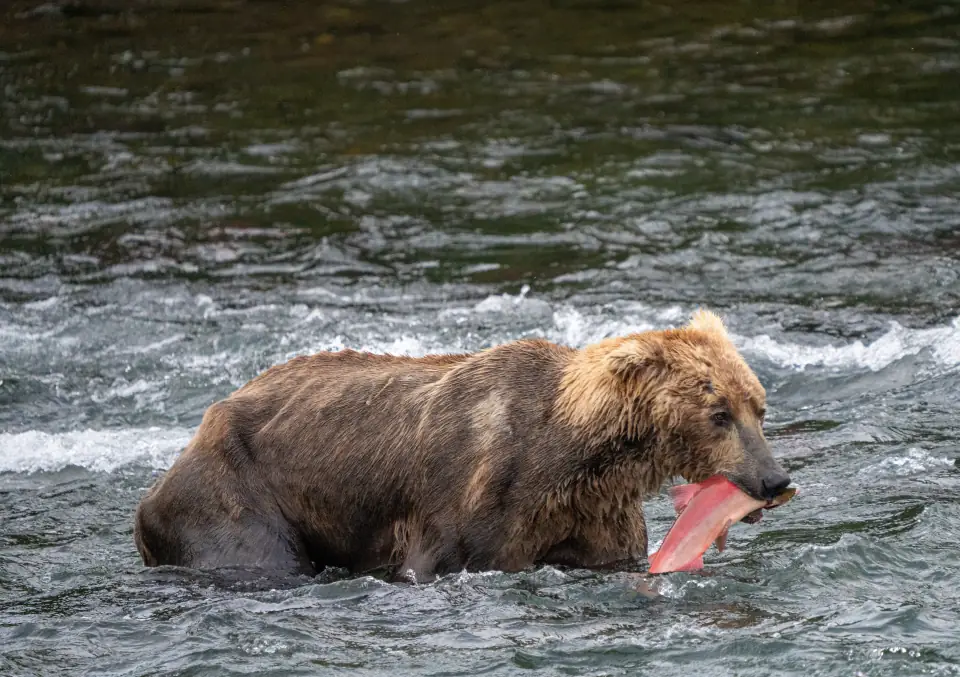
Brown bear 480 Otis sitting in the river at Brooks Falls with a salmon in his mouth.
Bear 480 "Otis" collecting a salmon, Brooks Falls, Katmai National Park, 2023. National Park Service. Wikimedia Commons, public domain.

No. 039 · Otis at Brooks Falls

A regular fishing position can reward patient observation.

This 2023 photograph shows bear 480, Otis, catching a salmon at Brooks Falls in Katmai National Park. He won Fat Bear Week in 2014, 2016, 2017 and 2021, according to the National Park Service’s account of the 2021 competition.57 The photograph catches the fish above the water and the bear’s muzzle immediately behind it. White water supplies a busy background; the fish’s dark outline remains clear. It is a short phase in the feeding that helps bears accumulate the fat reserves they use through winter.

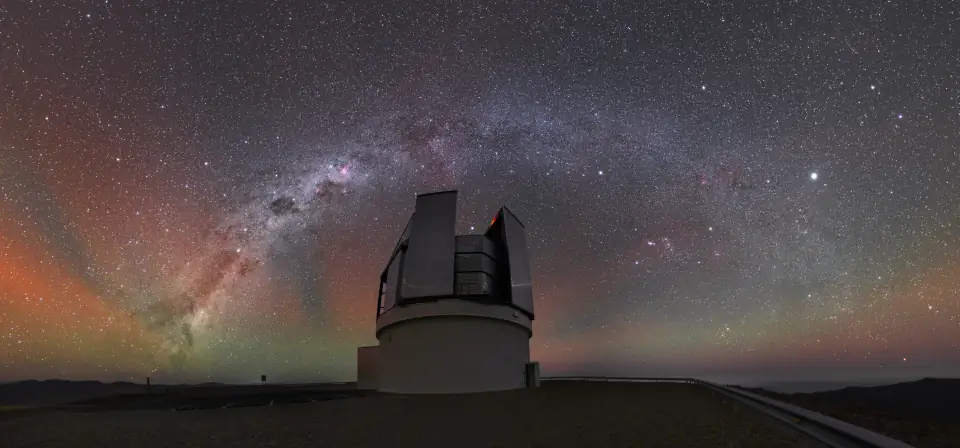
The full arc of the Milky Way over the VISTA telescope dome in the Chilean Atacama desert.
The Milky Way over the VISTA telescope, Paranal, Chile. ESO/Y. Beletsky, CC BY 4.0.

No. 040 · The Milky Way from Paranal

An exposure records more color than night vision does.

Yuri Beletsky photographed the Milky Way arching above the VISTA telescope at ESO’s Paranal Observatory in Chile. The dark, dry observing site limits interference from the atmosphere and artificial lighting.58 The luminous band is our view through the Milky Way’s disk from within it; dark lanes mark obscuring dust. Exposure and processing reveal stars and color that a person may not distinguish by eye. The telescope building gives the arch a foreground and a scale within the composition, while the bright and dark sky structures extend beyond it.

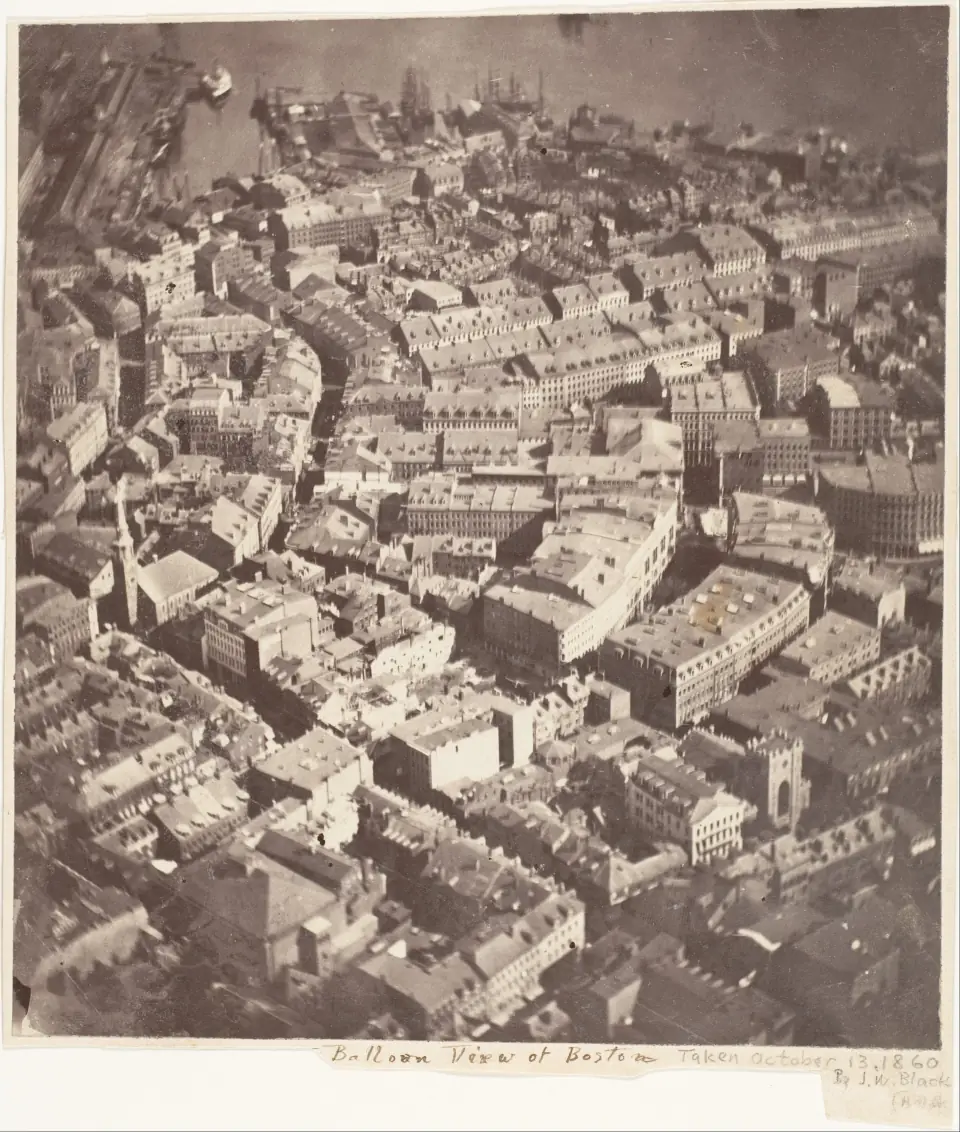
Boston from a balloon in 1860: rooftops, wharves and ships seen from twelve hundred feet, in a circular vignette.
James Wallace Black, "Boston, as the Eagle and the Wild Goose See It," October 13, 1860. The Met, public domain (Met Open Access).

No. 041 · A surviving balloon photograph

Boston appears from above in 1860.

James Wallace Black photographed Boston from a balloon on October 13, 1860, with balloonist Samuel Archer King. The Met identifies it as the first successful aerial photograph made in America. Nadar had photographed from a balloon in France in 1858.59 Preparing and developing wet glass plates in a balloon made the exposure unusually demanding. The high viewpoint turns roofs into a dense pattern and reveals how streets divide the city. Its title, Boston, as the Eagle and the Wild Goose See It, announces the unfamiliar vantage point.

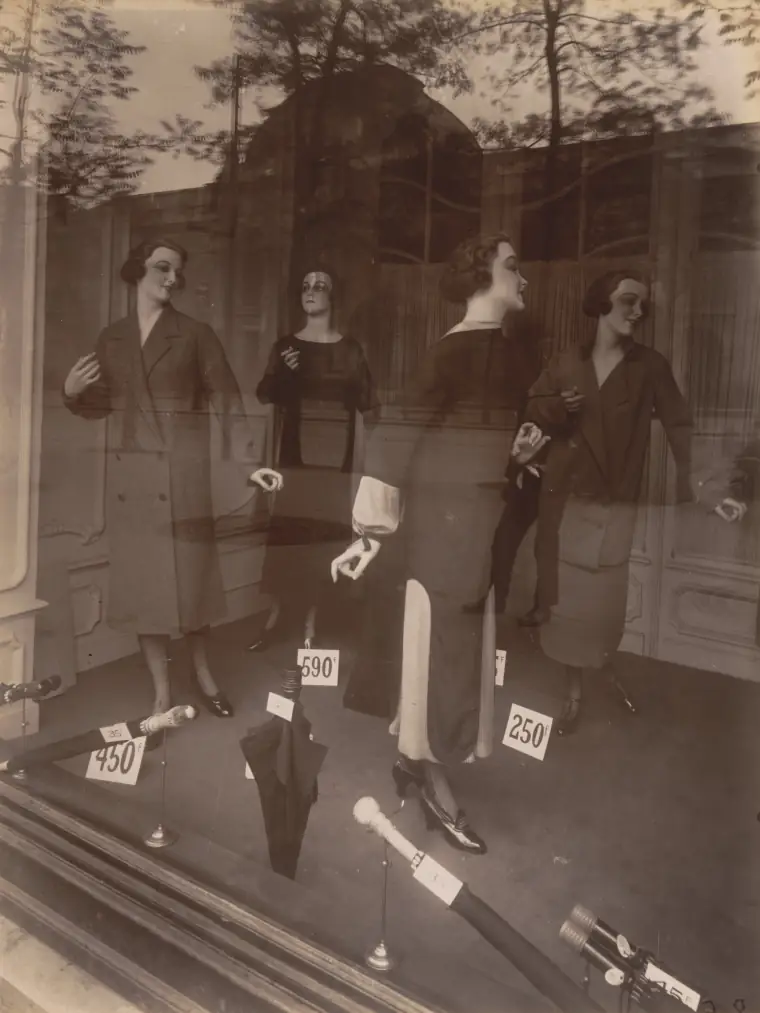
A 1925 Atget photograph of a Paris shop window: suited mannequins glowing behind glass, the street reflected over them.
Eugène Atget, "Magasin, avenue des Gobelins," 1925. Wikimedia Commons, public domain.

No. 042 · Atget’s Paris documents

The shop window reflects the street as well as its contents.

Eugène Atget photographed streets, buildings, shops and other details of Paris for customers who used the images as documents and artistic reference. In this 1925 window, mannequins and reflected surroundings occupy the same surface, making the interior difficult to separate from the street.60 After Atget’s death in 1927, Berenice Abbott and Julien Levy purchased a large part of his archive in 1928. Abbott’s preservation and promotion helped establish a wider audience. MoMA acquired the archive in 1968, bringing those commercial documents into a museum collection.

ROLL 07 · 1862 to 1945

Photographs as evidence

An exposure, its caption and its later use can tell different stories.

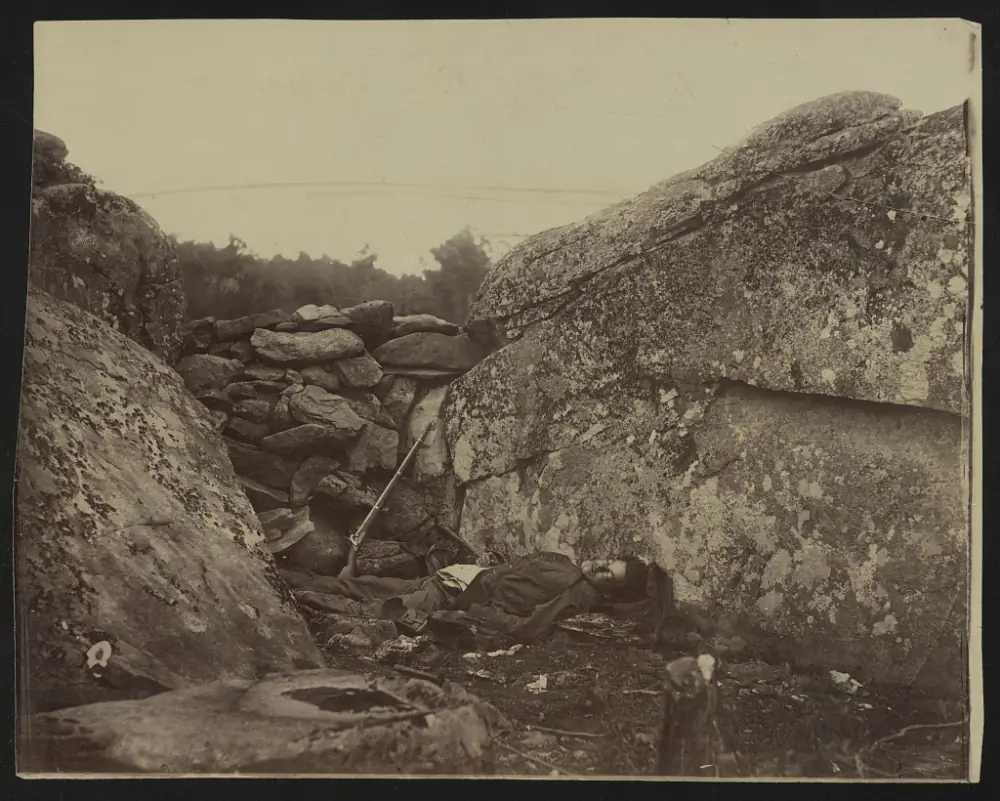
Home of a Rebel Sharpshooter, Gettysburg 1863: a dead Confederate soldier lying in a stone-walled rocky den, a rifle propped against the wall.
Alexander Gardner and Timothy O'Sullivan, "Home of a Rebel Sharpshooter," Gettysburg, July 1863. Library of Congress, no known restrictions.

No. 043 · Gardner’s staged battlefield

The evidence links one body to two locations.

The Library of Congress compares six Gettysburg photographs of the same dead soldier. Drawing on William Frassanito's analysis, it places four on a slope and two in this rocky recess, roughly forty yards away. The sequence supports the conclusion that the photographers moved the body to make the latter scene.61 The rifle appears elsewhere in Gardner's photographs and was probably a prop; it wasn't a sharpshooter's usual weapon. Gardner's published story supplied details the photographs cannot confirm. The corpse and battlefield were real, but the position and narrative were constructed. Earlier war photographers had already worked elsewhere, including Crimea.

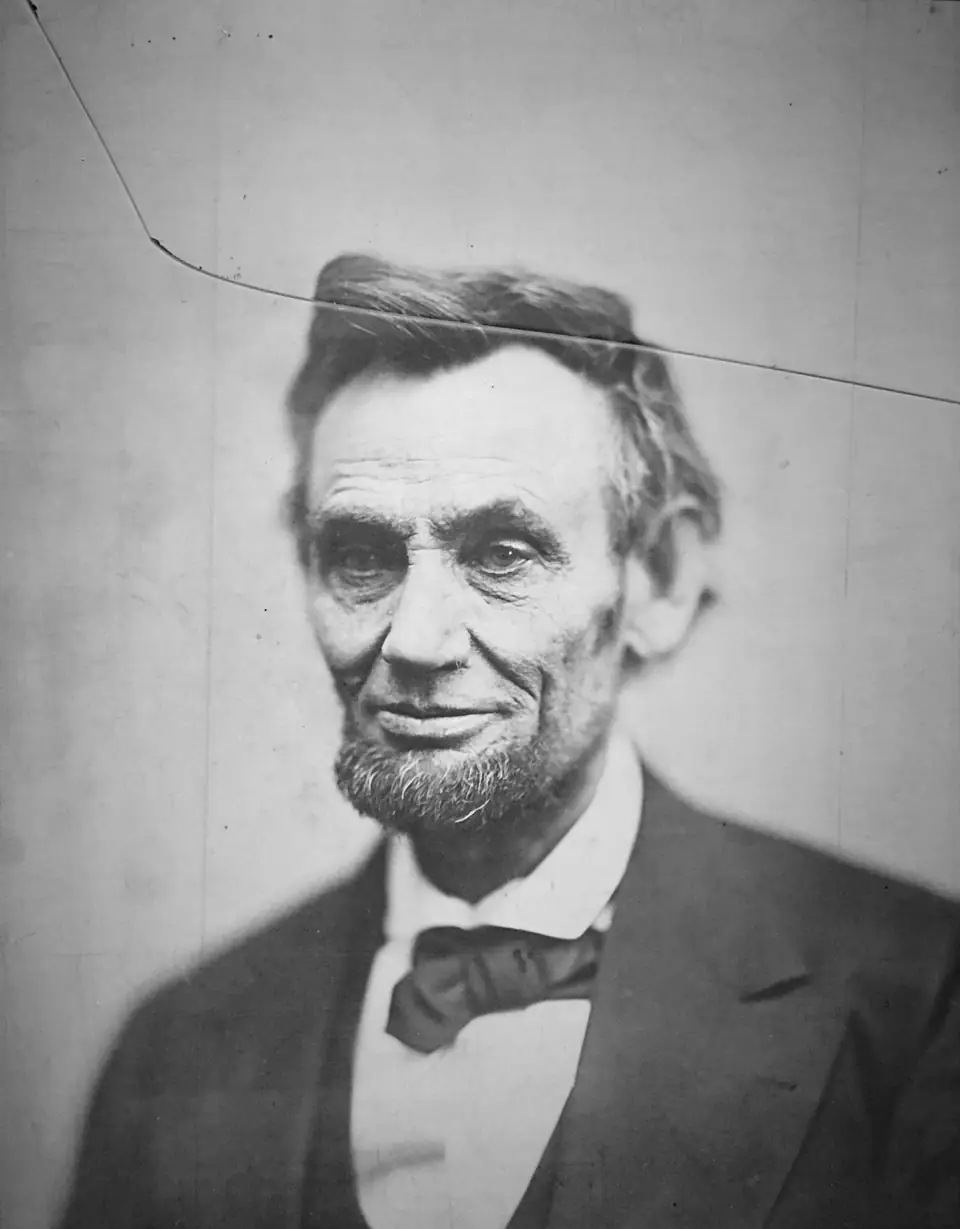
The cracked-plate portrait of Abraham Lincoln, 1865: a close, tired, faintly smiling Lincoln with a crack in the negative arcing across the top of the image.
Alexander Gardner, the "cracked plate" portrait, February 5, 1865. National Portrait Gallery. Wikimedia Commons, public domain.

No. 044 · Lincoln’s cracked-plate portrait

The crack belongs to the negative, before the surviving print.

Alexander Gardner photographed Lincoln on February 5, 1865. A crack developed across the upper part of the glass negative, possibly while it was being prepared for varnishing. Gardner made a print from the damaged negative and discarded the plate; the National Portrait Gallery holds that print.62 The fracture therefore appears in the printed image above Lincoln’s head. His face is sharper than the surrounding clothing and background. The visible damage and uneven focus belong to the photograph’s material history, while the sitting took place more than two months before Lincoln’s assassination.

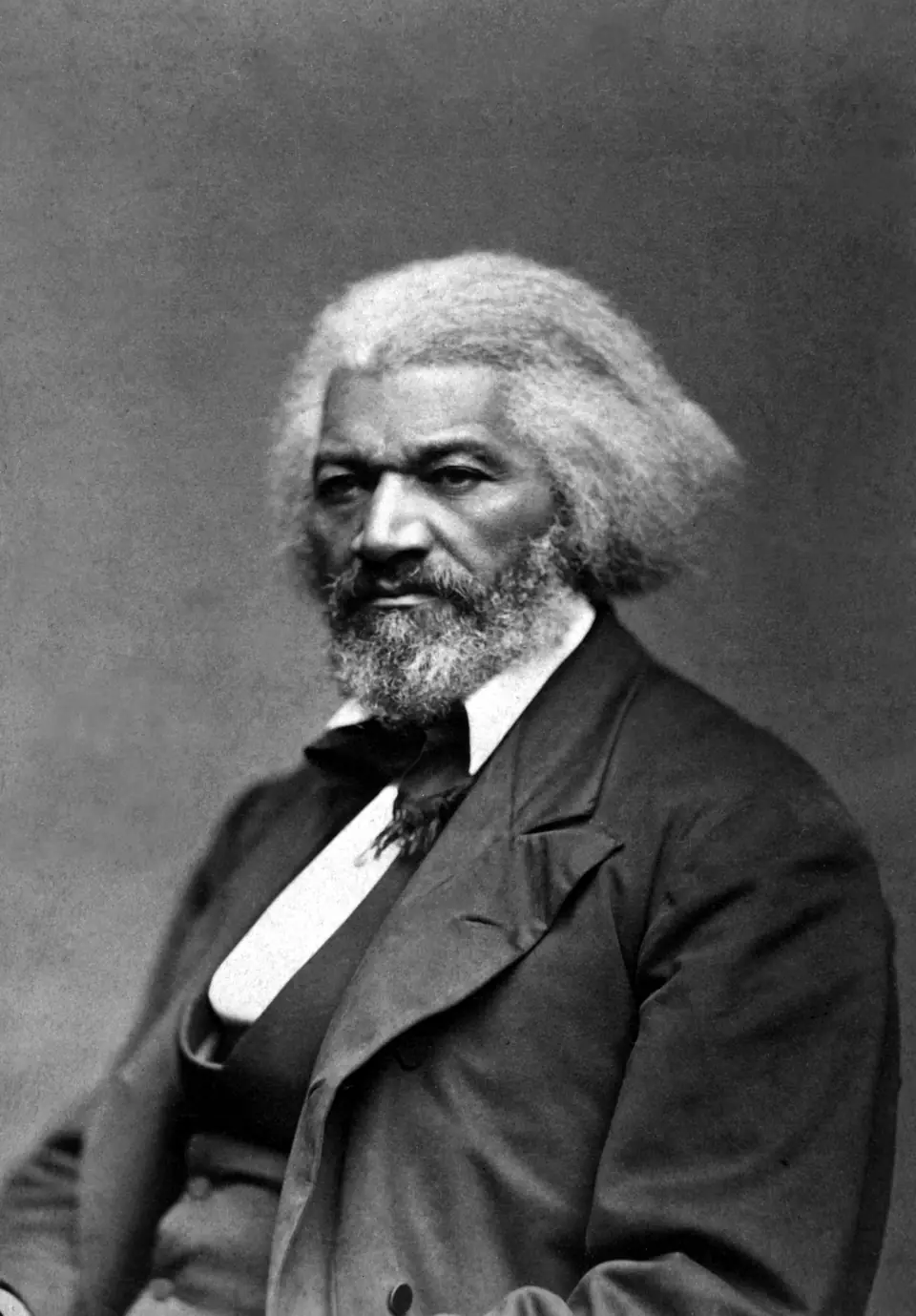
Frederick Douglass around 1879: a formal portrait of Douglass with white hair, set jaw, and a direct, unsmiling gaze.
Frederick Douglass, circa 1879, by George K. Warren. National Archives. Wikimedia Commons, public domain.

No. 045 · Douglass’s photographic portraits

He used portraiture to argue for equal human dignity.

More than 160 photographic portraits of Frederick Douglass are known. The National Park Service describes him as the most photographed American of the nineteenth century on the surviving record. He also wrote and spoke about photography’s capacity to challenge racist caricature and make dignified portraits widely available.63 Repeated sittings allowed him to circulate a consistent public image. George K. Warren’s portrait places his face and white hair against a quiet background, with the clothing giving the head a dark base. Douglass’s writings explain the political importance he attached to that act of representation.

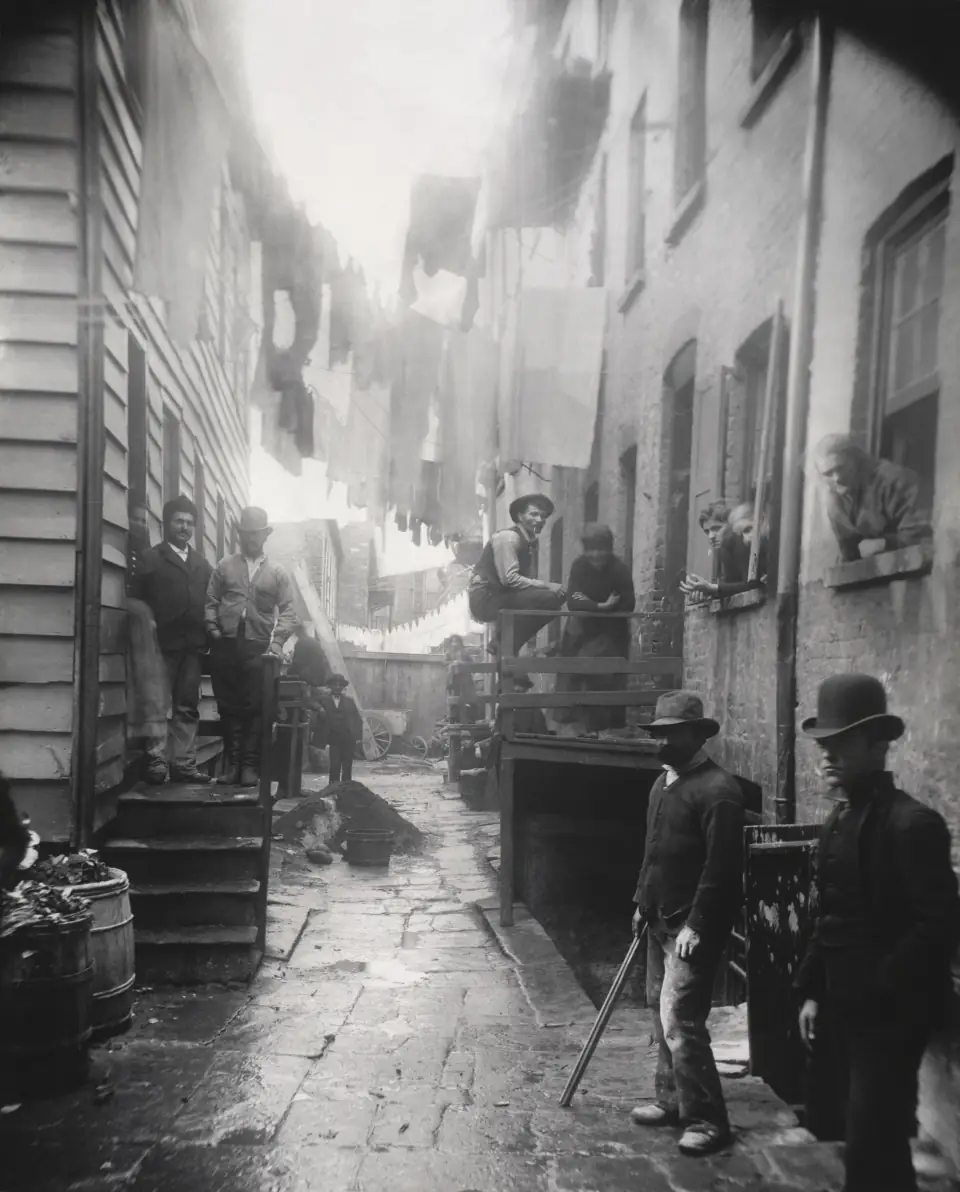
Bandit's Roost, 1888: men leaning in a narrow, laundry-strung Lower Manhattan alley, staring at the camera.
Jacob Riis, Bandit’s Roost, 59½ Mulberry Street, negative 1888; this reproduction is from a 1958 print. Digital restoration by Adam Cuerden. Wikimedia Commons, public domain.

No. 046 · Riis and urban reform

Photographs supported a campaign; they didn’t act alone.

Jacob Riis used photographs and writing to publicize crowded New York housing. His 1890 book How the Other Half Lives included views like this one. The Library of Congress credits the Bandits’ Roost photograph to Riis working with Richard Hoe Lawrence and Henry G. Piffard, using a stereoscopic camera.64 The narrow alley contains people at different depths, with clotheslines and windows above them. Riis used such scenes in a sustained reform campaign. Flash powder helped photograph some dark interiors, but this outdoor alley records a different part of the housing he wanted readers to examine.

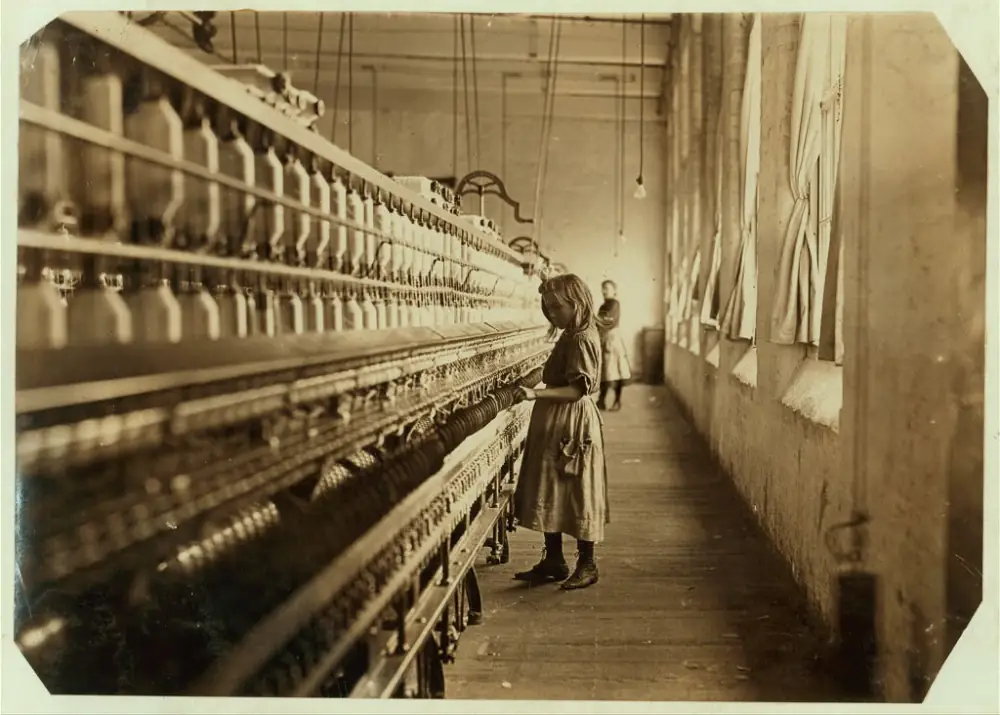
Sadie Pfeifer, a small girl in a work dress, standing at a towering cotton spinning frame in a 1908 South Carolina mill.
Lewis Hine, "Sadie Pfeifer, 48 inches high, has worked half a year," Lancaster, South Carolina, 1908. Library of Congress, no known restrictions.

No. 047 · Hine’s child-labor investigation

His captions record the conditions he found.

Lewis Hine photographed children for the National Child Labor Committee. His caption identifies Sadie Pfeifer as 48 inches tall and says she had worked in the mill for half a year. Such notes make the image part of an investigation, rather than leaving viewers to infer an age or work history from appearance.65 The photographs supported a sustained reform campaign. Congress passed the Keating-Owen Act in 1916, but the Supreme Court struck it down in 1918. The Fair Labor Standards Act of 1938 established later federal restrictions.95 Child labor didn't end everywhere with the publication of the pictures.

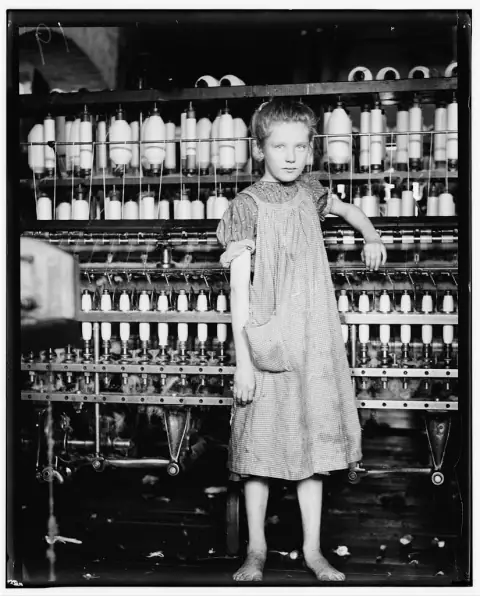
Addie Card, a barefoot twelve-year-old spinner, leaning on a spinning frame in a Vermont cotton mill, 1910.
Addie Card, 12, Vermont, 1910. In 1998 she ended up on a US postage stamp. Library of Congress, no known restrictions.
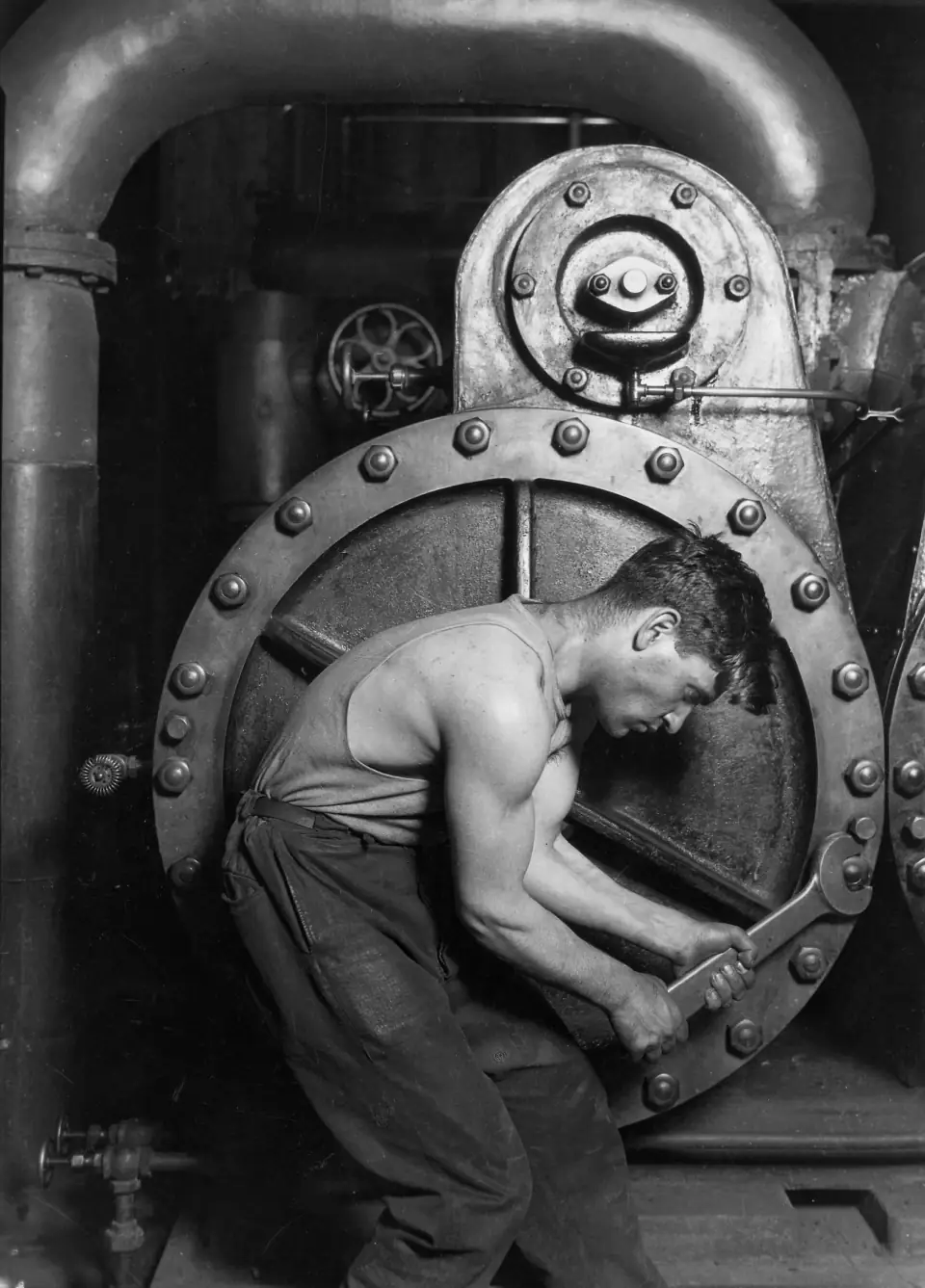
Powerhouse mechanic, 1920: a muscular worker curled into the circle of a huge steam pump wheel, wrench in both hands.
Lewis Hine, "Power house mechanic working on steam pump," 1920. National Archives. Wikimedia Commons, public domain.

No. 048 · Hine’s work portrait

The body and the machine repeat each other’s curves.

Hine’s 1920 portrait of a power-house mechanic arranges the worker within the circular forms of the steam pump. His bent arm and back repeat the curve of the machinery. Hine’s interest in labor included skilled adults as well as exploited children.65 This picture gives manual work a composed, monumental form: the tool, hand and large bolts make the task legible, while the circular housing contains the pose. The National Archives preserves it among Hine’s photographs of workers.

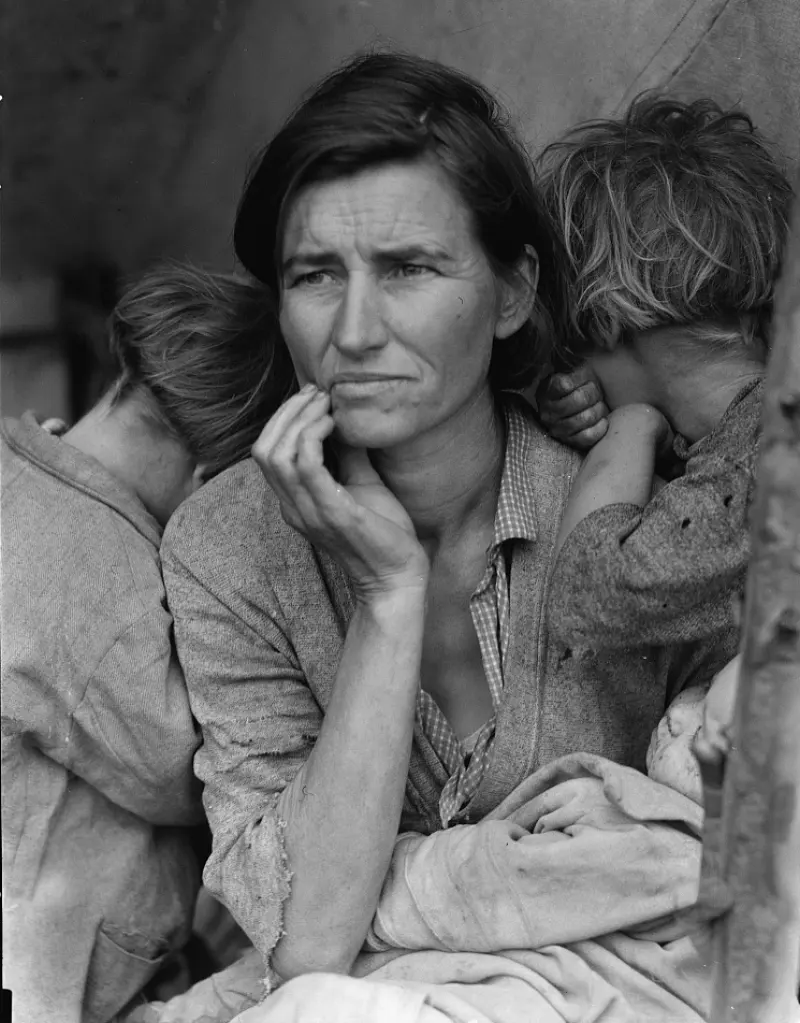
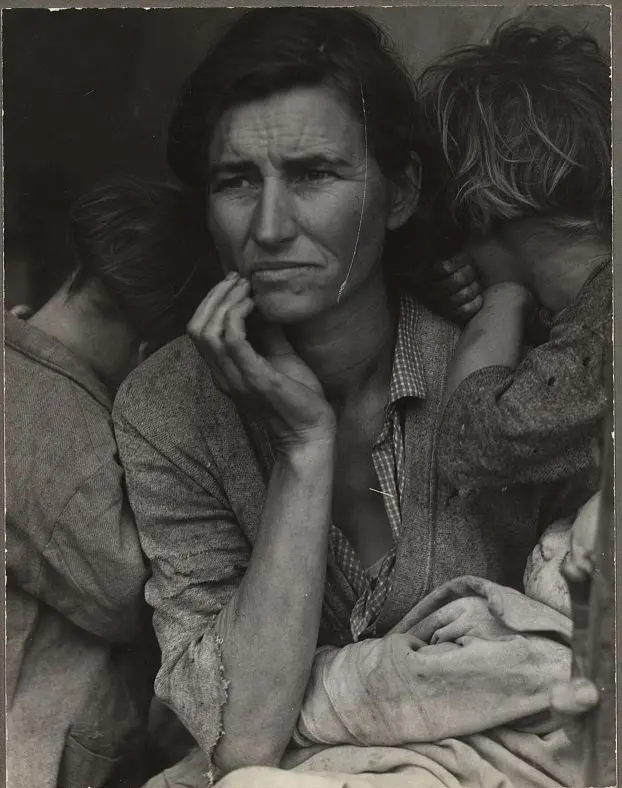
Migrant Mother, the famous retouched version: Florence Owens Thompson with two children turned away and a baby in her lap; the lower right shows no thumb. Migrant Mother, the unretouched file print: identical scene, but a thumb grips the tent pole at the lower right corner. 1936 print · thumb intact retouched negative
Dorothea Lange, "Migrant Mother," Nipomo, California, March 1936, unretouched file print (left) against the retouched negative (right). Drag the handle; watch the lower right corner. Library of Congress, FSA/OWI Collection, public domain.

No. 049 · Lange’s portrait and its retouching

A thumb was removed from the negative.

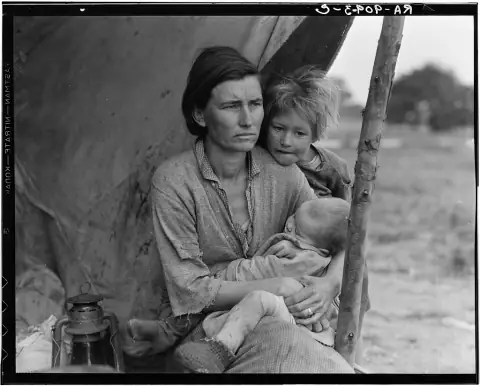
Dorothea Lange made Migrant Mother at a pea-pickers' camp in Nipomo, California, in March 1936. Florence Owens Thompson and her children appear in a short series that becomes progressively tighter. In the familiar frame, two children turn their faces away while Thompson looks past the camera. Lange later had Thompson's thumb removed from the lower corner of the negative. The Library of Congress retains an unretouched file print and the altered version, compared here.66 The Library also records Thompson’s dissatisfaction with the portrait; her daughter Katherine described a strong family leader who felt that the photograph had not shown her in that light.

The wider first frame of the Migrant Mother session: the family's lean-to tent with children and belongings scattered around it.
A wider view from Lange’s March 1936 session with the family. Library of Congress, public domain.
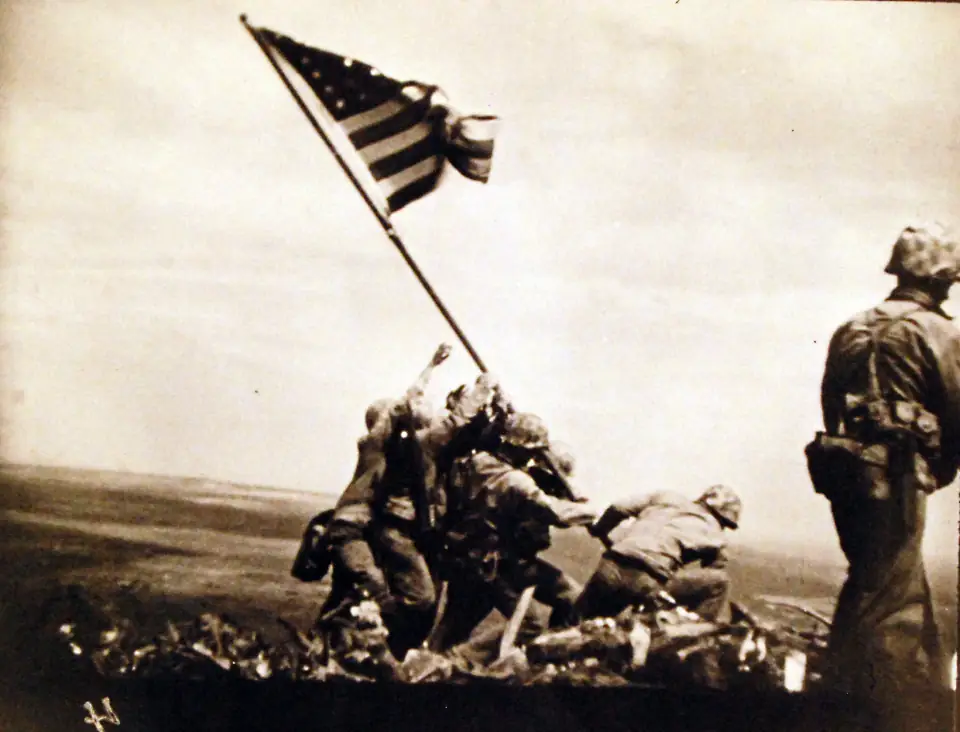
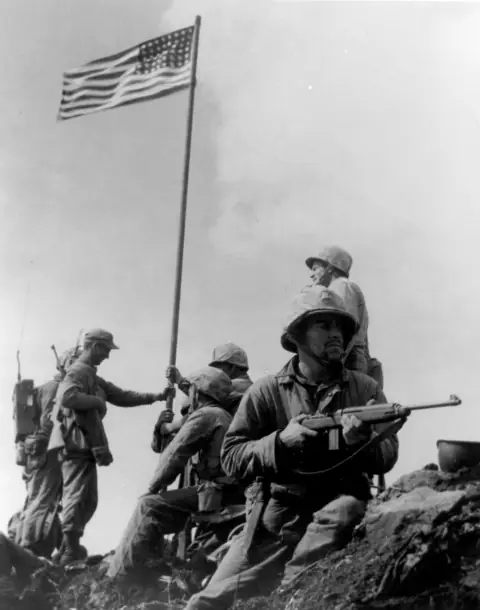
A color film frame of the second flag raising on Iwo Jima: Marines planting the flagpole on Mount Suribachi.
Sgt. Bill Genaust, USMC, film frame of the second flag raising, Mount Suribachi, February 23, 1945. U.S. Marine Corps footage, National Archives, public domain. Via Wikimedia Commons.

No. 050 · Two records of the Iwo Jima flag raising

Genaust’s film records the same second flag.

On February 23, 1945, Joe Rosenthal photographed Marines raising a larger replacement flag on Mount Suribachi. Marine cameraman Bill Genaust filmed the same event nearby. This is a frame from Genaust's color footage, preserved by the National Archives.67 It helps establish that Rosenthal's celebrated image records the actual second raising, rather than a scene repeated for his still camera. A different posed group photograph helped confuse later accounts. The first, smaller flag had been raised earlier. The film is US government material; Rosenthal worked for the Associated Press, whose photograph has a separate rights history.68

Marines around the first, smaller flag raised on Mount Suribachi a few hours earlier.
Sgt. Louis Lowery, USMC, the earlier, smaller flag on Mount Suribachi, February 23, 1945. US Marine Corps photograph, public domain.
Notes on two street photographers

Cartier-Bresson’s 1932 photograph

The leap and its reflection repeat a nearby dancer.

In Behind the Gare Saint-Lazare, a man leaps above water while his reflection and a dancer on a nearby poster repeat the movement. Cartier-Bresson photographed through a gap in a fence that restricted the view.69 His camera caught the heel still above the water, before the landing disturbed the reflection. The forms remain aligned for this brief phase of the leap. View the copyrighted image at Magnum.

Vivian Maier’s archive

Public recognition followed the sale of her stored negatives.

Vivian Maier photographed street life and made self-portraits while working as a nanny. Materials sold at auction in 2007 brought her previously little-known archive to collectors’ attention; she died in 2009. Later exhibitions and publications established her reputation.70 The archive includes negatives, prints, films and undeveloped rolls. John Maloof’s collection describes how it was dispersed at the auction and later brought back together for preservation and publication.

ROLL 08 · 1856 to 1942

Making the print

Focus, combination printing and tone control shape the result.

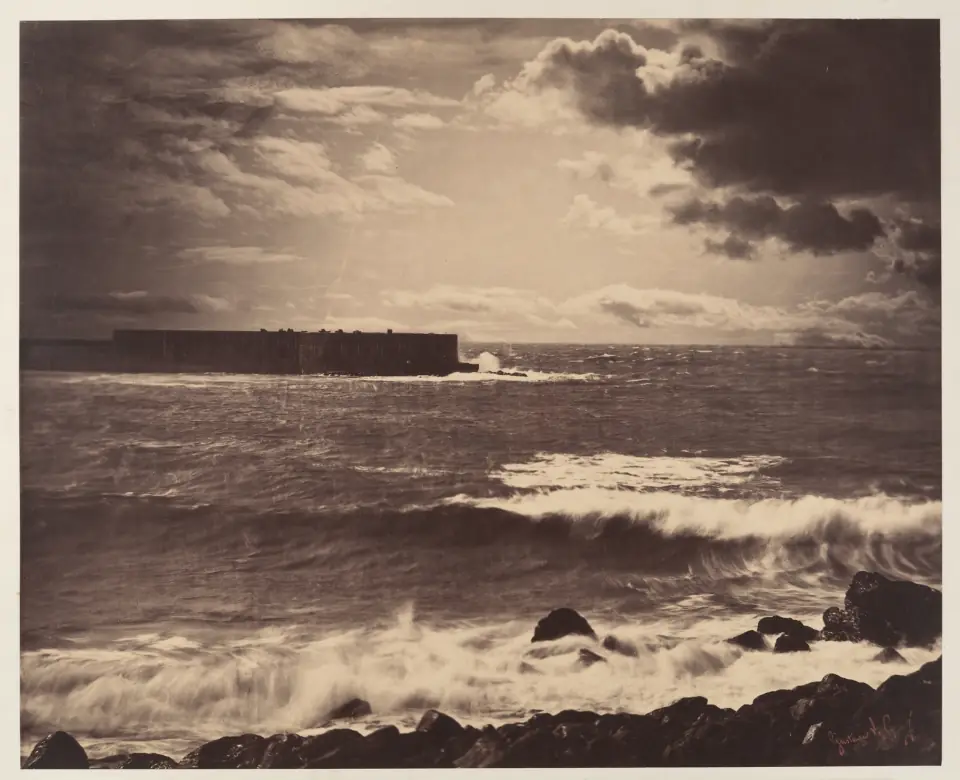
The Great Wave, Sete, 1857: a dramatic albumen seascape of waves breaking over rocks beneath a luminous clouded sky.
Gustave Le Gray, "The Great Wave, Sète," 1857. The Met, public domain (Met Open Access).

No. 051 · Le Gray’s combination printing

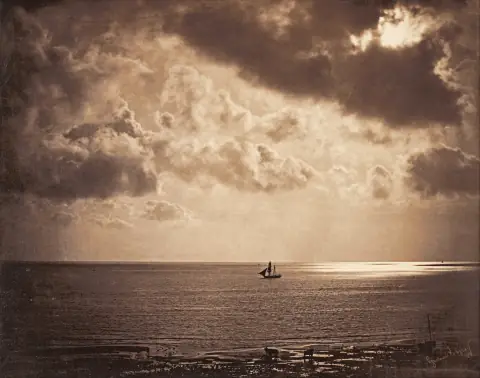
Sky and sea came from separate negatives.

In The Great Wave, Sète of 1857, Gustave Le Gray combined a negative exposed for the sea with another exposed for the sky. Early photographic materials could make it difficult to retain both a detailed sea and a satisfactory sky in the same exposure. The horizon offered a place to join the records.71 The Met identifies this print as albumen silver on paper, made from glass negatives. The clouds and waves therefore come from separate exposures. Their joined tones make a continuous-looking view, with the construction carried into the print rather than visible as an obvious seam.

Brig upon the Water, 1856: a small ship on a silvery sea under a vast glowing sky.
Gustave Le Gray, Brig upon the Water, 1856. Wikimedia Commons, public domain.
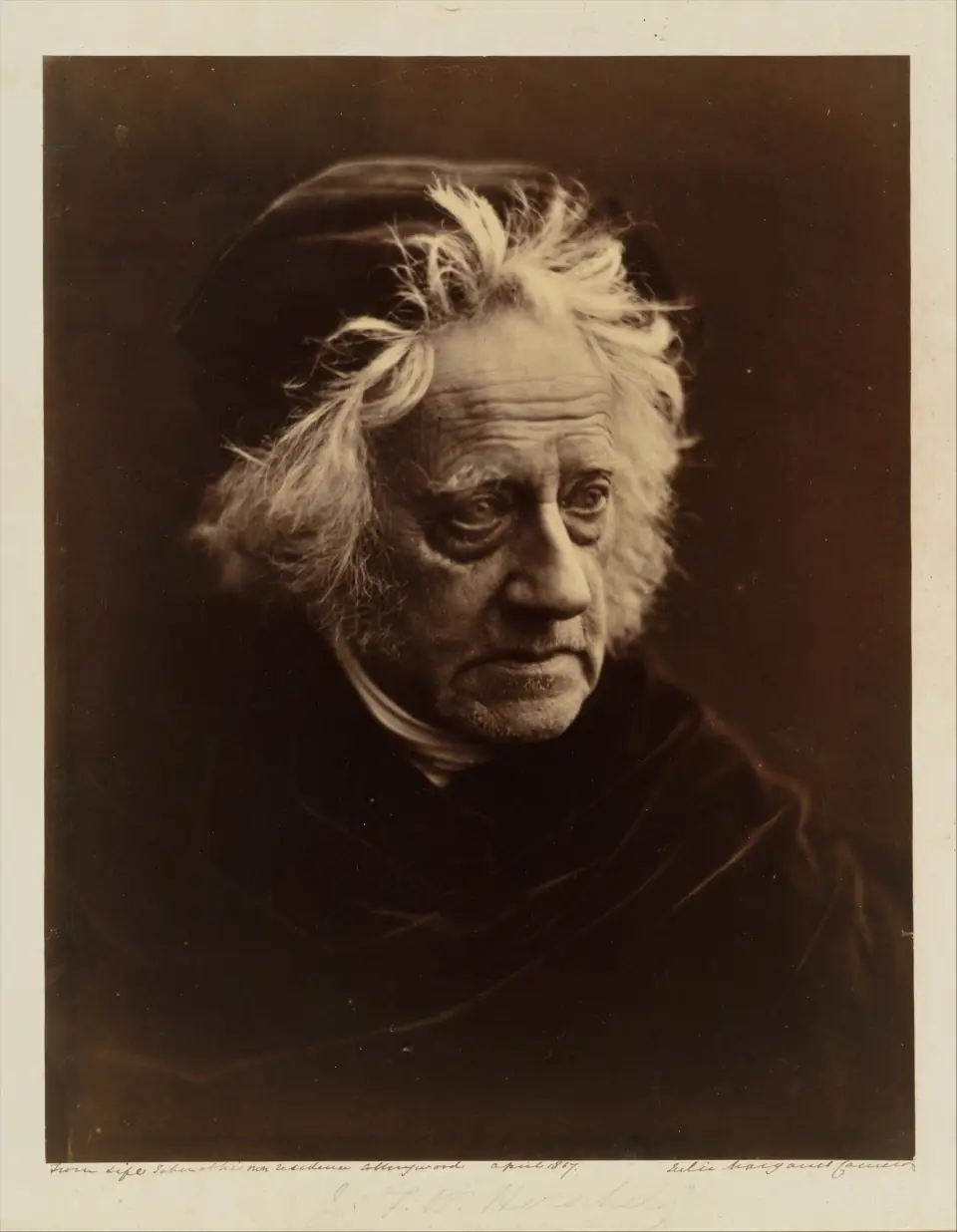
Julia Margaret Cameron's 1867 portrait of John Herschel: the astronomer's deeply lined face emerging from darkness under a halo of wild white hair.
Julia Margaret Cameron, "Sir John Herschel," April 1867. The Met, public domain (Met Open Access).

No. 052 · Cameron’s soft focus

A sharp likeness wasn’t her only aim.

Julia Margaret Cameron received a camera in 1863, when she was 48. She developed large, close portraits that often retained softness and visible imperfections in the wet-collodion process. The V&A records both her intentional use of soft focus and her practical struggle with difficult materials.72 Her 1867 portrait of astronomer John Herschel brings his face close while letting his hair and the surrounding darkness soften. The appearance can be described without assuming every flaw was deliberate. Cameron sometimes corrected negatives too. The finished print reflects choices about focus, scale, exposure and handling, as well as the person who sat for it.

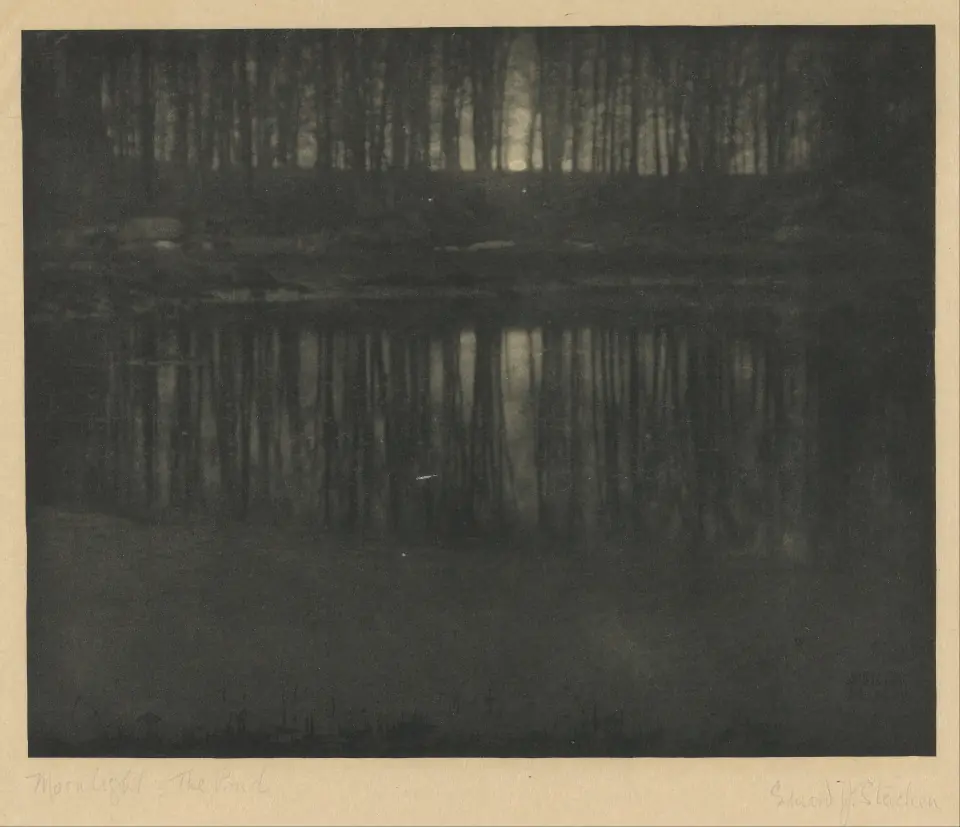
Getty’s 1906 photogravure from Steichen’s 1904 pond negative, with trees, reflected light and dark water.
Edward Steichen, Moonlight: The Pond, negative 1904; photogravure 1906. The J. Paul Getty Museum, Los Angeles (86.XM.625.4). Wikimedia Commons, public domain.73

No. 053 · Steichen’s pond negative

The negative survives in several kinds of print.

Steichen made the negative for The Pond, Moonlight in 1904. He produced large prints using layered processes, including gum bichromate over platinum, which could vary in color and surface. Sotheby’s described three such examples in its 2006 sale catalogue.96 The image reproduced here is a different object: Getty’s 1906 photogravure, published from the photograph, measuring about 6⅜ by 8 inches.73 Photogravure transfers the image to an inked printing plate. It preserves the arrangement of trees and reflected light, while the original photographic prints have their own materials and scale.

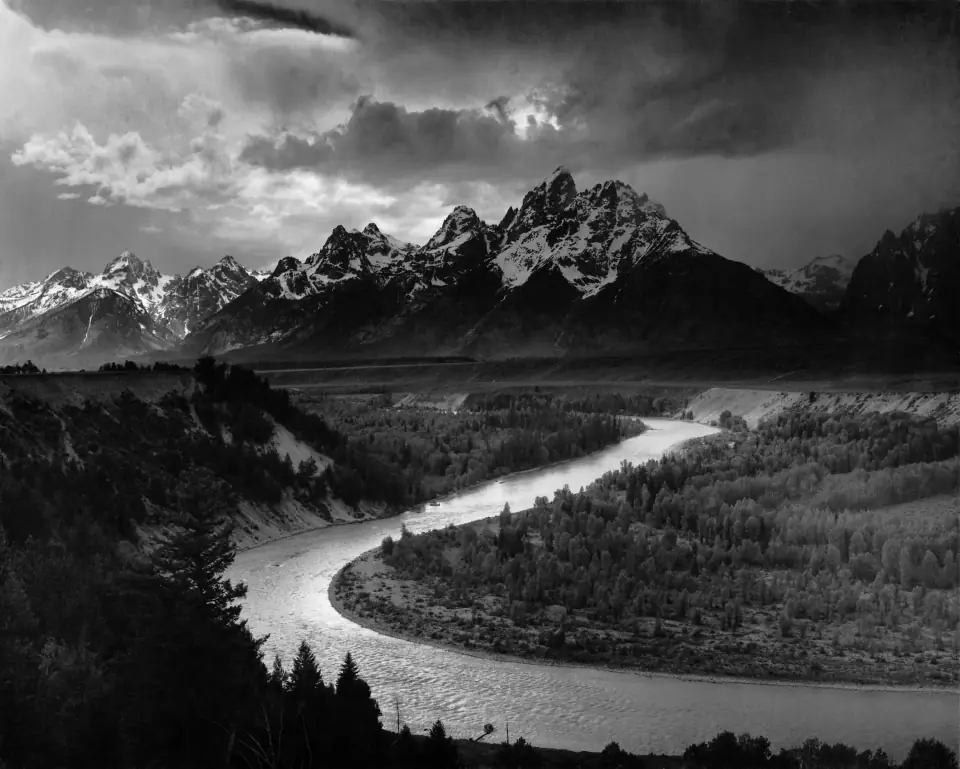
The Tetons and the Snake River, 1942: the river curving in silver S-bends toward jagged peaks under storm light.
Ansel Adams, "The Tetons and the Snake River," 1942, made for the Department of the Interior. National Archives (79-AAG-1). NARA, public domain as US government work.

No. 054 · Adams and Archer’s Zone System

Exposure and development determine where tones can land.

Ansel Adams and Fred Archer developed the Zone System as a practical way to connect scene luminance, exposure, negative development and the final print. Adjacent exposure zones differ by one stop, a factor of two in light. The familiar scale runs from 0 to X, black to paper white.74 The strip below is an illustrative display scale, not a calibrated light meter or a universal conversion from scene brightness to screen values. A print depends on paper, processing and local darkroom adjustments as well as camera exposure. Select a zone to see its conventional role.

Zone V · Middle gray. Select a zone to compare tones.

Adams made The Tetons and the Snake River in 1942 for the Department of the Interior. The National Archives holds the government image. It is also included among the photographs encoded on the Voyager Golden Record.75

Adams’s account of Moonrise, Hernandez

Exposure
In 1941, Adams stopped beside the road and photographed the last sunlight on the village’s crosses. Unable to find his meter, he estimated exposure from the Moon’s luminance.76
Printing
He later adjusted local exposure under the enlarger, darkening some areas and holding others back. Prints from the same negative can therefore differ.76
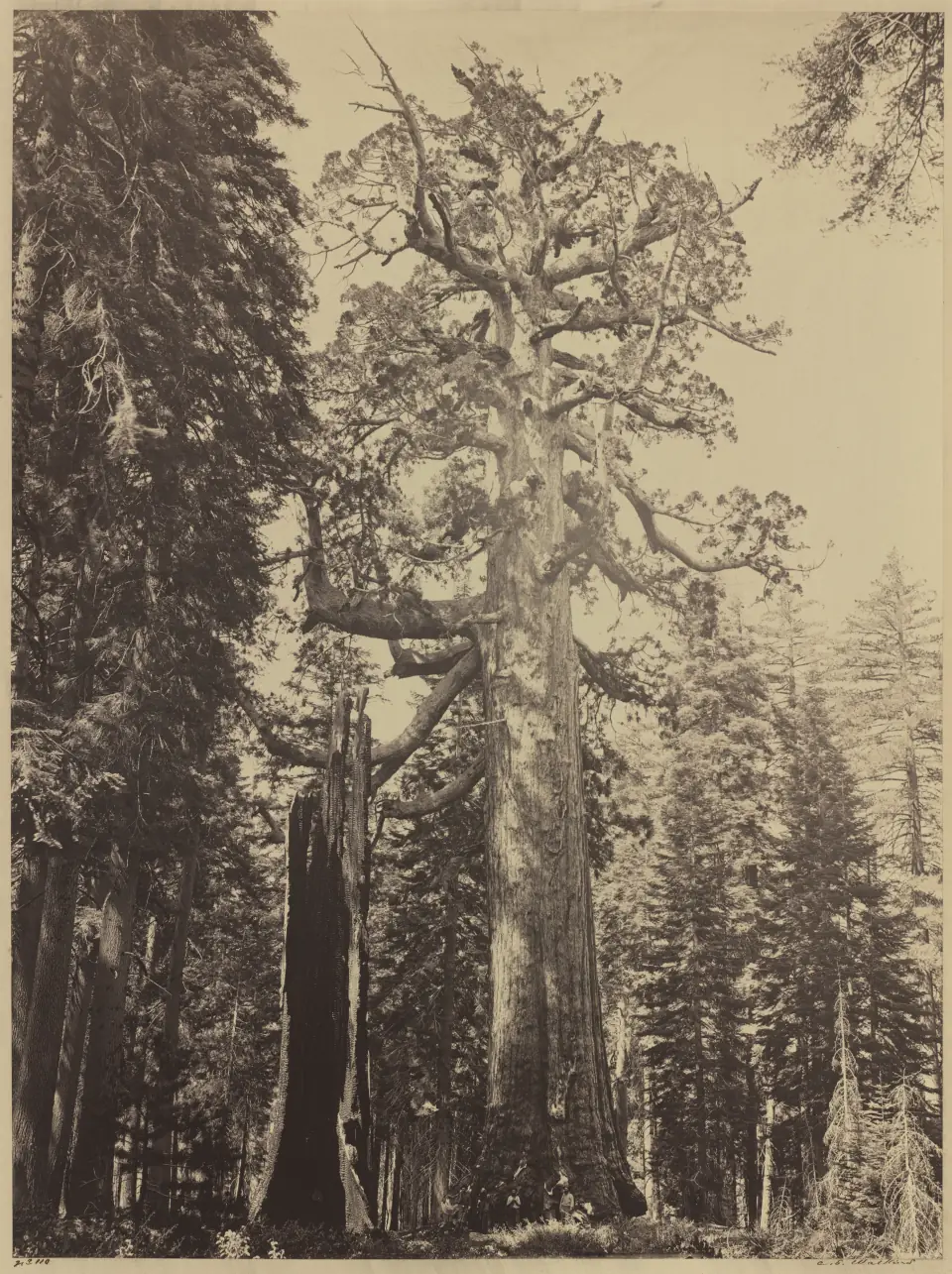
The Grizzly Giant sequoia, 1861: a colossal tree towering over the forest in a mammoth-plate photograph.
Carleton Watkins, "Grizzly Giant, Mariposa Grove," 1861. National Gallery of Art. Wikimedia Commons, CC0.

No. 055 · Watkins photographs Yosemite

The pictures helped make a distant landscape familiar.

Carleton Watkins made large glass-plate photographs in Yosemite in 1861, including this view of the Grizzly Giant. His approximately eighteen-by-twenty-two-inch plates required substantial equipment and preparation beside the camera.77 People at the tree’s base help convey its size within the photograph. Watkins’s views joined writing, paintings and political advocacy that helped lead to the 1864 Yosemite Grant. The grant set aside Yosemite Valley and the Mariposa Grove under California’s care for public use and preservation. The photographs introduced distant viewers to a landscape already inhabited and known by Indigenous people.

Light and the print surface

Gelatin silver
In a fiber-base gelatin-silver print, silver grains in gelatin form the image above the paper and its white baryta coating. Viewing light passes through the image layer, reflects, and returns through it to the eye.78
Surface
The paper, coating and surface texture change how the print reflects light. A screen reproduction shows an image of that object, rather than the object’s response to the room’s illumination.
ROLL 09 · 1827 to 1852

Early surviving photographs

The material object and its modern reproduction need to be distinguished.

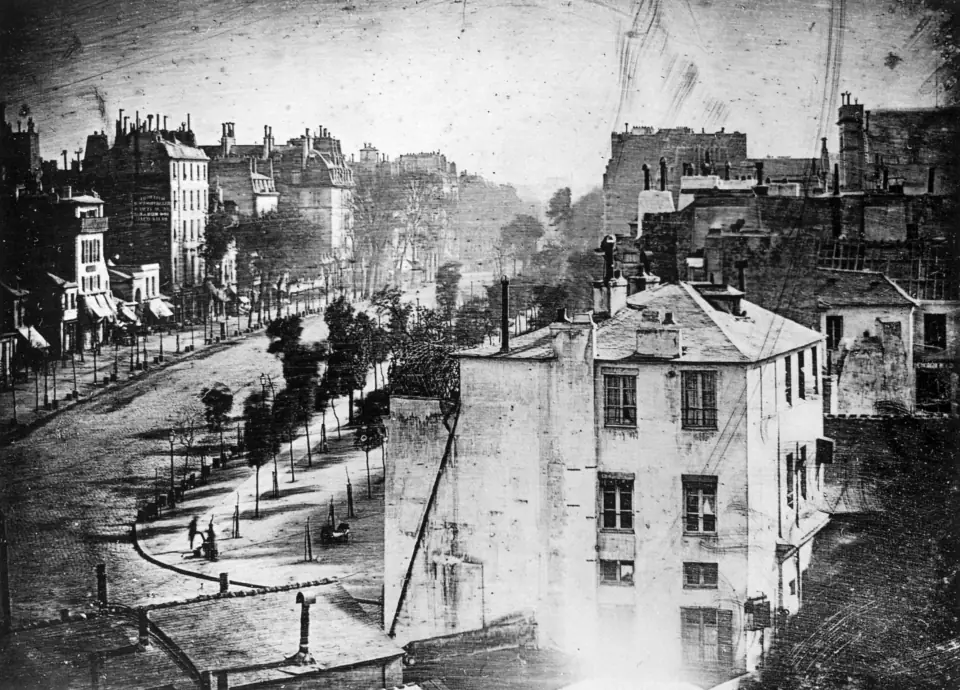
Daguerre’s late-1830s view of the Boulevard du Temple, with small stationary figures near the lower left.
Louis Daguerre, "Boulevard du Temple," 1838. Wikimedia Commons, public domain.

No. 056 · A long exposure on a Paris boulevard

Two people remain visible where moving traffic does not.

Daguerre’s 1838 view of the Boulevard du Temple includes a person apparently having his shoes polished and another bent near his feet. They remained sufficiently still during the long exposure to register, while much of the passing traffic did not.79 It is among the earliest surviving photographs to show people. The magnifier enlarges this part of the reproduction. Buildings and stationary figures persist; movement leaves less distinct evidence. The result makes a busy street appear much emptier than it was during the exposure.

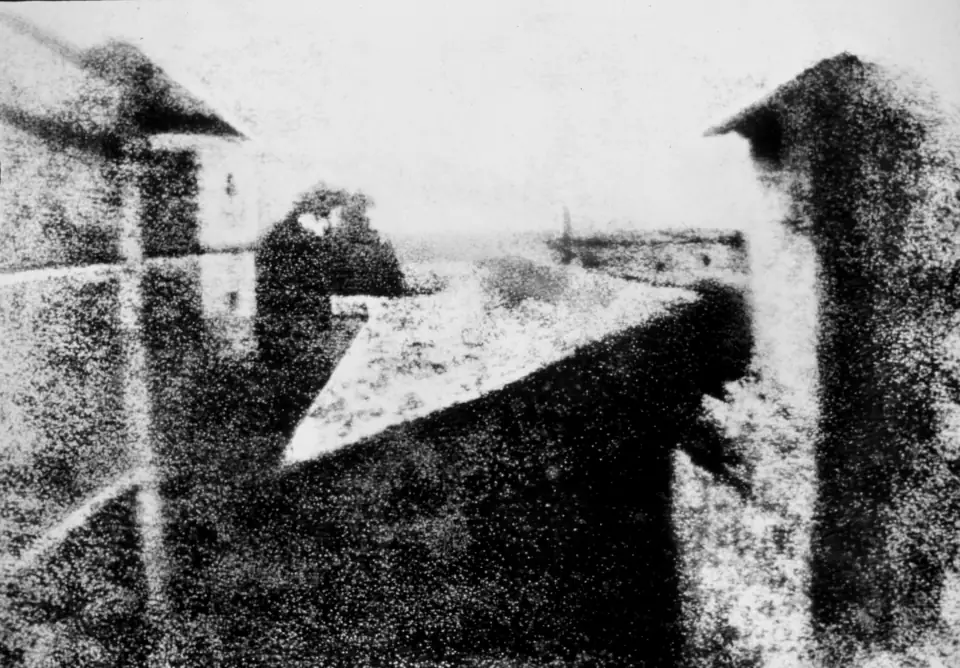
The enhanced 1952 reproduction of Niépce’s surviving camera photograph, showing buildings and a courtyard.
Joseph Nicéphore Niépce, "View from the Window at Le Gras," 1827. The 1952 enhanced reproduction. Wikimedia Commons, public domain.

No. 057 · Niépce’s surviving heliograph

The enhanced reproduction is easier to read than the plate.

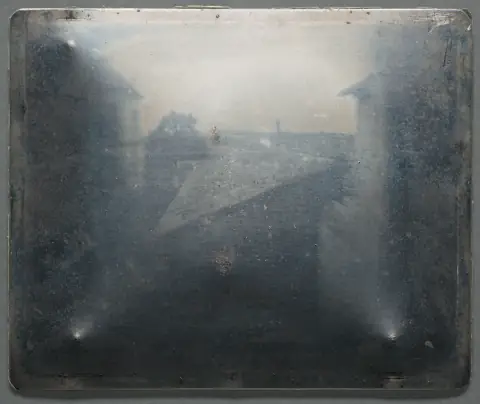
The Harry Ransom Center dates View from the Window at Le Gras to 1827 and identifies it as the earliest surviving photograph made with a camera. Niépce coated a pewter plate with light-sensitive bitumen and exposed the view from his workroom for an estimated several days.80 The main image here is an enhanced reproduction made in 1952, not a direct view of the original's contrast. Compare the plate photograph below. Roofs, outbuildings and foliage are difficult to separate on the reflective metal. The difference between the object and its reproduction is part of understanding this particular photograph.

The actual Niepce pewter plate photographed in raking light in 2020: a shiny gray metal rectangle with the faint image barely visible.
The original pewter plate photographed in 2020, for comparison with the enhanced reproduction above. Wikimedia Commons, public domain.
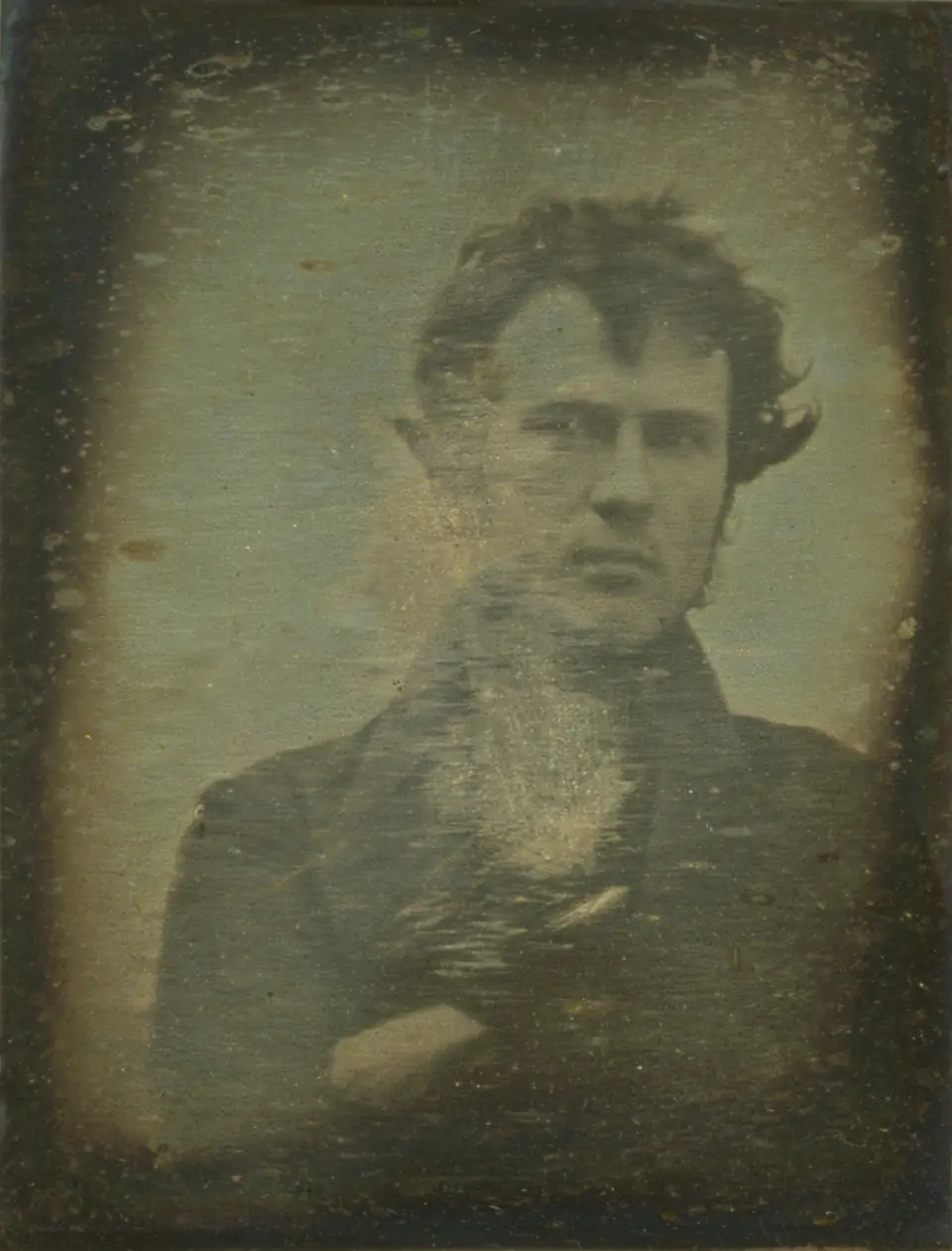
Robert Cornelius in 1839: a young man with windblown hair and crossed arms, looking warily at the camera, slightly off-center.
Robert Cornelius, self-portrait, 1839. Wikimedia Commons / Library of Congress, public domain.

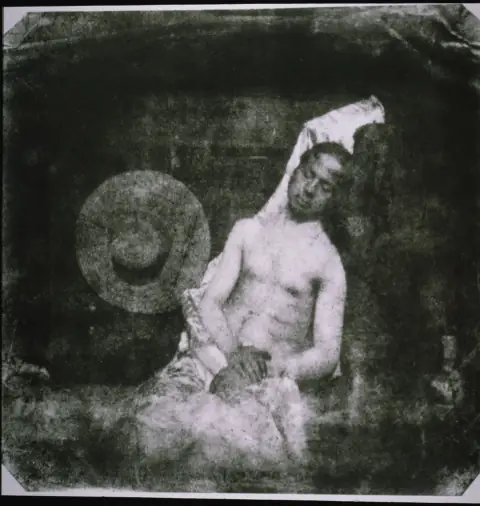
No. 058 · Cornelius and Bayard’s self-portraits

One records a sitting; the other stages a death.

Robert Cornelius made this self-portrait in Philadelphia in 1839. The Library of Congress identifies it as the earliest extant American photographic portrait. He posed for his own daguerreotype during photography’s first public year.81 In 1840, Hippolyte Bayard made Self-Portrait as a Drowned Man and supplied a satirical story about his own supposed death. He was protesting the lack of recognition for his photographic invention.82 His limp pose and closed eyes serve that fiction, while Cornelius faces the lens. Two early self-portraits put their makers before the camera for quite different purposes.

Bayard posing as a drowned man in his staged 1840 self-portrait.
Bayard, "Self Portrait as a Drowned Man," 1840. Commons, public domain.
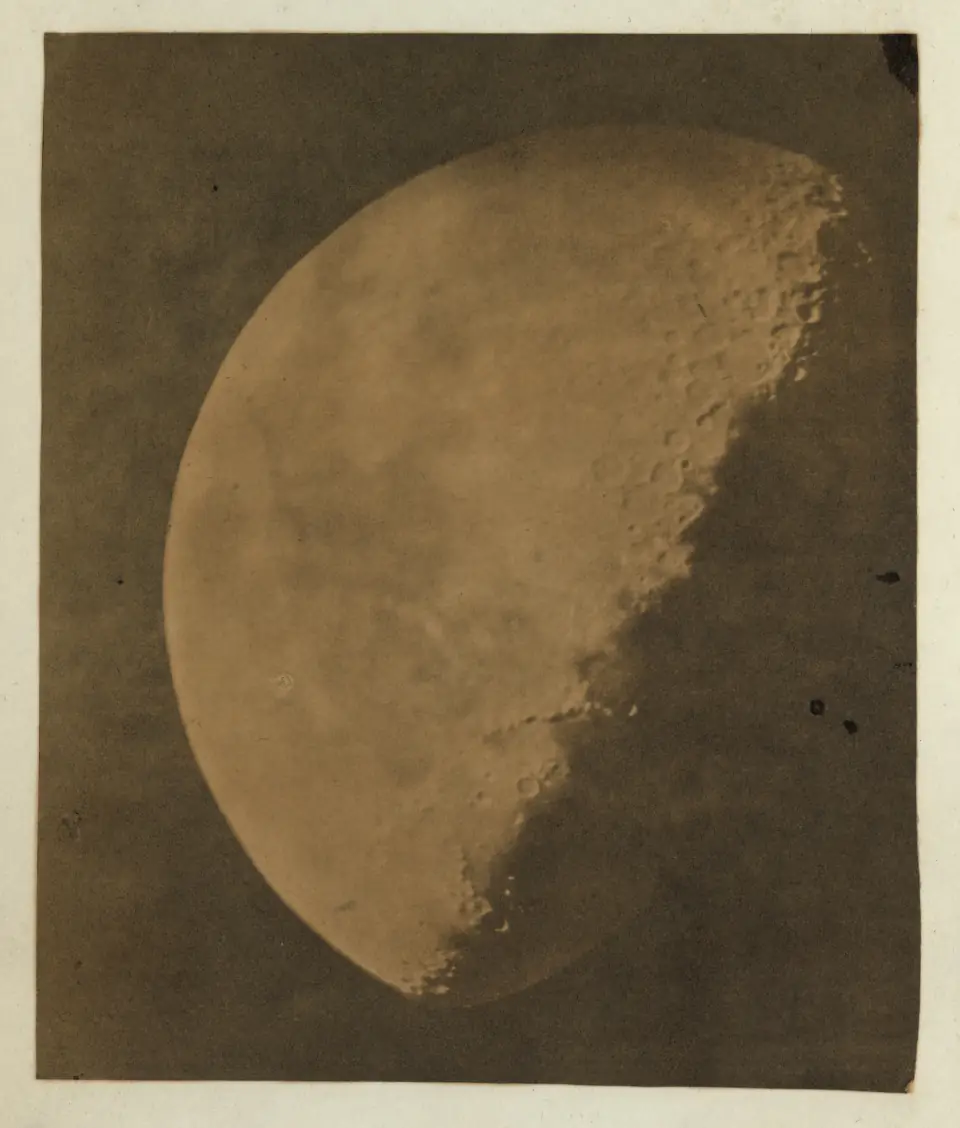
A salted-paper print made after Whipple’s 1851 Moon daguerreotype, with light and dark lunar regions.
John Adams Whipple, the Moon, March 1851. Salted-paper print after a daguerreotype made through Harvard’s Great Refractor. Wikimedia Commons / Library of Congress, public domain.

No. 059 · A telescope records the Moon

Tracking limits the blur during exposure.

John Adams Whipple worked with William and George Bond at Harvard Observatory to photograph the Moon through the Great Refractor in 1851. Tracking kept the telescope aligned during the exposure. The image shown here is a salted-paper print made after a daguerreotype, as the Library of Congress catalogue records.83 Bright and dark regions remain visible across the lunar surface. The apparatus had to gather enough light while keeping the Moon in the intended position, a problem that would remain central to astronomical photography as later detectors and processing methods changed.

The daguerreotype as an object

Plate
A polished, silver-coated copper plate carries a direct positive. Its reflective surface can make the image look positive or negative as the viewing angle changes.84
Development
The original process developed the sensitized plate with heated mercury vapor and then fixed the image.84
Copies
There is no separate negative for making identical paper prints. The plate is a unique object; a photographic reproduction is another image of it.
Fine detail
Microscopy can reveal detail finer than an ordinary scan records. The Cincinnati estimates below concern those plates, not a universal resolution for every daguerreotype.85

Cincinnati, September 24, 1848, at 1:55 in the afternoon

⟷ drag to pan

An eight-plate daguerreotype panorama of the 1848 Cincinnati riverfront: steamboats, warehouses, church spires and hills sweeping across two miles of shoreline.

Charles Fontayne and William Porter made this Cincinnati panorama from Newport, Kentucky, on September 24, 1848. Eight separate daguerreotype plates span the waterfront; their exposures were made in succession.86 The 14,000-by-984-pixel strip here is a reduced digital reproduction, about 13.8 megapixels. Microscopic study of the plates found far finer detail than this file preserves. The Rochester team’s much larger megapixel estimate describes potential plate detail, not the resolution of this displayed scan.85

Charles Fontayne and William Porter, 1848. Wikimedia Commons / Public Library of Cincinnati and Hamilton County, public domain.

ROLL 10 · The machines

Cameras for a wider audience

Lower cost, portability and immediate results changed ordinary photography.

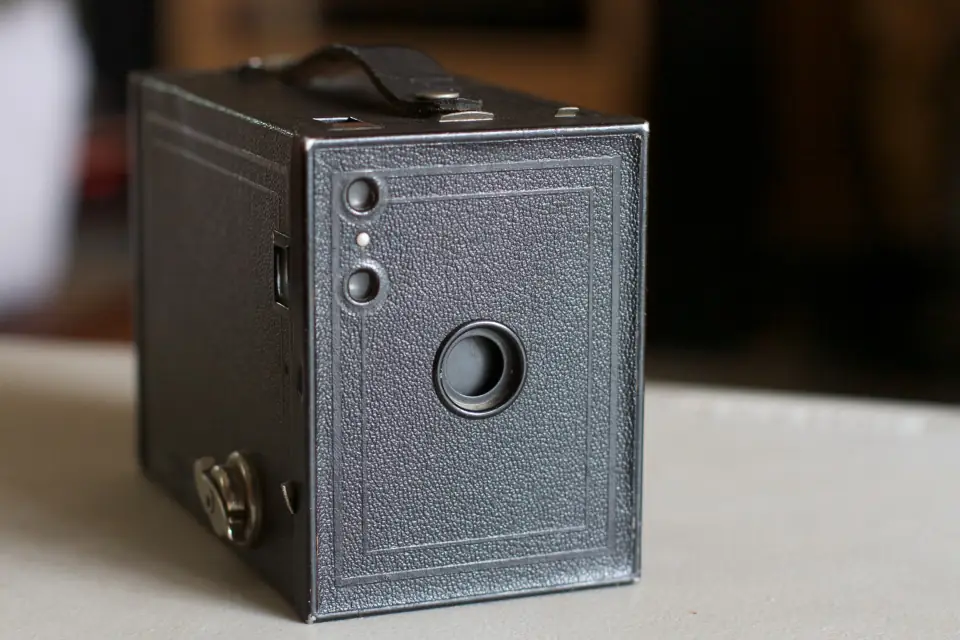
A simple black box Kodak Brownie camera with a small lens, sitting against a plain background.
A later Kodak Brownie box camera. Photograph by Alan Levine (cogdogblog), 2014. Wikimedia Commons, CC0. The original one-dollar Brownie was introduced in 1900.

No. 060 · The Brownie family

An inexpensive box camera widened the audience.

Kodak introduced the original Brownie in 1900 at a price of one dollar. Its simple controls and roll film made photography accessible to more families and children, building on earlier Kodak efforts to separate taking a picture from processing it. The Franklin Institute reports 100,000 sales in the first year.87 The later Brownie pictured here shows the box-camera form: a small lens, a simple housing and little to adjust. Inexpensive apparatus let more people make family photographs without learning the chemical work needed to develop and print them.

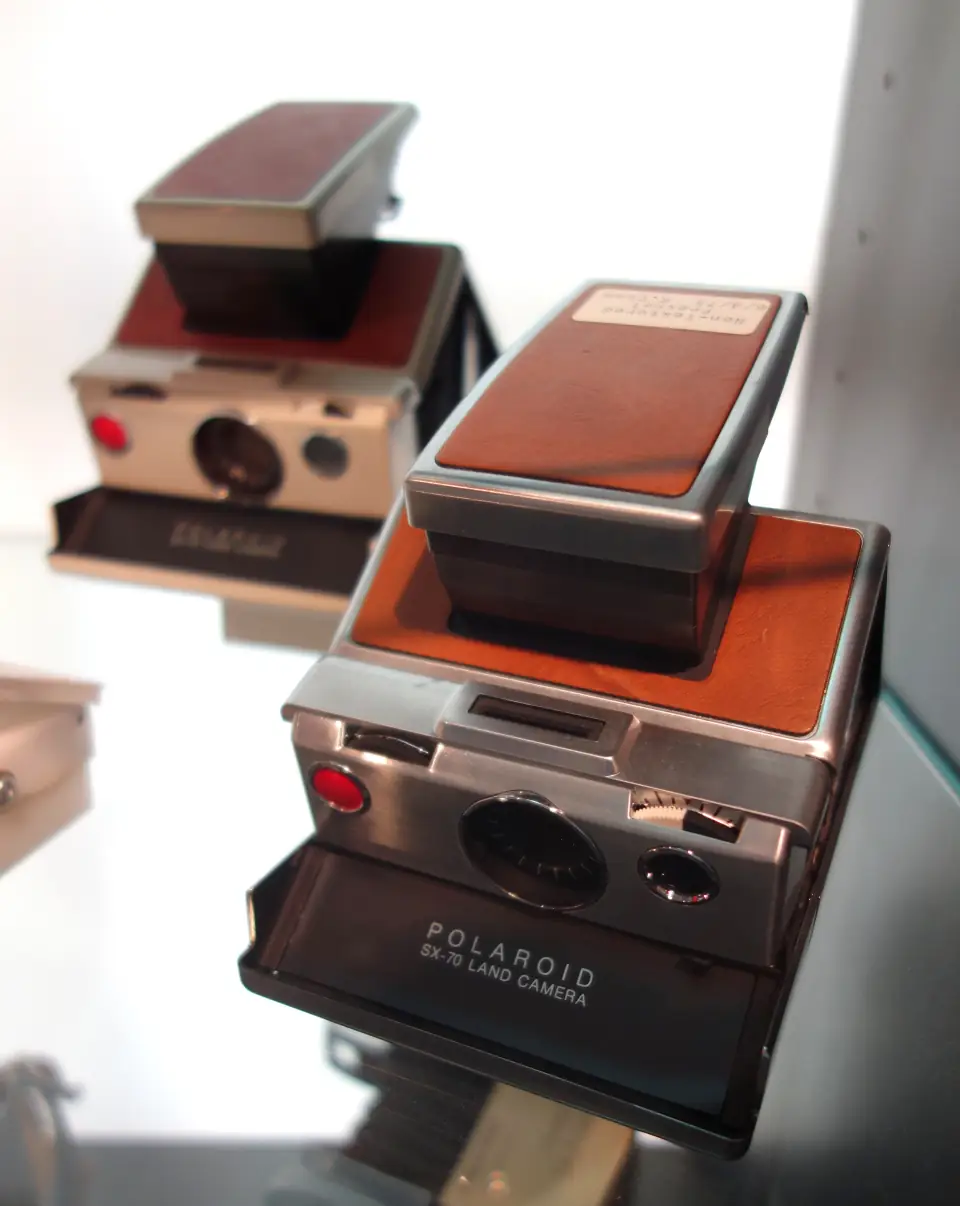
A Polaroid SX-70: the flat folding chrome-and-leather instant camera, opened into its angular shooting position.
A Polaroid SX-70 in the MIT Museum. Photograph by Daderot, 2013. Wikimedia Commons, CC0.

No. 061 · Polaroid’s SX-70

The developing chemistry travels with the print.

Introduced in 1972, the SX-70 folds into a compact package but opens into a single-lens-reflex camera. Its integral film develops outside the camera: chemical layers and an opacifying system protect and process the image as it emerges. The photographer doesn't need a separate darkroom or peel apart the print.88 Ansel Adams worked with Polaroid from 1949 until 1984, testing materials and corresponding with Edwin Land. Harvard's archive documents that relationship. Instant photography could therefore serve both an everyday snapshot and a photographer intensely concerned with control over the finished print.

Notes on portable and digital cameras

Barnack’s 35mm camera

The Ur-Leica and the auctioned prototype are different objects.

UR-LEICA · 1914 · fits in a coat pocket

Oskar Barnack developed the Ur-Leica in 1913 and 1914 around 35mm motion-picture film, using a 24-by-36-millimeter still frame. The Leica I entered production at the end of 1924 and was publicly introduced in 1925. The smaller apparatus made handheld photography more practical.89 Leica 0-series No. 105, sold for EUR 14.4 million in 2022, belonged to the later 1923 experimental series. It was Barnack's personal camera, but it wasn't the original 1914 Ur-Leica.42

Sasson’s 1975 prototype

The camera recorded a small monochrome image to tape.

Kodak engineer Steven Sasson built a self-contained electronic still camera in 1975. A CCD sensor supplied the image data, which the apparatus recorded to cassette tape for later playback.90 This was a camera that could be carried away from a computer, rather than a scanner digitizing an existing print. Sasson continued working on digital imaging, including a later digital SLR prototype.

DEDICATED CAMERAS SHIPPED, WORLDWIDE millions of units · CIPA members 121.5M 62.8M 24.2M 15.2M 7.7M 2010 2013 2016 2019 2023 SELECTED YEARS, 2010 TO 2023 · SMARTPHONE CAMERAS EXCLUDED
Digital-camera shipments by CIPA member companies, selected years from 2010 to 2023. This chart counts camera units shipped, with smartphone cameras excluded.91

No. 062 · Dedicated-camera shipments

Shipments fell sharply, but the chart doesn’t count photographs.

CIPA member shipments of digital cameras fell from about 121.5 million in 2010 to 7.7 million in 2023, a decline of roughly 94 percent. The series includes cameras with built-in lenses and interchangeable-lens bodies; it excludes smartphone cameras.91 These are units shipped, not a count of photographs taken. The chart selects five years from that decline. CIPA’s later totals show shipments rising to about 8.5 million in 2024 and 9.4 million in 2025, so the descending bars should not be read as a prediction of every subsequent year.

ROLL 11 · February 14, 1990

Earth unresolved

Voyager’s camera records a point too small to show a world’s detail.

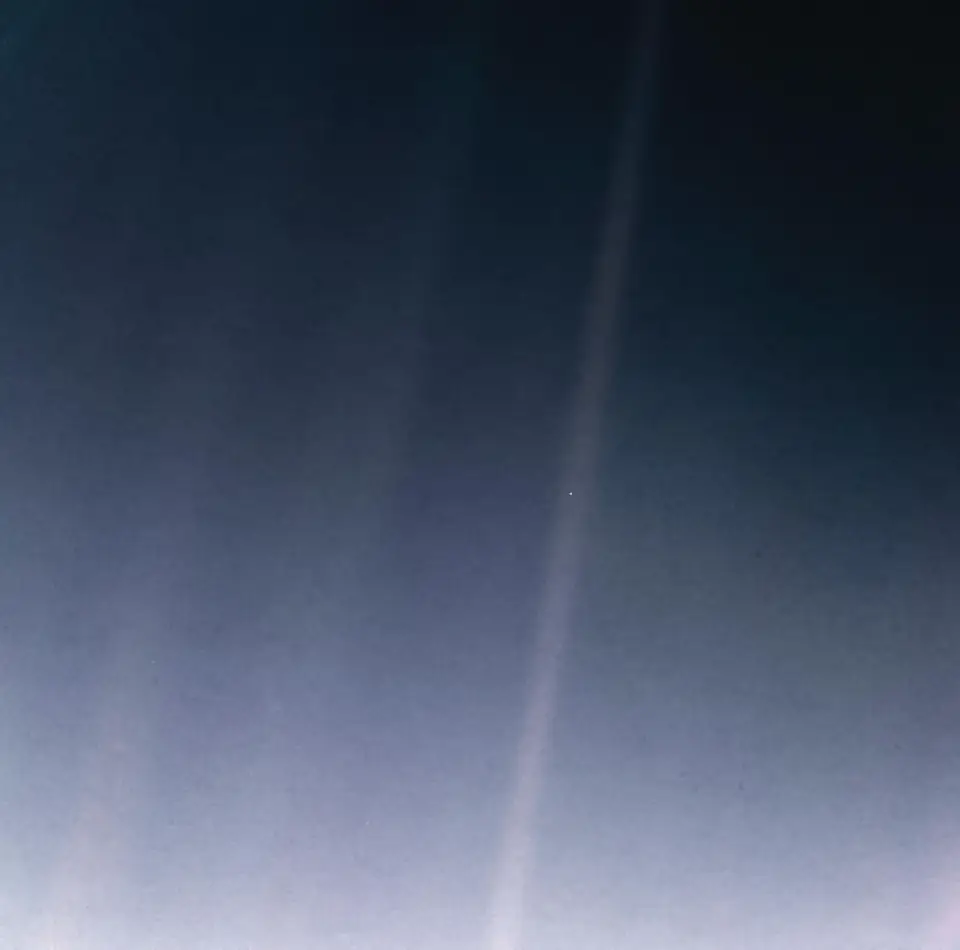
Earth as a small bright point amid bands of sunlight scattered inside Voyager’s camera optics.
Voyager 1, "Pale Blue Dot," February 14, 1990, reprocessed 2020 (PIA23645). NASA/JPL-Caltech, public domain.

No. 063 · Voyager’s distant Earth

The planet is too small for the camera to resolve.

“That's here. That's home. That's us.”Carl Sagan, Pale Blue Dot, 199493

Voyager 1 made its solar-system family portrait on February 14, 1990, before its cameras were turned off. Earth appears as a small bright point. The version shown here was reprocessed in 2020 from the original data, with green, blue and violet filtered exposures assigned to visible color channels.92 Earth’s apparent width was less than one original camera pixel. The enlarged reproduction adds display pixels without resolving continents or people. The diagonal bands come from sunlight scattered inside the camera optics.

Sources and rights notes
  1. Library of Congress, The Horse in Motion, 1878
  2. Université Paris Cité, Marey: photographic motion studies
  3. NASA history, the origins of supersonic aerodynamics
  4. Simon Fraser University Physics, Vapour Cones
  5. A. M. Worthington, A Study of Splashes, 1908
  6. MIT Museum, Milk Drop Coronet and Edgerton collection
  7. MIT News, trillion-frame-per-second reconstruction, 2011
  8. Wang and colleagues, compressed ultrafast spectral photography, 2020
  9. Library of Congress, Prokudin-Gorskii collection and color reconstruction
  10. National Science and Media Museum, the autochrome process
  11. Natural History Museum, Anna Atkins’s photographic book
  12. National Museums Scotland, Maxwell’s color experiments
  13. Harvard Countway Library, Röntgen’s hand image
  14. Franklin Institute, William Jennings’s lightning photographs
  15. NASA, Apollo 8’s Earthrise and the recorded crew conversation
  16. NASA, Apollo 17’s Blue Marble
  17. Hasselblad, cameras used in space
  18. NASA, Photos from STS-41B
  19. NASA, lunar-orbiter film, transmission and recovery
  20. ESA/Hubble, eXtreme Deep Field release, 2012
  21. ESA/Webb, First Deep Field release, 2022
  22. ESA/Webb, Pillars of Creation, 2022
  23. NASA, Andromeda mosaic release, 2025
  24. NASA, the 1946 V-2 photographs
  25. NASA/JPL, The Day the Earth Smiled: acquisition and processing
  26. SLAC, the LSST Camera · Brookhaven, the 2020 assembled focal-plane test
  27. Rubin Observatory, first imagery release, June 2025
  28. NASA/JPL, Perseverance’s 62-image selfie with Ingenuity · NASA, Ingenuity’s first flight, April 19, 2021
  29. ITU-T T.81, JPEG coding specification, 1992
  30. W3C, rationale for PNG’s lossless format
  31. Bryce Bayer, original color-array patent, US3971065A
  32. NASA EPIC, July 2015 lunar transit · NASA Science Planner, 2016: sequential filtered exposures, page 14
  33. Google Research, Night Sight, 2018 · Google Research, Pixel astrophotography, 2019
  34. Guinness World Records, Messi overtakes the egg, December 2022
  35. Christie’s, Le Violon d’Ingres lot and print construction
  36. Christie’s, Man Ray’s 2022 sale result
  37. Christie’s, Rhein II print, dimensions and alterations · Christie’s, Gursky’s 2011 sale result
  38. Simon Baker, The Mammoth Camera of George R. Lawrence, article reprint with archival sources
  39. Library of Congress, San Francisco in Ruins, 1906 · Northwestern University, Lawrence’s kite apparatus and electrical shutter
  40. The Legacy Project, The Great Picture: production facts
  41. Rijksmuseum, 717-gigapixel Night Watch photograph, 2022
  42. Leica, 0-series No. 105 auction result, June 2022
  43. US Copyright Office, Compendium chapter 300, human authorship · Naruto v. Slater, Ninth Circuit opinion, 2018
  44. National Science and Media Museum, the Cottingley photographs
  45. Natural History Museum, the Loch Ness photographic hoax
  46. Wikimedia Commons, source record for the Lincoln-Calhoun composite
  47. NIST, Kirsch’s first digital-image experiment
  48. NASA, Falcon Heavy’s first flight and booster landings
  49. University of Cambridge, Quentin Stafford-Fraser’s coffee-camera account · University of Cambridge, the switch-off image, August 2001
  50. Les Horribles Cernettes, the band’s own photograph history
  51. International Center of Photography, Che: Revolution and Commerce
  52. TIME, O’Rear’s interview about the Windows XP photograph, 2014
  53. Brooke Alexander and Sam Droege, USGS laboratory macro-photography guide
  54. Smithsonian Institution Archives, Bentley’s snowflake photography teaching resource
  55. Louis Boutan, La photographie sous-marine, 1900, pages 204 to 206 · Original book transcription
  56. NOAA Ocean Exploration, the 2016 Casper discovery
  57. National Park Service, Otis and Fat Bear Week 2021
  58. ESO, Beletsky’s Milky Way panorama and credit
  59. The Met, Black’s 1860 Boston balloon photograph
  60. MoMA, Abbott, Levy and the Atget archive
  61. Library of Congress, The Case of the Moved Body
  62. National Portrait Gallery, presidential portrait labels: cracked plate, page 38
  63. National Park Service, Douglass and photographic representation
  64. Library of Congress, Riis and reform · Library of Congress, Riis’s photographic methods
  65. Library of Congress, National Child Labor Committee collection · Library of Congress, Sadie Pfeifer, 1908
  66. Library of Congress Magazine, November/December 2020, page 7: thumb removal and Thompson’s response
  67. National Park Service, the two Iwo Jima flag raisings
  68. US Marine Corps historical account, Rosenthal and Genaust at the second flag raising
  69. MoMA, Cartier-Bresson audio transcript: shooting through the fence
  70. The Maloof Collection, Maier’s biographical and archive account
  71. The Met, Le Gray’s The Great Wave, Sète and combined negatives
  72. Victoria and Albert Museum, Cameron’s working methods
  73. J. Paul Getty Museum, Moonlight: The Pond, negative 1904, photogravure 1906
  74. Ansel Adams, The Negative, chapter 4: zones and print values, original book transcription
  75. National Archives, The Tetons and the Snake River · NASA, photographs encoded on the Voyager Golden Record
  76. Ansel Adams Gallery, the Moonrise exposure account and later prints
  77. National Park Service, Watkins, Yosemite images and the 1864 grant · National Gallery of Art, Grizzly Giant, Mariposa Grove
  78. Gawain Weaver, A Guide to Gelatin Silver Prints, layers and reflected-light viewing
  79. Source daguerreotype reproduction, Boulevard du Temple
  80. Harry Ransom Center, the Niépce heliograph and later reproductions
  81. Library of Congress, Cornelius’s 1839 self-portrait
  82. Getty, Bayard’s drowned-man self-portrait
  83. Library of Congress, salted-paper print after Whipple’s Moon daguerreotype · Middlebury College Museum of Art, Whipple, Bond and lunar tracking
  84. National Portrait Gallery, the daguerreotype process
  85. University of Rochester, estimated detail in the Cincinnati plates
  86. Cincinnati and Hamilton County Public Library, the 1848 panorama
  87. Franklin Institute, the first Brownie and its first-year sales
  88. American Chemical Society, Land and integral instant film · Harvard Library, Adams and Polaroid correspondence, 1949 to 1984
  89. Leica, Ur-Leica, 0-series and Leica I chronology
  90. National Inventors Hall of Fame, Sasson’s 1975 camera
  91. CIPA, historical camera shipment series through 2025
  92. NASA/JPL, Pale Blue Dot Revisited: filters, subpixel Earth and scattered light
  93. The Planetary Society, Sagan’s Pale Blue Dot passage
  94. NASA, Artemis II’s lunar flyby, April 6, 2026
  95. National Archives, the 1916 child-labor law and later federal legislation
  96. Sotheby’s, Steichen’s original gum-over-platinum print and later photogravures

Each photograph retains a link to its source and that source’s stated rights. Public-domain status can depend on jurisdiction; it is not a worldwide permission claim. Commons hosts the Man Ray, Korda and Loch Ness reproductions under the rationales on their file pages. Library of Congress records may say “no known restrictions,” which differs from a copyright guarantee. ESA/Hubble, ESA/Webb, ESO and Rubin imagery retain their institutional credits and CC BY 4.0 attribution. The SpaceX photographs and the modern Brownie and SX-70 photographs are credited as CC0; the illustrative egg is Ren West’s separate CC BY 2.0 photograph. The peacock JPEG demonstration re-encodes the Met’s CC0 autochrome reproduction. Source pages also identify later prints, digital restorations and color reconstructions. Copyrighted works discussed without a reproduction are linked to their museum or publisher.