

Home

Photography's Greatest Hits

Two centuries of pictures people built machines, broke records, and risked their necks to make. Every image here is the real thing, and every one is free to look at as long as you like.

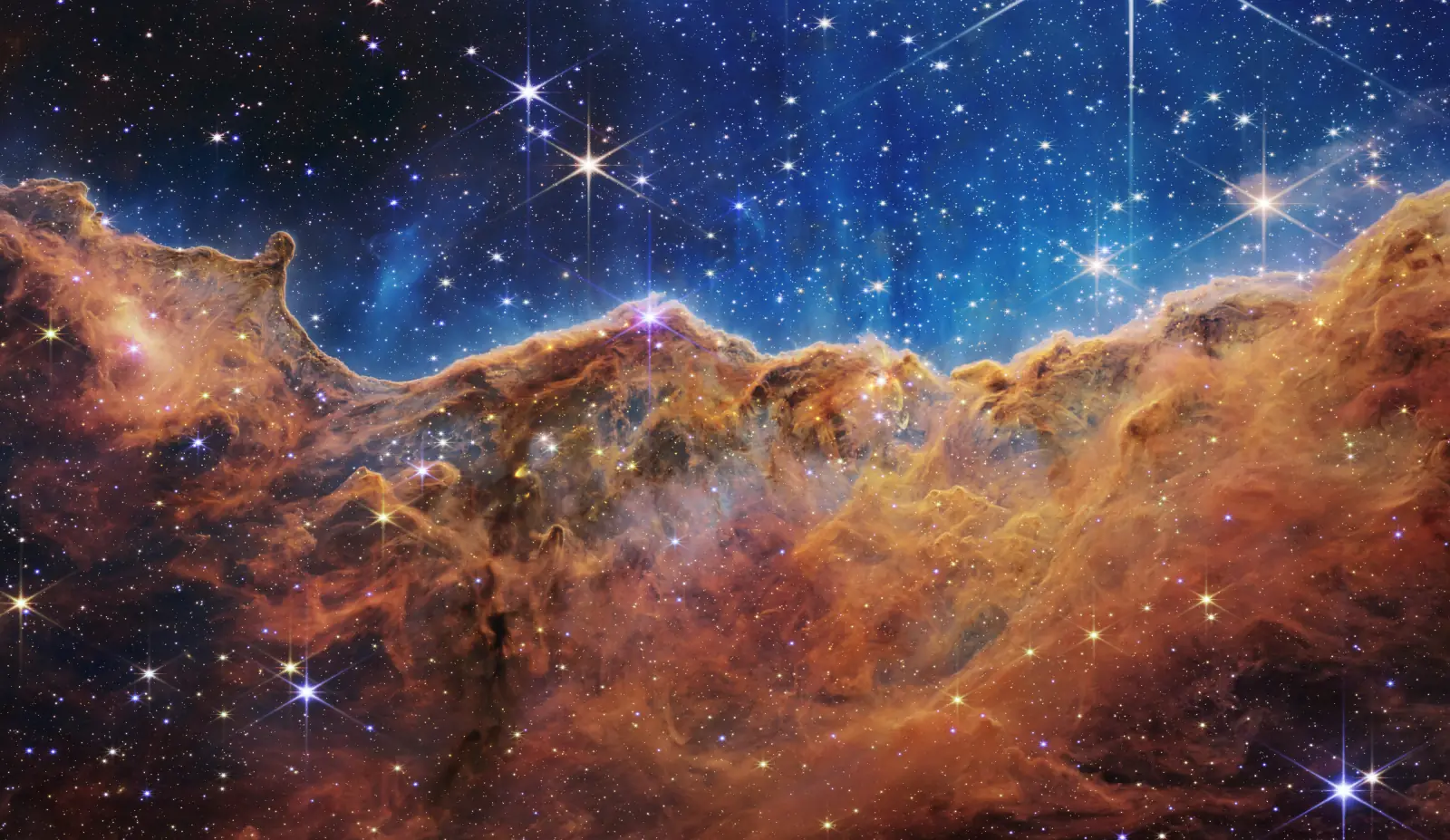
The Cosmic Cliffs of the Carina Nebula photographed by the James Webb Space Telescope: glowing amber mountains of gas under a deep blue starfield.
The Cosmic Cliffs, Carina Nebula. NASA, ESA, CSA, STScI (CC BY 4.0)

The first photograph took days of staring at a French courtyard. Last year humans took about two trillion pictures, most of them in less time than a sneeze. Between those two numbers sits every image in this post: horses frozen mid-flight, a thumb erased from history, galaxies you can drag across your screen, one extremely smug monkey.

House rules. Every photograph on this page is public domain or Creative Commons, license checked, credited and linked under the frame. When an icon is still under copyright (and a lot of the 20th century is), its story gets told in words instead, which is its own kind of fun. Little numbers1 lead to the sources at the bottom. Click any photo to see it big on black.

A note on the hang: this gallery is sorted by wow, not by date. The mud-colored ancestors that started everything get their own small room near the end, once you can see what they grew into. Now dim the lights.

ROLL 01 · 1878 to 2020

Stopping Time

From a galloping mare to light caught mid-flight.

FR 01 / 11
SALLIE GARDNER · 1878 · ~25 FPS

Eadweard Muybridge, "Sallie Gardner at a Gallop," June 19, 1878, Palo Alto. Animated here from the original cabinet card. Wikimedia Commons / Library of Congress, public domain.

No. 001 · The photographs that became the movies

Twelve cameras, one running horse, and the moment painting lost an argument.

For a century, painters drew galloping horses stretched out like rocking horses, all four legs flung wide. Leland Stanford bankrolled Muybridge (no, there was never a documented $25,000 bet, just a railroad baron spending a fortune on a horse question2) to settle it. Muybridge lined the track with twelve cameras triggered by threads; Sallie Gardner ran a mile-in-1:40 pace and photographed herself as she broke each one.3 The card brags that each exposure beat two-thousandths of a second. Yes, horses fly; but only with their legs gathered underneath. Spin the frames and you are watching the birth of cinema, twenty years early.

The footnote that ought to be a miniseries: four years before this, Muybridge shot and killed his wife's lover, said so plainly in court, and a Napa jury acquitted him anyway.4 Then he went back to work.

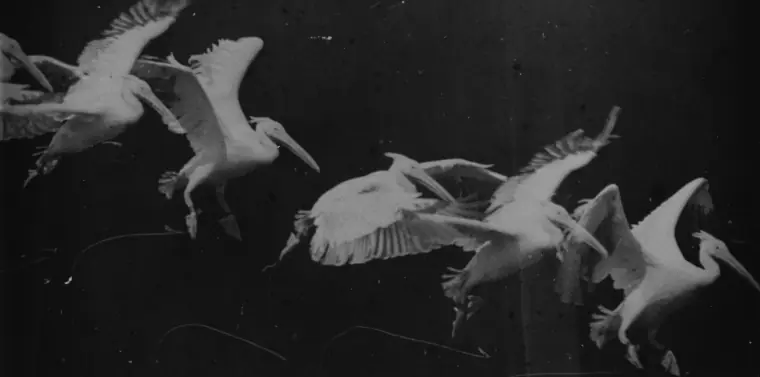
Etienne-Jules Marey chronophotograph: five overlapping ghostly positions of a pelican in flight on one dark plate.
Étienne-Jules Marey, a pelican's wingbeats on a single plate, circa 1882. Wikimedia Commons, public domain.

No. 002 · Chronophotography

The man who shot birds with a camera shaped like a rifle.

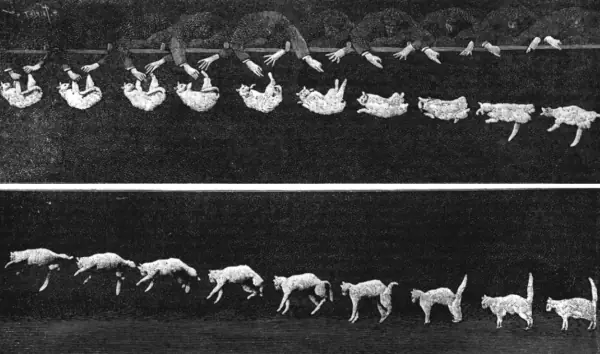
Where Muybridge used twelve cameras, the Paris physiologist Marey used one. His "photographic gun" of 1882 looked exactly like a rifle, tracked flying birds, and fired 12 exposures a second at 1/720th each onto a spinning glass disc.5 Then he went further: every phase of a movement layered onto one plate, a whole flight in a single frame. In 1894 he chronophotographed a falling cat righting itself in midair, a sequence physicists still argue about for fun.5

Marey's 1894 chronophotograph strip of a cat falling and twisting upright frame by frame.
The falling cat, 1894. The cat was fine. Physics was shaken. Commons, public domain.
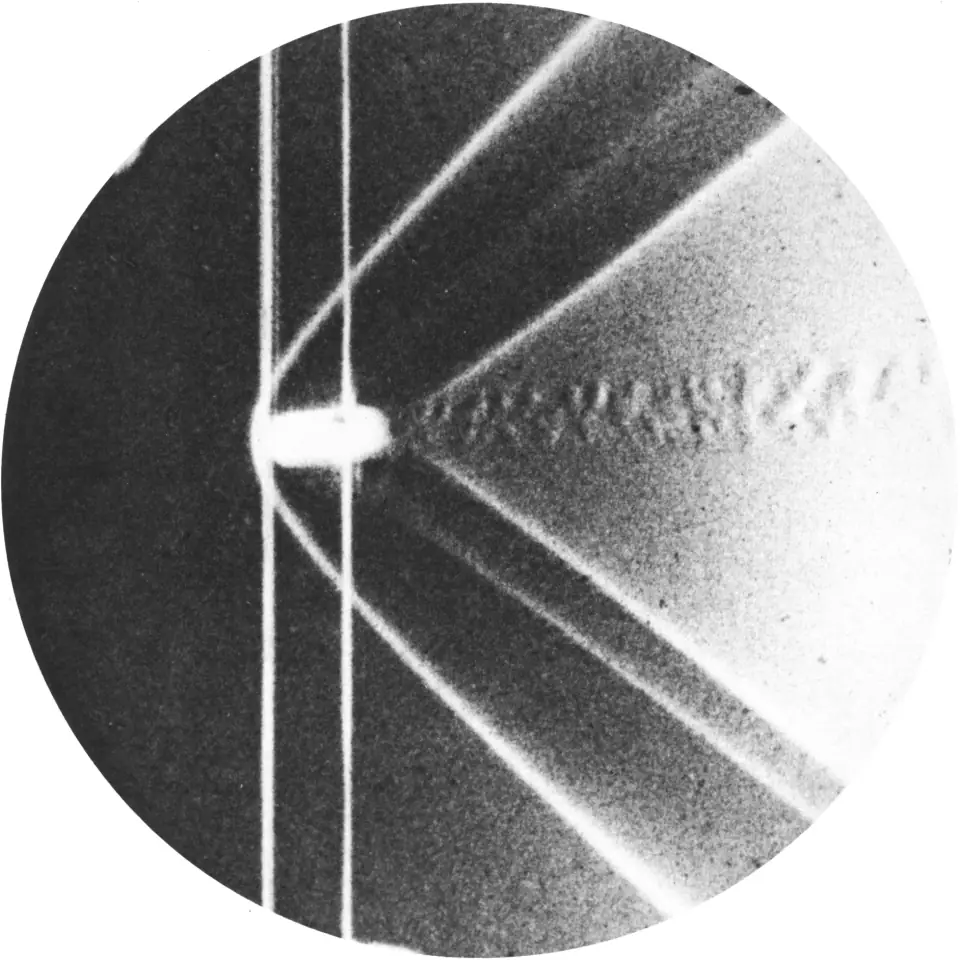
An 1888 shadowgraph of a supersonic bullet: the dark projectile trailing a visible cone-shaped shock wave through the air.
Ernst Mach's 1888 photograph of a brass bullet's bow shock, after Peter Salcher's 1886 firsts. Wikimedia Commons, public domain.

No. 003 · Faster than sound

The bullet took its own picture. The cone got a man's name.

Ernst Mach predicted that anything outrunning sound must drag a cone of compressed air behind it. To photograph one, his collaborator Peter Salcher fired roughly 80 shots through a spark-flash rig in 1886; the bullet itself tripped the spark, and the "shutter" was a flash lasting microseconds.6 There it is: the first shock wave anyone ever saw, the geometry that gave us the Mach number. Every supersonic jet readout traces back to this smudge of 19th-century air.

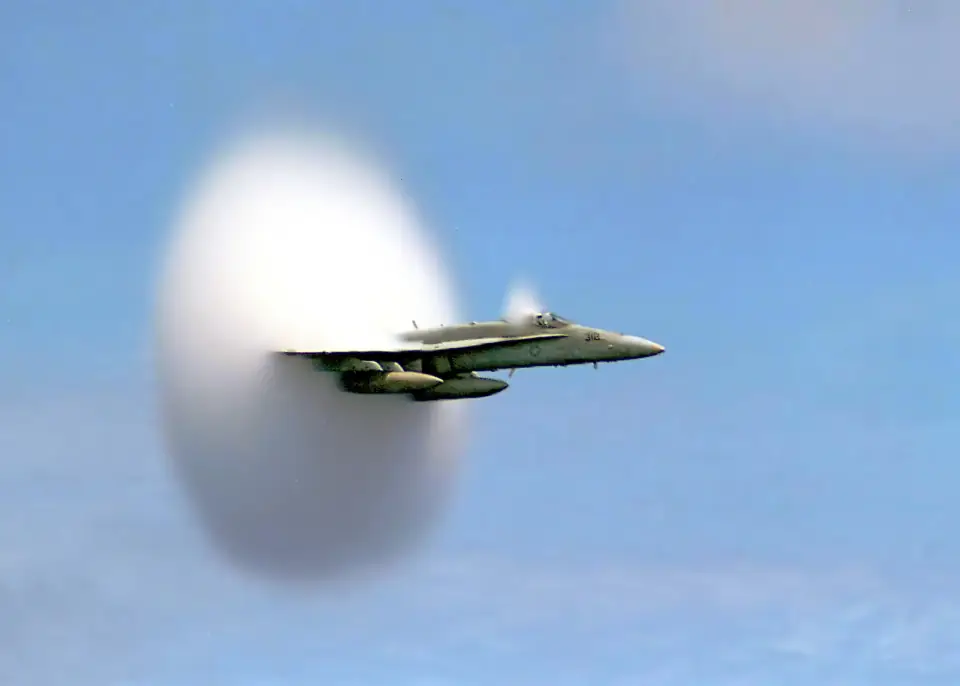
An F/A-18 Hornet skimming low over the ocean, wrapped in a perfect white cone of condensation at the edge of the sound barrier.
Ensign John Gay, US Navy, F/A-18 Hornet at transonic speed over the Pacific, July 7, 1999. Wikimedia Commons, public domain (US Navy).

No. 004 · Mach's physics, wearing a cloud

111 years after the bullet, the cone came back in broad daylight.

July 7, 1999, flight deck of the USS Constellation: Navy photographer John Gay caught an F/A-18 skimming the Pacific right at the edge of the speed of sound, one frame at 1/1,000th of a second.7 The cone is not the sound barrier "snapping." It is the same pressure shell Ernst Mach's spark rig photographed around a bullet in 1888 (above), here squeezing humid sea air until it condenses into a one-second cloud.7 Wire services ran it around the planet; physics classrooms never let it leave. Same cone, 111 years apart, now in daylight and carrying a pilot.

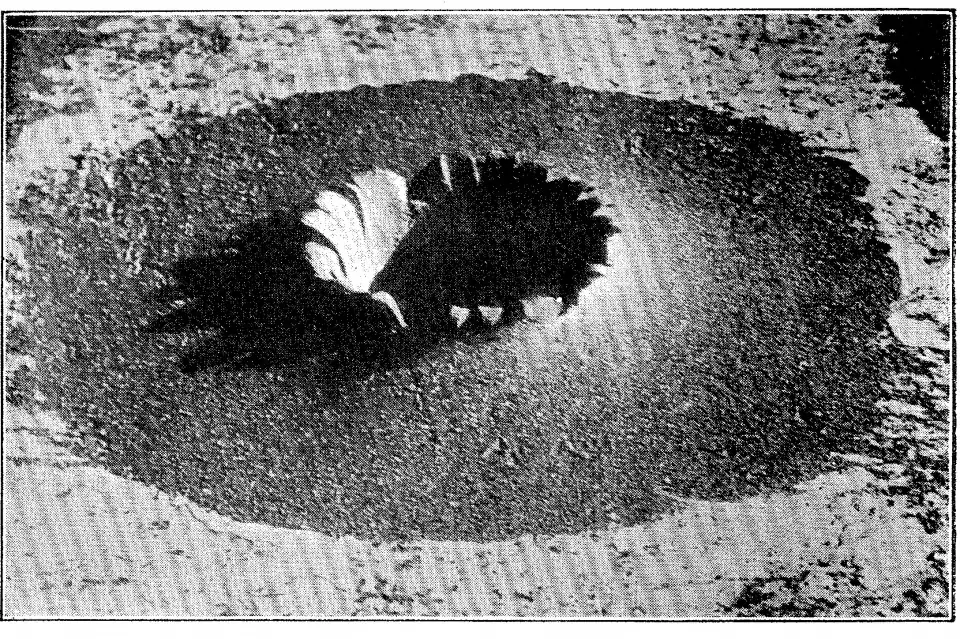
A 1900 spark photograph of a liquid splash: a perfect crater and crown frozen in milk-white liquid.
A. M. Worthington, splash study, 1900, from his spark-flash series. Wikimedia Commons / Biodiversity Heritage Library, no known restrictions.

No. 005 · The honest splash

His camera called his own drawings beautiful liars.

Decades before strobes, physics professor Arthur Worthington froze milk splashes with electric sparks lasting under three-millionths of a second.8 The twist: for twenty years before that, he had drawn splashes from naked-eye glimpses, and his drawings came out perfectly symmetrical. The photographs showed real splashes are lopsided, messy, gloriously irregular. His own camera falsified his own idealized science, and he published anyway.8 That little crown of milk is a monument to admitting it.

Told, not shown · still in copyright

Doc Edgerton freezes a bullet through an apple

MIT's Harold "Doc" Edgerton built strobes flashing for a millionth of a second and spent 25 years perfecting one milk-drop crown ("Milk Drop Coronet," 1957). His 1964 lecture title for the bullet-through-apple photo: "How to Make Applesauce at MIT."9 His rapatronic cameras later photographed nuclear fireballs at 1/100,000,000th of a second from seven miles away, through a lens ten feet long.9 The MIT Museum holds the rights, so the pictures live at the link; they are worth the click.

Images © Harold & Esther Edgerton Foundation / MIT Museum.

Told, not shown · the current record

Filming light itself in slow motion

In 2011 an MIT team built a camera system with an effective rate of one trillion frames per second and filmed a laser pulse traveling through a soda bottle, light sloshing down the bottle like water.10 The catch: capturing that nanosecond of footage took about an hour of perfectly repeated pulses, which the lead researcher cheerfully called "the world's slowest fastest camera." Caltech's CUSP camera has since hit 70 trillion frames per second, in a single shot.11 Muybridge needed a horse and tripwires; we now strobe individual moments of light.

Footage © MIT Media Lab / Caltech.

ROLL 02 · 1843 to 1913

New Kinds of Light

Prussian blue, potato starch, and the inside of a hand.

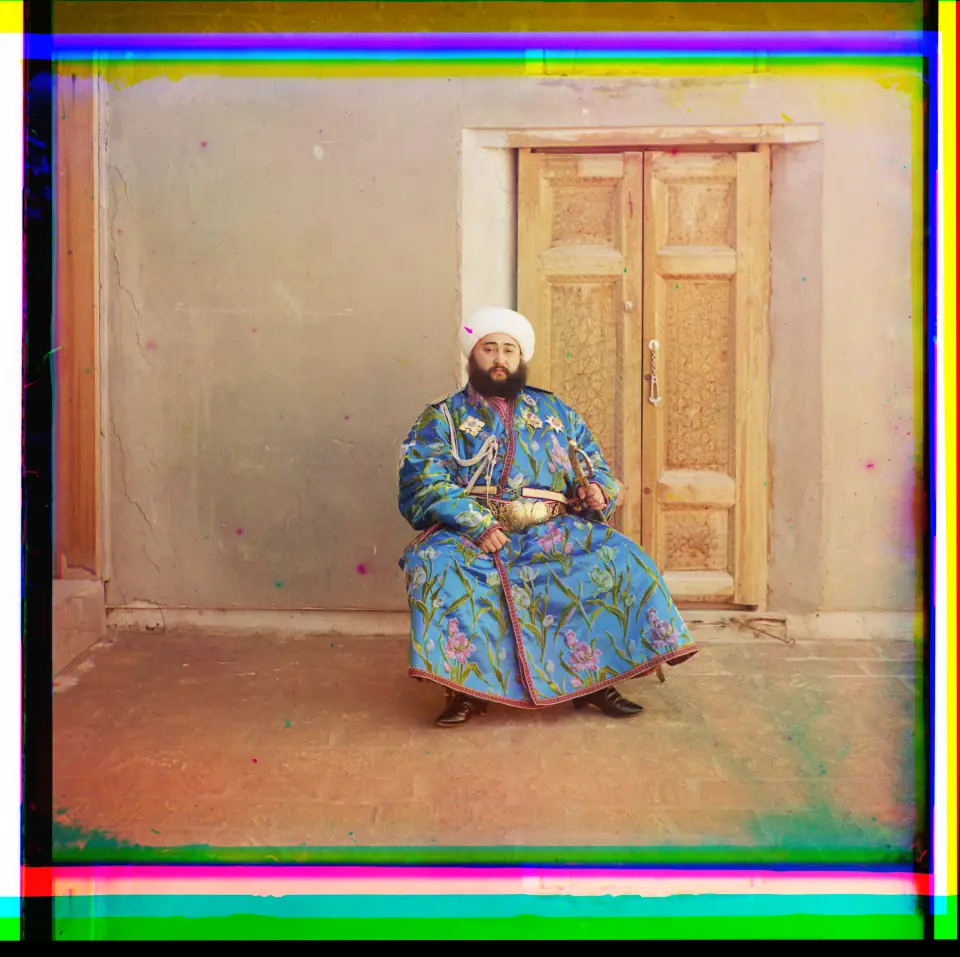
The Emir of Bukhara in 1911, in full color: a bearded man in a brilliant blue silk robe with a gold belt, rainbow fringes at the photo's edges.
Sergei Prokudin-Gorskii, Emir Alim Khan of Bukhara, 1911. Digital color composite by the Library of Congress. LOC, no known restrictions.

No. 006 · Color before color film

1911, in color so good it looks like a costume drama. The fringes are the receipts.

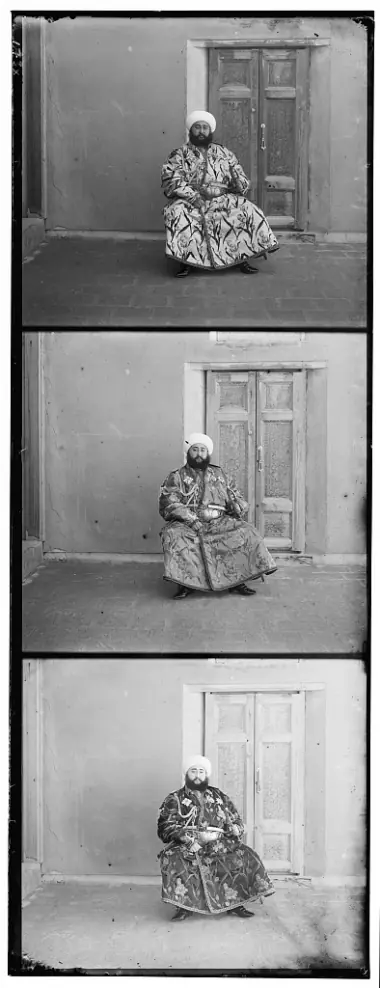
The Tsar gave Prokudin-Gorskii a railroad car with a built-in darkroom and permission to photograph the whole Russian Empire.12 His camera shot three black-and-white plates in quick succession through red, green and blue filters; stack them and 1911 turns to color, silk robe and all. The rainbow edges of the frame are where the three plates did not perfectly agree, the seams of the trick left showing. The Library of Congress bought the surviving 1,902 negatives from his heirs in Paris in 1948 and now composites them for anyone to use.12 The Emir fled the Soviets nine years after this exposure; the robe outlived the throne.

The raw glass plate: three vertical black-and-white frames of the same Emir, one per color filter.
The actual plate: same Emir, three times, one frame per color. LOC, no known restrictions.
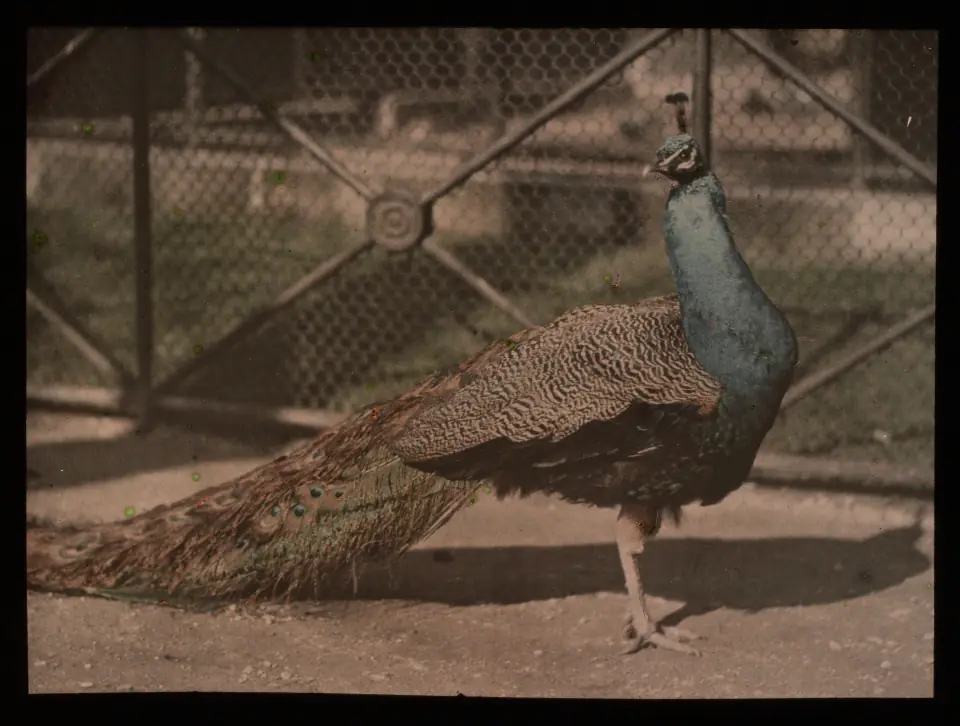
A Lumiere autochrome of a peacock, its blue-green plumage shimmering in soft pointillist grain.
Auguste and Louis Lumière, "Peacock," autochrome, circa 1907. The Met. Via Wikimedia Commons, CC0 (Met Open Access).

No. 007 · Color for everyone, via potato

The first color film was a mosaic of dyed potato starch.

The Lumière brothers, fresh from inventing cinema, commercialized color in 1907 with the autochrome: a glass plate dusted with millions of microscopic potato-starch grains dyed orange, green and violet, each grain a tiny color filter.13 The result shimmers like pointillism because it literally is pointillism, done by starch. This peacock is the inventors' own plate. The most famous autochromes of all, Mervyn O'Gorman's 1913 portraits of "Christina" in a scarlet swimsuit at Lulworth Cove, are still locked in a UK collection until the copyright clock runs out; see them at the V&A, and know that the red was chosen because autochromes loved red.13

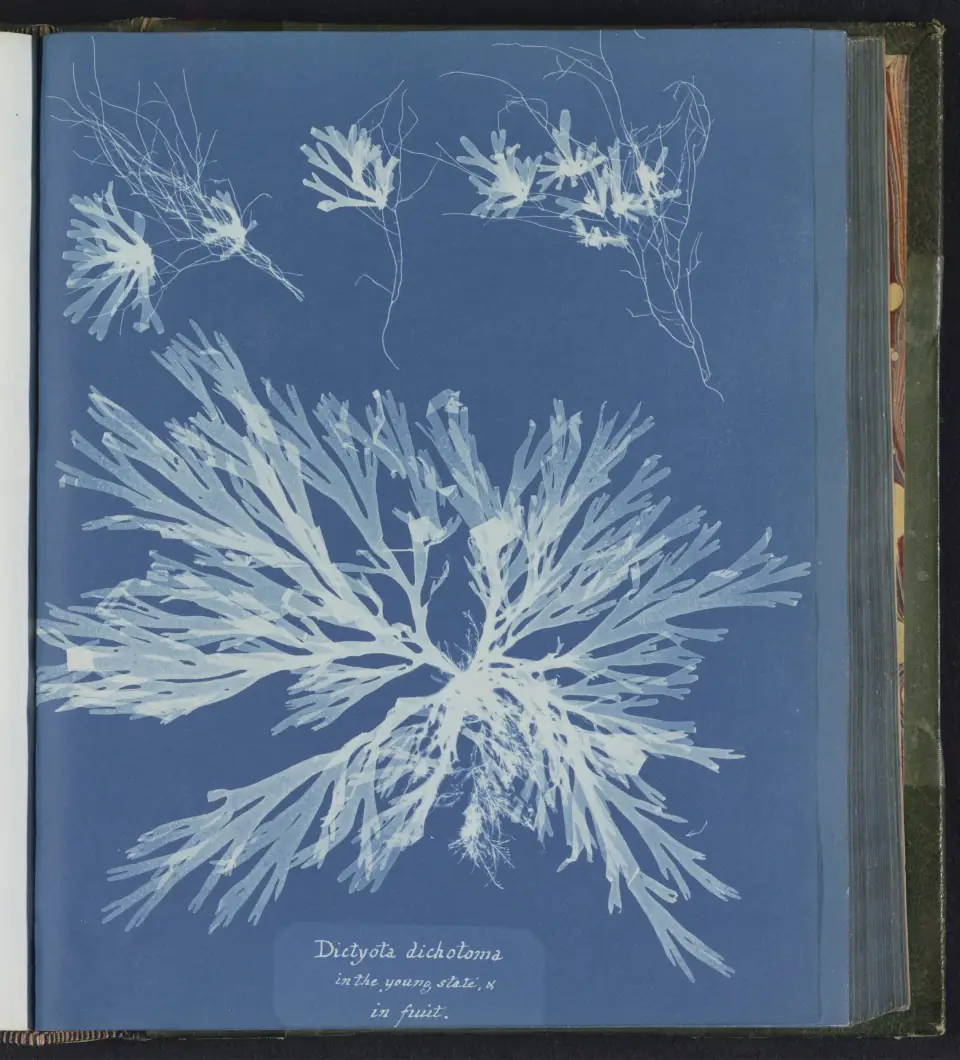
An 1843 cyanotype by Anna Atkins: pale ghostly seaweed fronds glowing white against deep Prussian blue.
Anna Atkins, Dictyota dichotoma, from "Photographs of British Algae," 1843 to 1853. Rijksmuseum. Wikimedia Commons, CC0.

No. 008 · The first book of photographs

The first photo book has no camera in it anywhere.

In October 1843, eight months before the famous men got theirs out, Anna Atkins published the first book ever illustrated with photographs.14 Her method needed no camera: lay wet seaweed straight onto paper soaked in iron salts, let the sun print it, rinse to that impossible Prussian blue. Even the title page and the captions are photograms of her own handwriting, sunlight tracing her pen. Botanists got reference plates; everyone since gets the blue. The cyanotype process survives today as the architect's "blueprint," which means the first photo book and your house plans are cousins.14

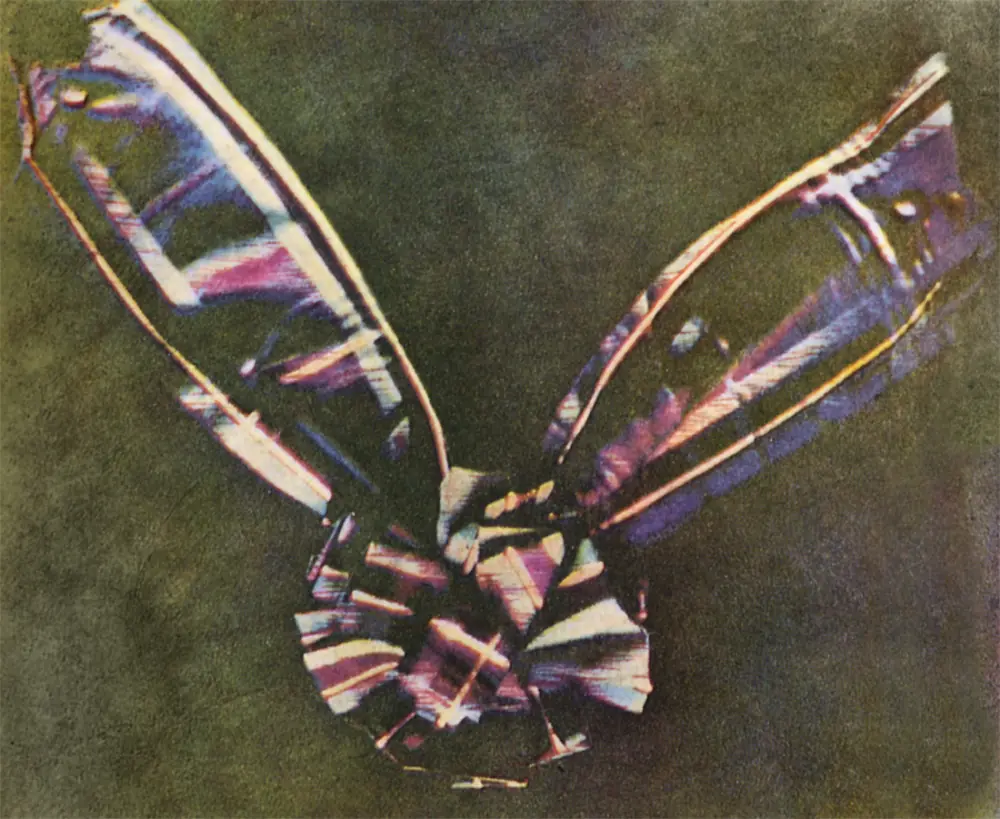
The 1861 tartan ribbon photograph: a blurry but unmistakably colorful bow of red, green and blue plaid, the first color photograph.
James Clerk Maxwell and Thomas Sutton, the tartan ribbon, May 17, 1861. Wikimedia Commons, public domain.

No. 009 · The first color photograph

It should have failed. It worked by accident, and your screen still uses the idea.

To prove human vision mixes three primaries, Maxwell had a ribbon photographed three times, through red, green and blue filters, then projected the three plates back through the same filters. Color appeared. Every screen you own is still doing exactly this, 160 years later.15 The delicious part: 1861 plates were essentially blind to red light, so the demo should have flopped. A century later, Kodak researchers figured out the red dyes also reflected ultraviolet, which leaked through the red filter and landed in the right place anyway.15 The first color photograph is partly an ultraviolet photograph wearing a red costume.

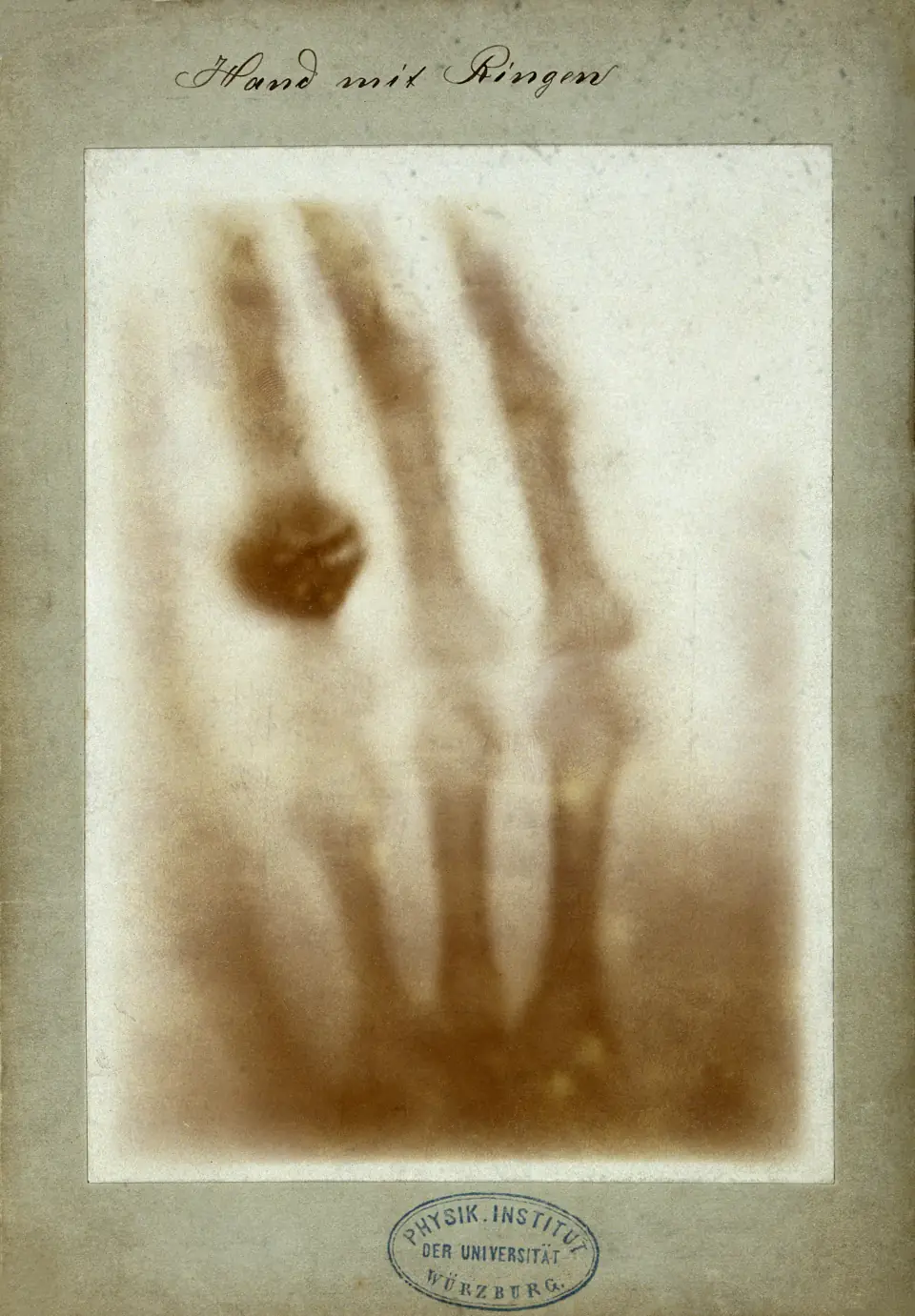
The first medical X-ray, 1895: the bones of a hand with two dark rings floating around the shadow of a finger.
Wilhelm Röntgen, the hand of Anna Bertha Ludwig, December 22, 1895. Wikimedia Commons, public domain.

No. 010 · Light nobody can see

"I have seen my death."

Six weeks after stumbling onto X-rays, Röntgen had his wife rest her hand on a photographic plate for fifteen minutes. The print showed her finger bones and her two rings hanging on a shadow of flesh. Anna Bertha looked at her own skeleton and said, "Ich habe meinen Tod gesehen", I have seen my death, and reportedly never entered the lab again.16 Röntgen mailed prints to colleagues on New Year's Day; within weeks the world was queueing to be photographed from the inside. He refused to patent any of it and gave his first-ever Nobel Prize money away.16

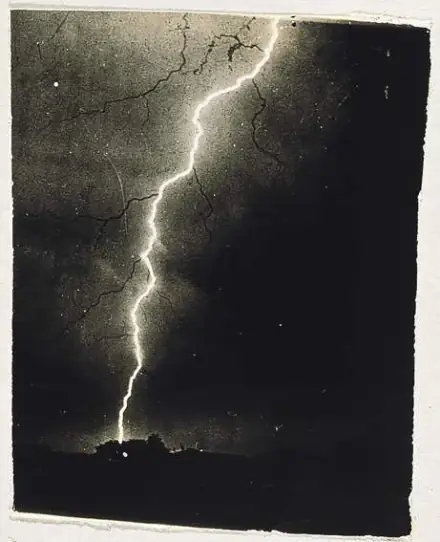
An 1882 photograph of a branching lightning bolt over Philadelphia rooftops.
Bonus new light: William Jennings catches lightning, 1882, and proves painters had drawn it wrong for centuries (real bolts branch like rivers, not zigzags). Commons, public domain.17
ROLL 03 · 1946 to 2022

The Void

Cameras leave Earth and keep looking back.

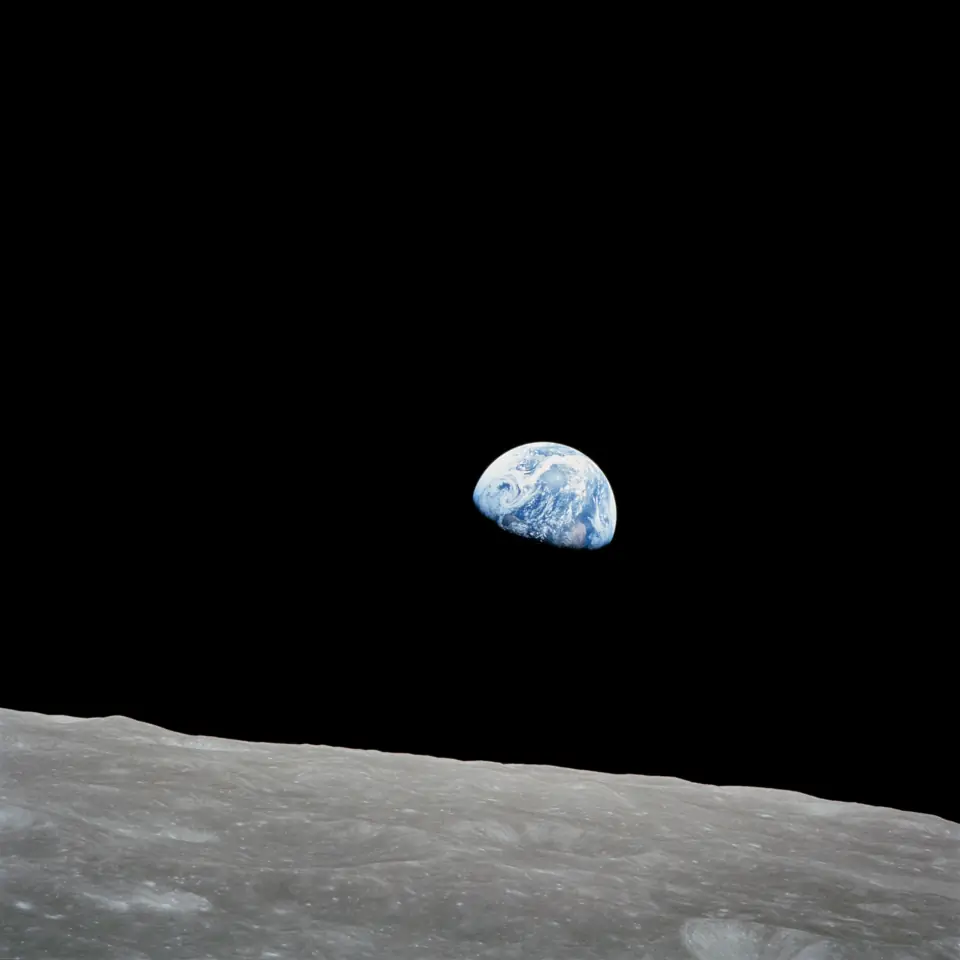
Earthrise: the blue and white Earth rising over the gray lunar horizon, photographed from Apollo 8.
Bill Anders, "Earthrise," Apollo 8, December 24, 1968 (AS08-14-2383). NASA, public domain.

No. 011 · The picture that started Earth Day

They went to photograph the Moon. The Moon was upstaged.

Three orbits in, the spacecraft happened to roll, the Earth swung into a window, and the flight plan briefly lost control of the crew18:

Anders: "Oh my God! Look at that picture over there! There's the Earth coming up. Wow, that's pretty."
Borman: "Hey, don't take that, it's not scheduled."
Anders: "You got a color film, Jim? Hand me that roll of color, quick, would you..."Apollo 8 onboard tape, December 24, 196818

Anders got the color magazine loaded in time: 1/250th at f/11. The nature photographer Galen Rowell later called it "the most influential environmental photograph ever taken."19 Eighteen months later, the first Earth Day. Nobody plans the good ones; you just have the film ready.

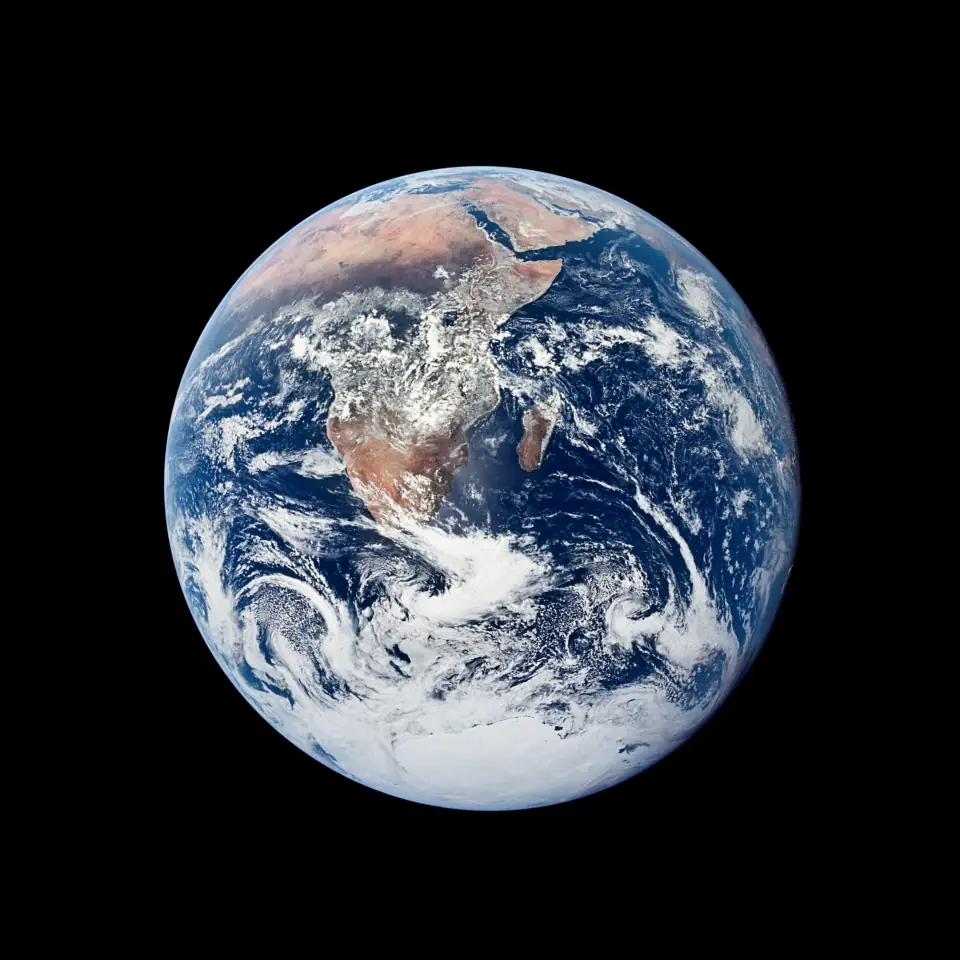
The Blue Marble: the full sunlit disk of Earth showing Africa, Arabia and Antarctica against black space.
The Blue Marble, Apollo 17, December 7, 1972 (AS17-148-22727). NASA, public domain.

No. 012 · The whole thing, once

No human has been far enough to retake this photo since 1972.

Five hours after launch, about 29,000 kilometers out, the Apollo 17 crew caught the only kind of Earth portrait that still cannot be repeated: the entire disk, fully lit, one frame, by hand.20 Every full-Earth image since has been a robot's mosaic or a satellite's composite, because no person has left low Earth orbit in over fifty years. All three astronauts claimed the shutter; the evidence leans toward geologist Harrison Schmitt.20 NASA calls it one of the most reproduced images in history, and for a while it was the default photo of home for the entire species.

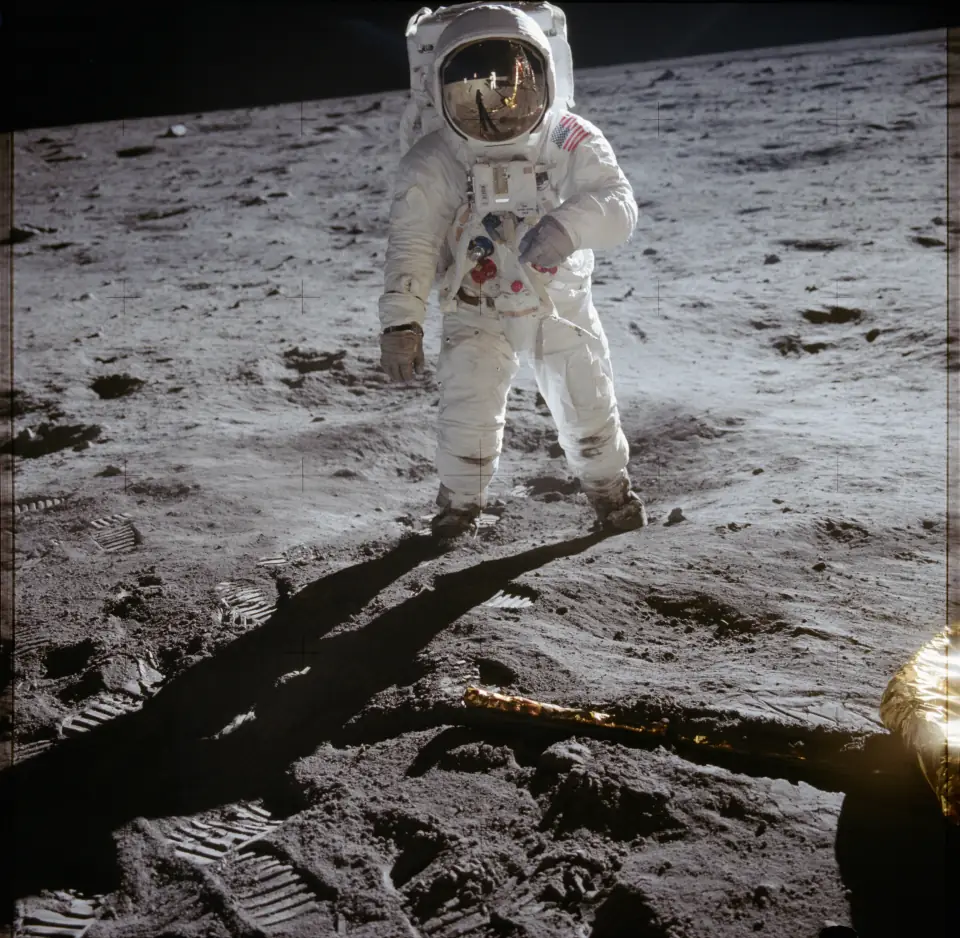
Buzz Aldrin standing on the Moon, Neil Armstrong and the lunar module reflected in his gold visor.
Neil Armstrong, Buzz Aldrin on the Sea of Tranquility, July 1969 (AS11-40-5903). NASA, public domain.

No. 013 · The visor portrait

The photographer is in the picture. So is everything else on the Moon.

Armstrong took almost every still on the surface, so he is barely in any of them, except here, where he lives in Aldrin's gold visor along with the lander and the entire scene, a 360-degree photograph smuggled inside a portrait.21 The camera was a Hasselblad bolted to Aldrin's chest with no viewfinder at all; you aimed by faith. Note the small crosses printed on the frame: a built-in measuring grid, photogrammetry's fingerprints.

Field notes · the moon Hasselblads

Body
Hasselblad 500EL "Data Camera," silver-finished for the minus 65 to plus 120°C swings.21
Aiming
no viewfinder. Chest-mounted. Practice and prayer.
Still up there
12 camera bodies were left on the Moon across the six landings to save weight for rock samples. Only the film magazines came home.21
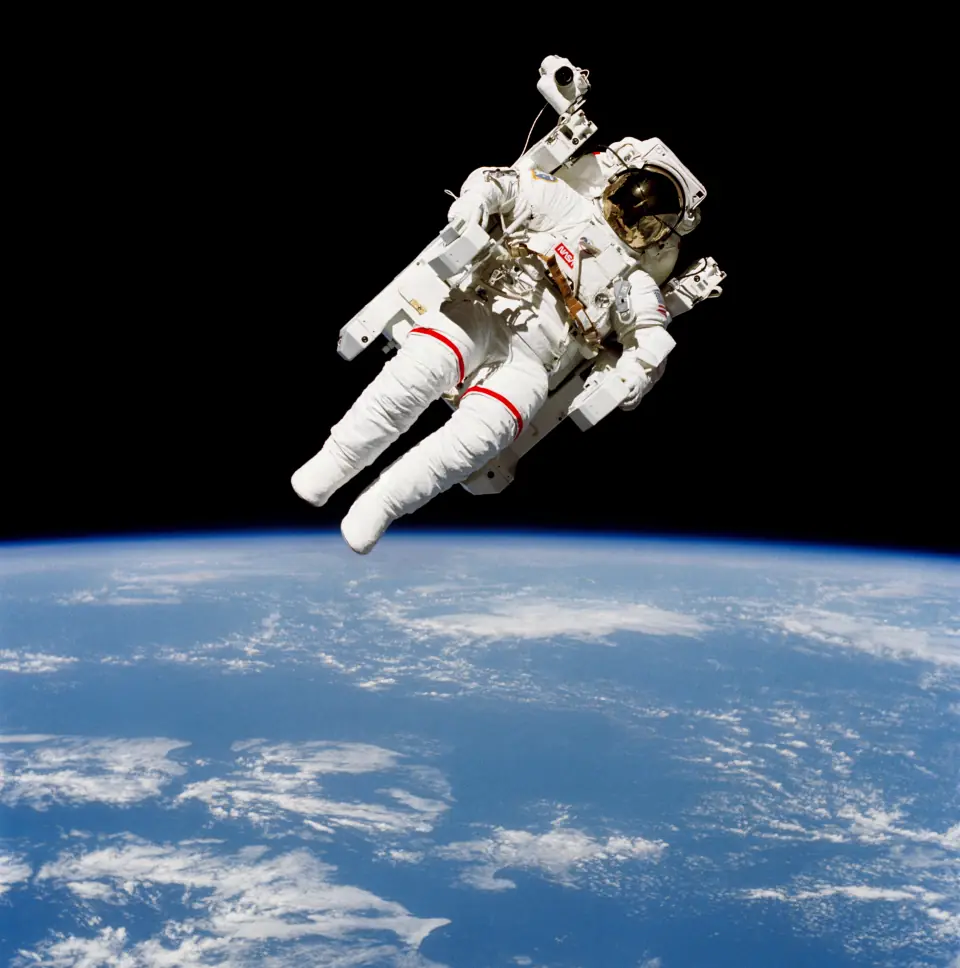
Bruce McCandless floating utterly alone in black space above the blue Earth, in a white suit with a jetpack, no tether.
Bruce McCandless II, first untethered spacewalk, STS-41-B, February 7, 1984. NASA, public domain.

No. 014 · The loneliest portrait

320 feet from the ship, nothing attached to anything.

The first human to float free in space, riding a nitrogen-thruster armchair, drifted out 320 feet from Challenger while a crewmate photographed him from the cabin.22 McCandless knew exactly what he was doing to history's most famous one-liner, radioing: "It may have been one small step for Neil, but it's a heck of a big leap for me."22 He later said the line was partly to calm his wife. It is the rare great photograph whose subject, suit, camera and entire visible universe are all government work, which is why it hangs here free.

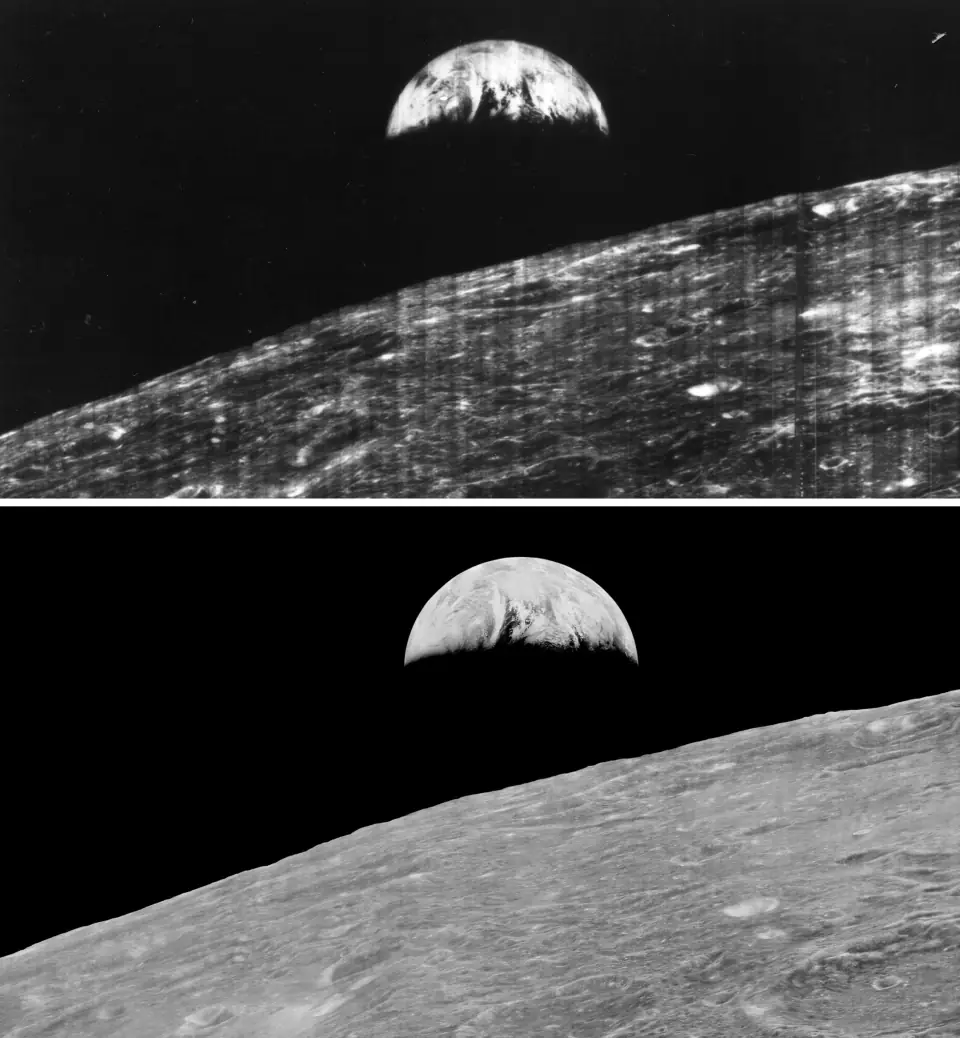
Two versions of the 1966 first Earth-from-Moon photo stacked: the blurry stripey 1966 reconstruction above, the crisp 2008 restored version below.
Lunar Orbiter 1's Earth, August 23, 1966: the 1966 reconstruction (top) versus the 2008 tape-recovery restoration (bottom). NASA / LOIRP, public domain.

No. 015 · Restored in an abandoned McDonald's

The better version waited 42 years inside obsolete tape.

Two years before Apollo 8, a robot caught Earth over the Moon's limb first, but 1966 ground equipment could not pull the full detail off the telemetry tapes. The tapes survived: 1,500 reels, stored for decades, finally hauled to a shuttered McDonald's on NASA Ames property that volunteers renamed "McMoon's."23 They resurrected the last working FR-900 tape drives on Earth (head refurbishment by the one shop left that could), and in 2008 out came this: a 1966 photograph at 2008 fidelity, sharper than anyone alive had ever seen it.23 Burgers to gigabytes, same kitchen.

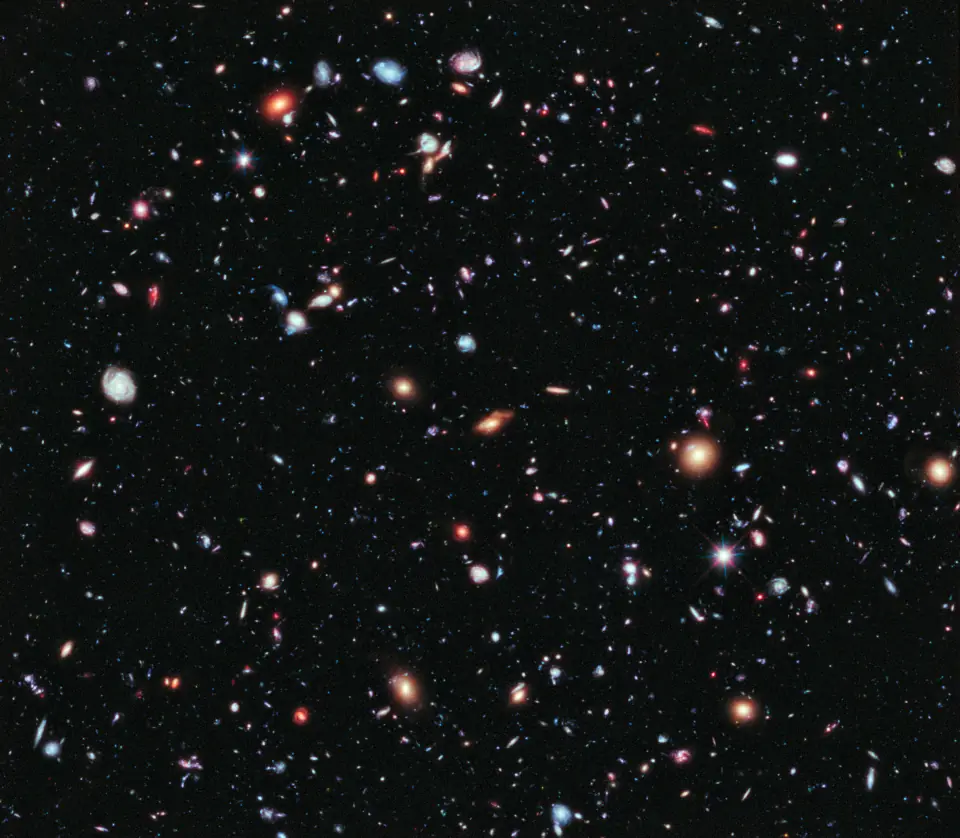
The Hubble eXtreme Deep Field: thousands of galaxies of every color and shape scattered across blackness.
The Hubble eXtreme Deep Field, 2012. NASA, ESA, G. Illingworth, D. Magee, and P. Oesch (UCSC), R. Bouwens (Leiden) and the HUDF09 Team, CC BY 4.0.

No. 016 · The deepest photograph

He pointed the world's telescope at nothing. He offered to resign if it flopped.

In 1995, Hubble's director Bob Williams spent his personal allocation of telescope time staring at a deliberately empty speck of sky for ten straight days over Christmas: 342 exposures of, supposedly, nothing. Colleagues warned it would be an embarrassment. His answer, later: "Scientific discovery requires risk. If it's that bad, I'll resign."24 The nothing contained three thousand galaxies. This frame is the upgraded sequel, the eXtreme Deep Field: 23 days of stacked exposure on 1/32,000,000th of the sky, about 5,500 galaxies, the faintest at one ten-billionth of what your eye can see.25 Hold a grain of sand at arm's length; that is the window. Now multiply by the whole sky.

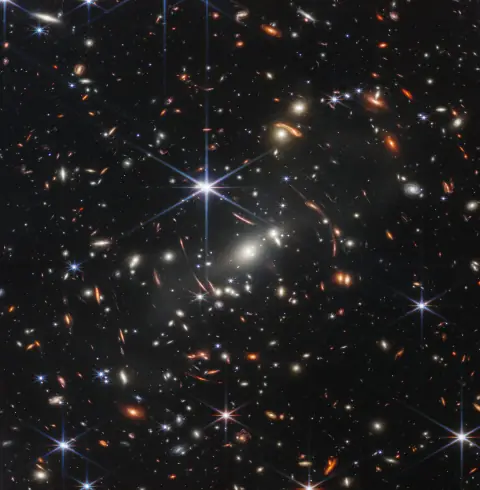
Webb's First Deep Field: a dense cluster of galaxies with gravitationally lensed arcs of light bent around it.
Webb's First Deep Field (2022): 12.5 hours of exposure going deeper in infrared than Hubble's weeks; the arcs are galaxies bent around a cluster's gravity. NASA, ESA, CSA, STScI, CC BY 4.0.26
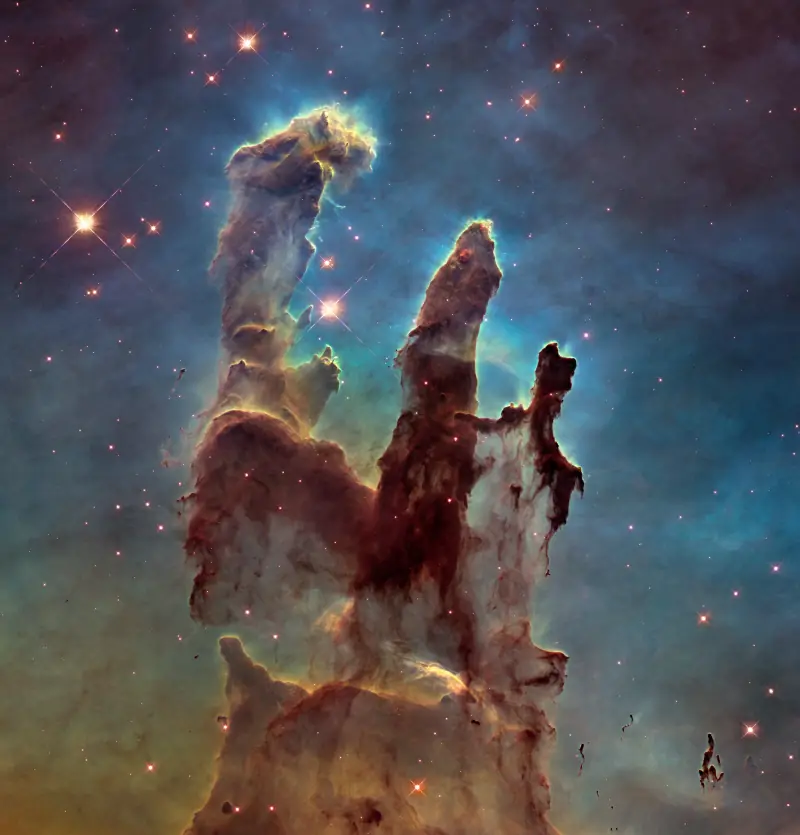
The Pillars of Creation seen by the James Webb Space Telescope: sharp rust-red columns of gas crowded with stars. The Pillars of Creation seen by Hubble: towering green-brown columns of gas against a teal glow. Hubble · visible light JWST · infrared
The Pillars of Creation, Eagle Nebula. Left of the handle: Hubble's 2014 visible-light view (NASA, ESA/Hubble and the Hubble Heritage Team). Right: JWST's 2022 infrared view (NASA, ESA, CSA, STScI; J. DePasquale, A. Koekemoer, A. Pagan). Both CC BY 4.0, framed to match by STScI.

No. 017 · Same pillars, new eyes

Drag the line and watch dust become stars.

The pillars are columns of gas in the Eagle Nebula, around 6,500 light-years out, the tallest several light-years high.27 Hubble sees the dust; Webb's infrared sees through it, to the newborn stars inside. Fun panic from 2007: a study suggested a supernova shockwave had already destroyed the pillars and we were watching ghosts. Later observations found no supernova remnant and erosion so slow the pillars should outlast everyone reading this by about 100,000 years.28 They are still standing. Drag away guilt-free.

Andromeda, star by star

⟷ drag to pan

A long strip of the Andromeda galaxy from Hubble's gigapixel mosaic: the bright core, dust lanes, and millions of individual stars, with stair-stepped mosaic edges.

This is a slice of the largest photomosaic Hubble has ever made: the full Andromeda galaxy, 2.5 billion pixels, stitched from about 600 overlapping pointings across more than ten years of orbits.29 The stair-stepped edges are the seams of individual exposures, left honest. Roughly 200 million stars resolve as individual points. Nearly every grain of that granular texture you are dragging past is a sun, 2.5 million light-years from your mouse.

NASA, ESA, B. Williams and Z. Chen (UWashington), L. C. Johnson (Northwestern); processing J. DePasquale (STScI). NASA, public domain.

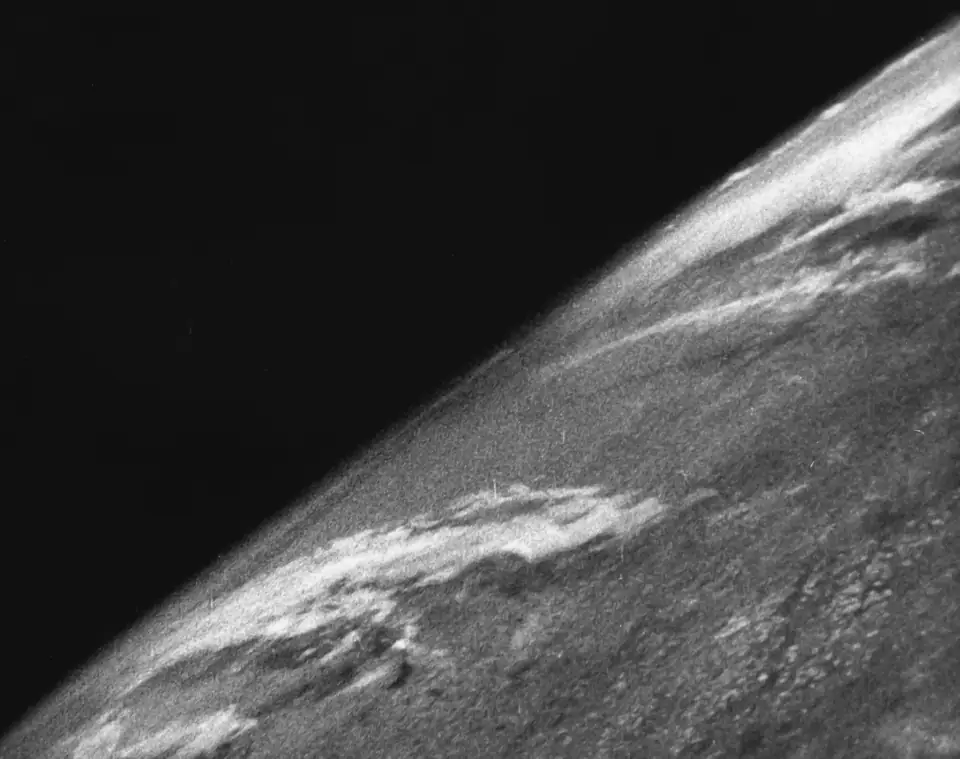
The first photograph from space, 1946: a grainy black-and-white curve of Earth under the black of space.
First photograph from space, V-2 rocket No. 13, White Sands, October 24, 1946. US Army. Wikimedia Commons, public domain.

No. 018 · Where this room started

The camera was smashed to pieces. The film didn't care.

Everything above began here: a captured German V-2, relaunched from New Mexico in 1946 with a 35mm movie camera snapping a frame every second and a half, reached 65 miles and photographed Earth against black for the first time.30 Then it fell back and hit the desert at 500 feet per second. The camera was pulverized; the film, riding in a steel cassette, was fine. A recovery crew member remembered the scientists' reaction: "they were jumping up and down like kids."30 The previous altitude record for a photograph, a balloon at 13.7 miles, had stood for eleven years. This one beat it five times over in three minutes.

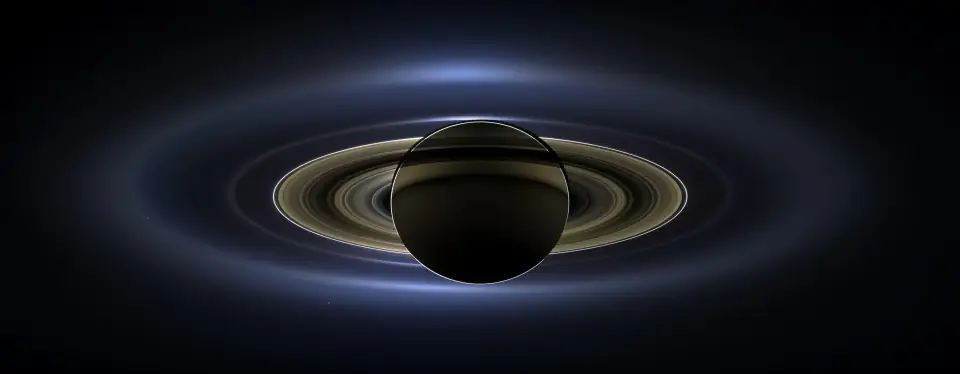
Saturn backlit by the Sun, its rings glowing, with Earth visible as a tiny pale blue dot below the rings.
"The Day the Earth Smiled," Cassini at Saturn, July 19, 2013. NASA/JPL-Caltech/Space Science Institute, public domain.

No. 019 · Smile, you're on Saturn camera

The first photo of Earth where Earth was told in advance to pose.

On July 19, 2013, Cassini slid into Saturn's shadow and shot a 141-frame mosaic of the backlit rings, with Earth a pale blue point 1.44 billion kilometers below them. For the first time ever, humanity was notified beforehand that its picture was being taken from the outer solar system. People threw rooftop parties and waved at Saturn.31 You are somewhere in this photograph, slightly blurry, definitely waving or not waving. Either way: present.

ROLL 04 · 1976 to 2025

The Digital Age

The camera becomes a computer.

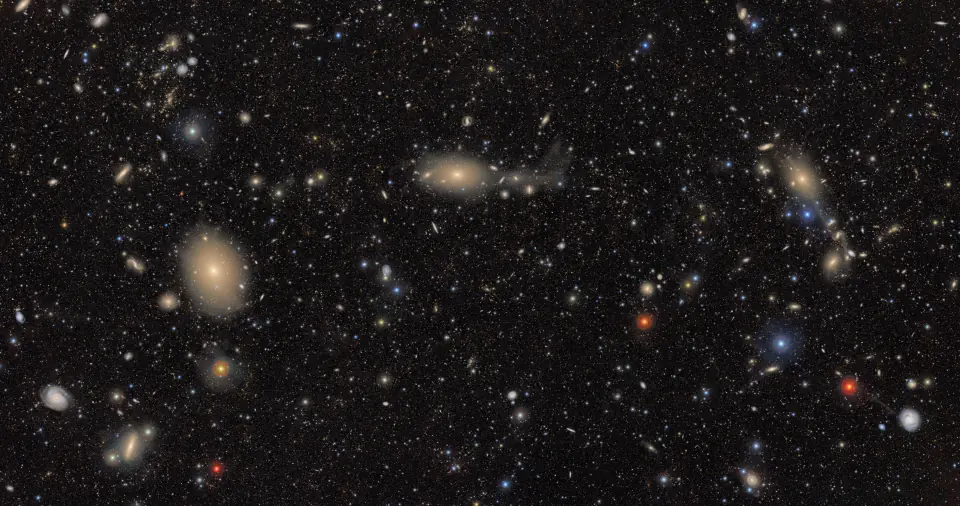
The Cosmic Treasure Chest: a vast field of thousands of galaxies and stars from the Rubin Observatory's first public image release.
"The Cosmic Treasure Chest," the Virgo cluster region, from the Rubin Observatory's first public release, June 2025. NSF-DOE Vera C. Rubin Observatory, CC BY 4.0.

No. 020 · The largest digital camera ever built

3,200 megapixels. The debut photo holds about ten million galaxies.

On a Chilean mountaintop sits a camera the size of a small car: 189 sensors fused into one 3,200-megapixel eye, certified by Guinness as the largest digital camera on Earth.32 Its first public image, released June 23, 2025, was stitched from over 1,100 exposures and contains roughly ten million galaxies; displaying one frame at full size would take about 400 4K televisions.33 In its first ten hours of test imaging it found 2,104 asteroids nobody had ever seen. It will now rescan the entire southern sky every few nights for ten years, the whole universe on a pub-quiz schedule.33 And the first thing this monster ever photographed, during 2020 lab tests, was a head of romanesco broccoli.32

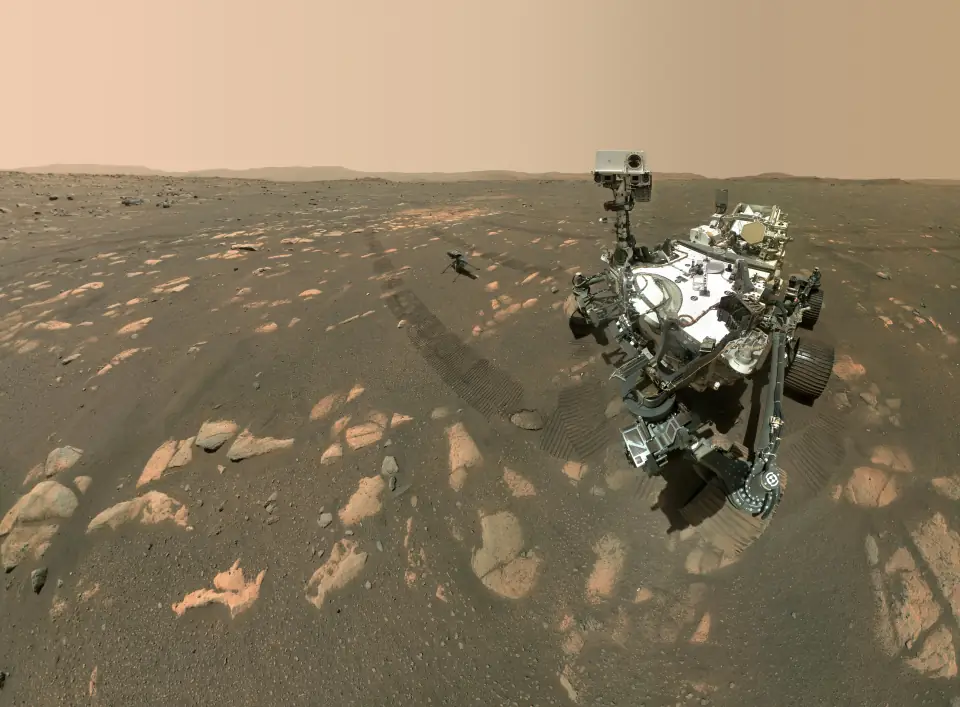
The Perseverance rover's selfie on Mars: the rover looking at the camera on rocky orange ground, with the small Ingenuity helicopter sitting a few meters behind it.
Perseverance and the Ingenuity helicopter, Jezero Crater, Mars, April 6, 2021 (PIA24542). NASA/JPL-Caltech/MSSS, public domain.

No. 021 · The 180-million-mile selfie

A robot on Mars took a 62-frame selfie with its helicopter.

Robert Cornelius had to sprint into his own frame in 1839. Perseverance does it with choreography: the camera rides the end of its robotic arm, the arm waves through 62 positions, and the frames are stitched so the arm itself vanishes from the result.34 It is combination printing, the 1850s darkroom trick, performed by a nuclear-powered robot on another planet. Sitting 13 feet back: the Ingenuity helicopter, photographed here like a proud parent's kid on the first day of school, days before it became the first aircraft to fly on another world.34

A detail of the Lumiere peacock autochrome compressed to extremely low JPEG quality, showing blocky artifacts. The same peacock detail at high JPEG quality, smooth and clean. quality 92 · 320 KB quality 2 · 52 KB
Both halves are the Lumières' peacock from Roll 02, re-encoded by us. Left: JPEG quality 92, 320 KB. Right: the same pixels strangled to 52 KB. Drag the line; the damage hides in the smooth feathers first.

No. 022 · The invisible compromise

Every image tonight has been quietly compressed about ten to one. You never noticed.

JPEG, born 1992, slices every photo into 8-by-8 pixel blocks and throws away the details human eyes ignore, which is most of them.35 Done politely, that buys a 10-to-1 shrink with no visible cost; this very page serves its photographs as WebP, JPEG's younger cousin, and you have been admiring compressed masterpieces all night. Its lossless sibling PNG exists out of spite: when the patent holder behind GIF started demanding royalties in 1994, furious engineers built a free replacement, and the internet held a "Burn All GIFs Day" to celebrate.36 Compression is this gallery's unsung curator. Without it, tonight weighs a gigabyte.

THE BAYER MOSAIC · WHAT YOUR CAMERA ACTUALLY SEES one color filter per pixel · Bryce Bayer, Kodak, 1976 one full-color pixel two channels guessed per 2x2 tile: 1 red · 2 green · 1 blue (eyes favor green) TWO-THIRDS OF EVERY DIGITAL PHOTO'S COLOR IS INTERPOLATED
The mosaic under every sensor pixel. Diagram ours.

No. 023 · The colorblind sensor

Your camera sees no color at all. It guesses two-thirds of every photo.

Every pixel on a digital sensor is colorblind; it only counts light. So since 1976, nearly every camera has worn a mosaic of tiny filters, one color per pixel, with twice as many green squares because human eyes favor green.37 The processor then reconstructs the two missing color values at every single pixel, meaning two-thirds of the color in every digital photograph you have ever taken is an educated guess, made well.37 It is Maxwell's three-filter tartan from Roll 02, shrunk to microns and run a few billion times per snapshot.

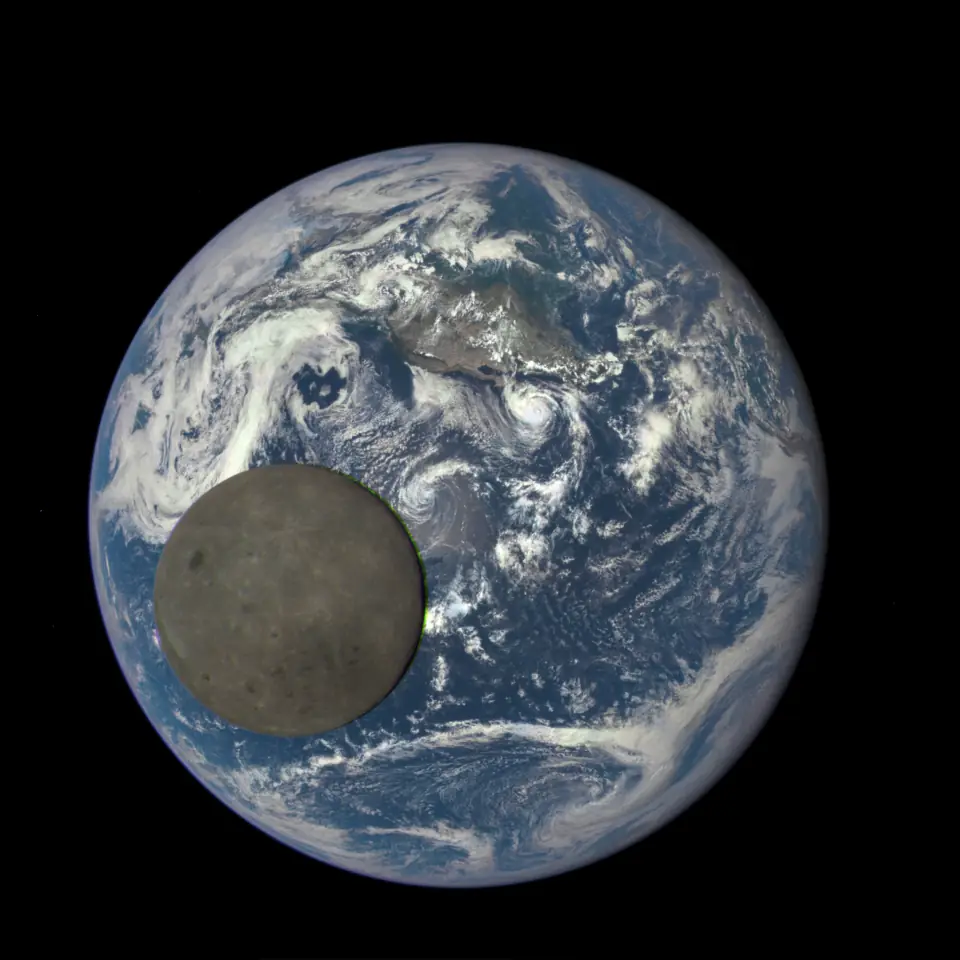
The far side of the Moon, fully lit, crossing in front of the blue sunlit Earth, photographed from a million miles away.
The Moon's far side crossing Earth, DSCOVR's EPIC camera, one million miles out, July 16, 2015. NASA/EPIC, public domain.

No. 024 · The million-mile photobomb

A camera a million miles up watches Earth all day. Twice a year, the Moon walks through the shot.

DSCOVR hangs at the gravitational balance point between Earth and Sun and photographs the full sunlit planet every couple of hours, with, delightfully, a 4-megapixel sensor. Your phone beats its pixel count; its view is unbeatable.38 About twice a year the geometry lines up and the camera catches the Moon's far side, the face Earth never sees, fully lit and strolling across our planet.38 No "dark side" jokes hold up here: the far side gets exactly as much sunshine as ours. It just never turns around.

Inside your pocket

Night mode is this whole gallery, automated

Press the shutter in the dark and a modern phone fires up to 15 frames in a couple of seconds, aligns them, and merges the stack into one clean exposure; astrophotography modes stack four full minutes of sky.39 Recognize the moves? That is Le Gray's two-negative composite, Muybridge's burst, and Adams' tone placement, running as firmware. The old tricks never died. They got jobs.

The most-liked photograph in history

It's an egg.

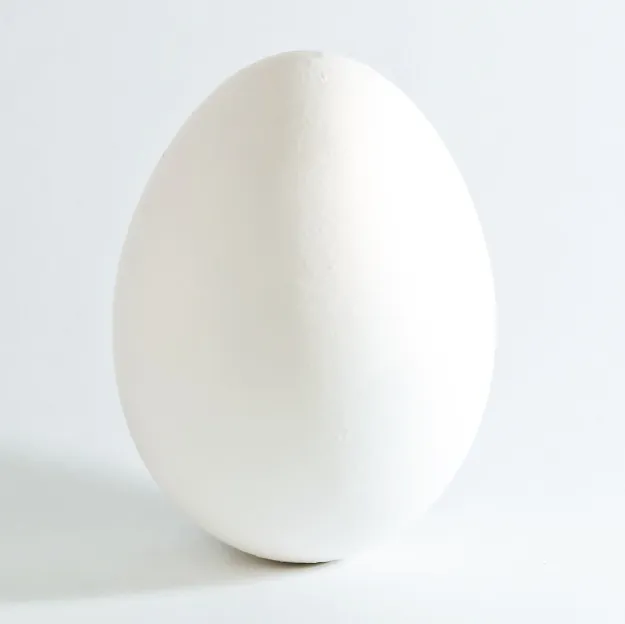
A single plain white chicken egg on a white background.

In January 2019 an anonymous account posted a stock photo of a plain egg with one goal: beat Kylie Jenner's record of 18 million likes. It did so in ten days and now sits near 60 million, the most-liked photograph in the history of the medium.40 No zone system, no kites, no mercury vapor. An egg, a white background, perfect timing.

Pictured: a legally distinct stand-in egg by Ren West, CC BY 2.0. The record egg remains copyrighted, and famous.

ROLL 05 · The wild stuff

Records, Money, Beautiful Nonsense

Auction lunacy, kite cameras, fairy hoaxes, one litigious monkey.

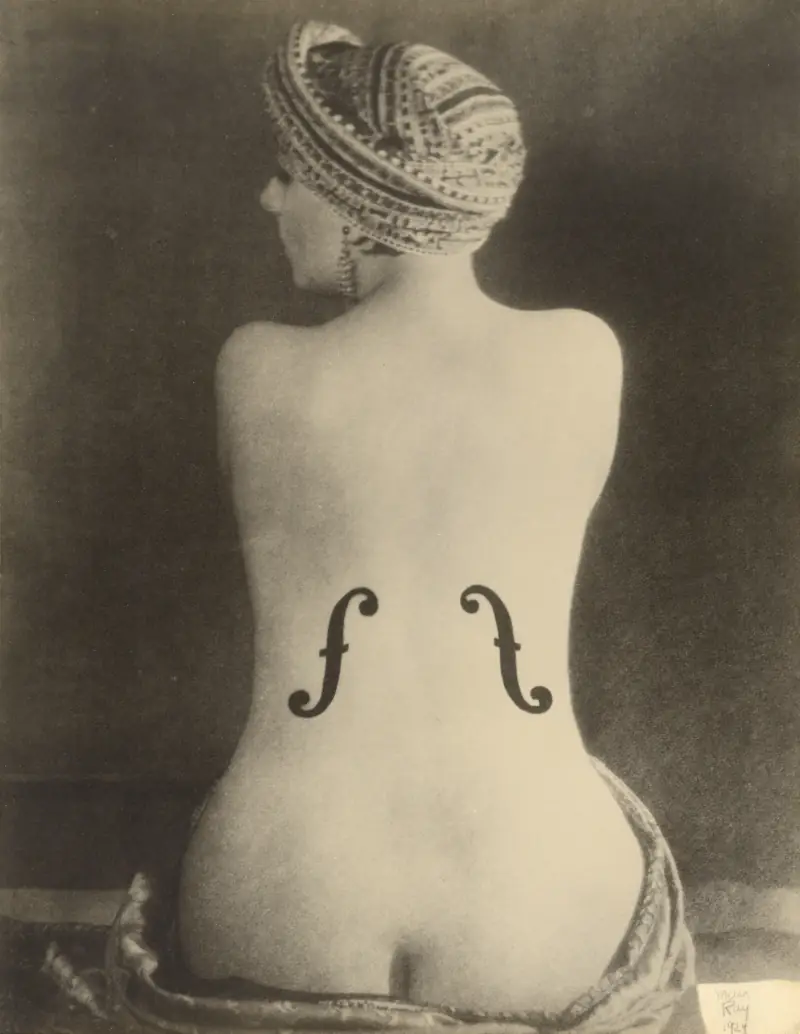
Le Violon d'Ingres, 1924: a woman's bare back in a turban, with two violin f-holes printed onto her skin.
Man Ray, "Le Violon d'Ingres," 1924. Public domain in the United States (published before 1930); still under copyright in France. Via Wikipedia.

No. 025 · The most expensive photograph ever sold

$12.4 million for a pun about a woman's back.

The title means "Ingres's violin," French slang for a hobby, and the joke is a triple: the model (the cabaret legend Kiki de Montparnasse) is posed like an Ingres painting, her back becomes the instrument, and Man Ray "plays" both photography and her. He added the f-holes to the print and rephotographed it; 1924's idea of compositing.41 In May 2022 the print he sold directly to a collector couple in 1962 went for $12,412,500 at Christie's, roughly triple the previous record for any photograph.42 The leaderboard, for the record:

Most expensive photographs, verified sales1

  1. Le Violon d'Ingres · Man Ray, 1924$12.41M
  2. Rhein II · Andreas Gursky, 1999$4.34M
  3. Untitled #96 · Cindy Sherman, 198143$3.89M
  4. The Pond, Moonlight · Steichen, 1904$2.93M
Asterisk division: Peter Lik's "Phantom" allegedly sold privately for $6.5M in 2014. The only evidence is the seller's own press release; his verified auction record is $15,860. The art press headline ran "Is That $6.5 Million Photo Sale for Real? Probably Not!"44
"Rhein II" (1999), artist's impression, rendered in six rectangles at a savings of $4,338,500. The original is © Andreas Gursky, and to be fair, his rectangles are better.

No. 026 · The $4.3 million river

He deleted the dog walkers, the factory, and the entire idea of company.

Gursky's "Rhein II" is a six-foot-wide photograph of the Rhine as pure horizontal bands: sky, grass, water, grass, path, grass. The river never actually looks like that; Gursky digitally removed pedestrians, dog walkers and a power plant, explaining that "a fictitious construction was required to provide an accurate image of a modern river."45 In 2011 it became the most expensive photograph on Earth at $4,338,500, a title it held for eleven years.45 The internet has never forgiven it. The internet is also not done arguing about it, which may be the point.

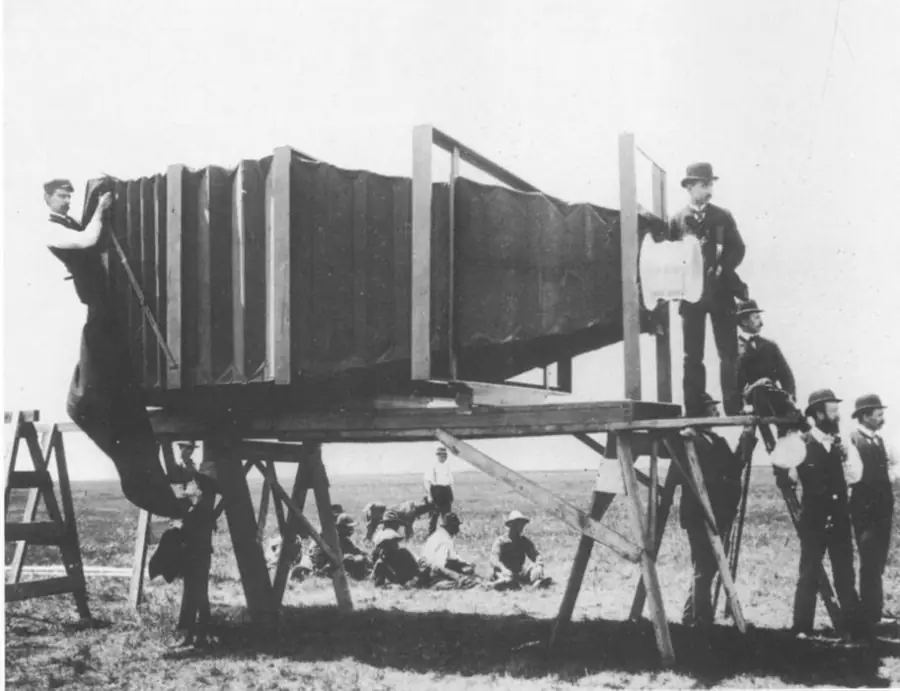
The 1900 Mammoth camera: a camera the size of a garden shed with its bellows extended, posed with the crew of men needed to run it.
George R. Lawrence's "Mammoth" camera, 1900, with some of the 15 men it took to run it. Wikimedia Commons, public domain.

No. 027 · The largest camera of its century

France sent a diplomat to check the camera was real.

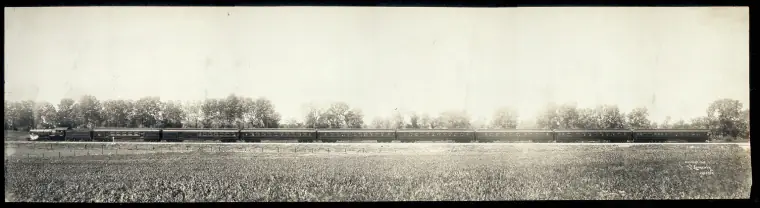
A railroad wanted its new luxury train photographed in one shot, so Lawrence built a camera weighing 1,400 pounds loaded, exposing a single glass plate four and a half feet by eight. Fifteen men operated it; developing one plate drank ten gallons of chemicals.46 When the prints reached the 1900 Paris Exposition, the judges flatly refused to believe a photograph that size existed, so the French consul in Chicago was dispatched to inspect the camera in person. It was real. Lawrence took the Grand Prize.46 His studio motto, lightly worn: "The Hitherto Impossible in Photography Is Our Specialty."

The Alton Limited train photographed in one exposure on the eight-foot plate, the whole train sharp from end to end.
The photograph itself: the Alton Limited, one exposure, one very large piece of glass. Commons, public domain.
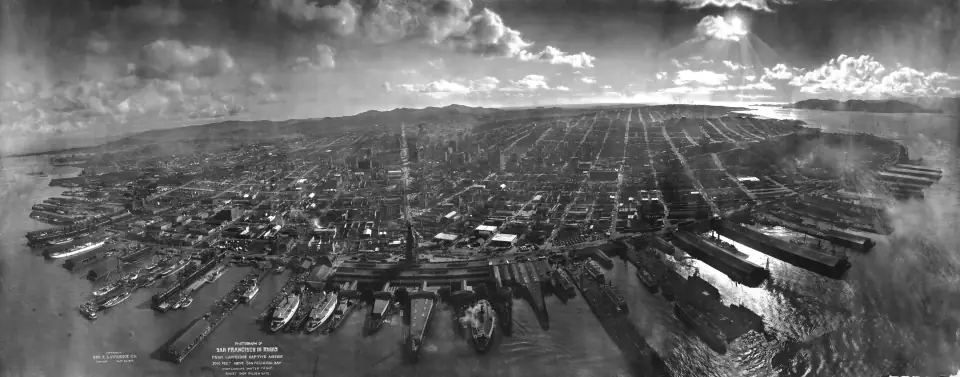
San Francisco in Ruins, May 1906: a sweeping aerial panorama of the burned city from two thousand feet over the bay, sun glinting on the water.
George R. Lawrence, "San Francisco in Ruins," May 28, 1906, from a camera lifted by seventeen kites. Library of Congress, no known restrictions.

No. 028 · The same man, six years later, no airplane required

A 49-pound camera, 17 kites, 2,000 feet of piano wire, one perfect negative.

Six weeks after the 1906 earthquake, Lawrence lofted a panoramic camera above San Francisco Bay on a train of seventeen kites and fired the shutter electrically through the steel kite wire.47 The curved film swept 160 degrees of ruined city in one exposure. Prints sold at $125 apiece and earned him at least $15,000 in 1906 money, around half a million today, from a single press of a button.47 Powered flight was three years old and could not have done this; the kites could. Sometimes the best drone is 1906 string.

pinhole, 6 mm control tower image: upside down, 31 x 107 ft of muslin THE GREAT PICTURE, 2006 · a jet hangar as the camera
How you take the largest photograph ever made: turn the building into the camera. Diagram ours; the photograph itself is © The Legacy Project.

No. 029 · The largest photograph ever made

The camera was an aircraft hangar. The darkroom tray was an Olympic pool.

In 2006, six artists blacked out a decommissioned Marine jet hangar in California, pierced one 6-millimeter hole in the door, and hung a 31-by-107-foot piece of muslin hand-coated with 21 gallons of photographic emulsion inside. Exposure: about 35 minutes of the base outside pouring through the pinhole.48 Development took some 80 volunteers wading around a custom vinyl tray the size of an Olympic pool, sloshing 600 gallons of developer.48 Guinness certified it the largest photograph and the largest camera on Earth. Every camera is a dark room with a hole in it; this one just admitted it.

Field notes · the records shelf

Sharpest scan
Rijksmuseum's Night Watch: 717 gigapixels, 8,439 frames, 5.6 terabytes, pixels finer than a blood cell.49
Fastest
Caltech's CUSP, 70 trillion frames per second.11
Deepest
Hubble XDF, 23 days of exposure (Roll 03).25
Priciest camera
Leica 0-series No. 105, Barnack's own prototype: EUR 14.4M in 2022.50
Heaviest book
Helmut Newton's SUMO: 66 pounds, sold with its own stand; copy No. 1 fetched DM 620,000.51
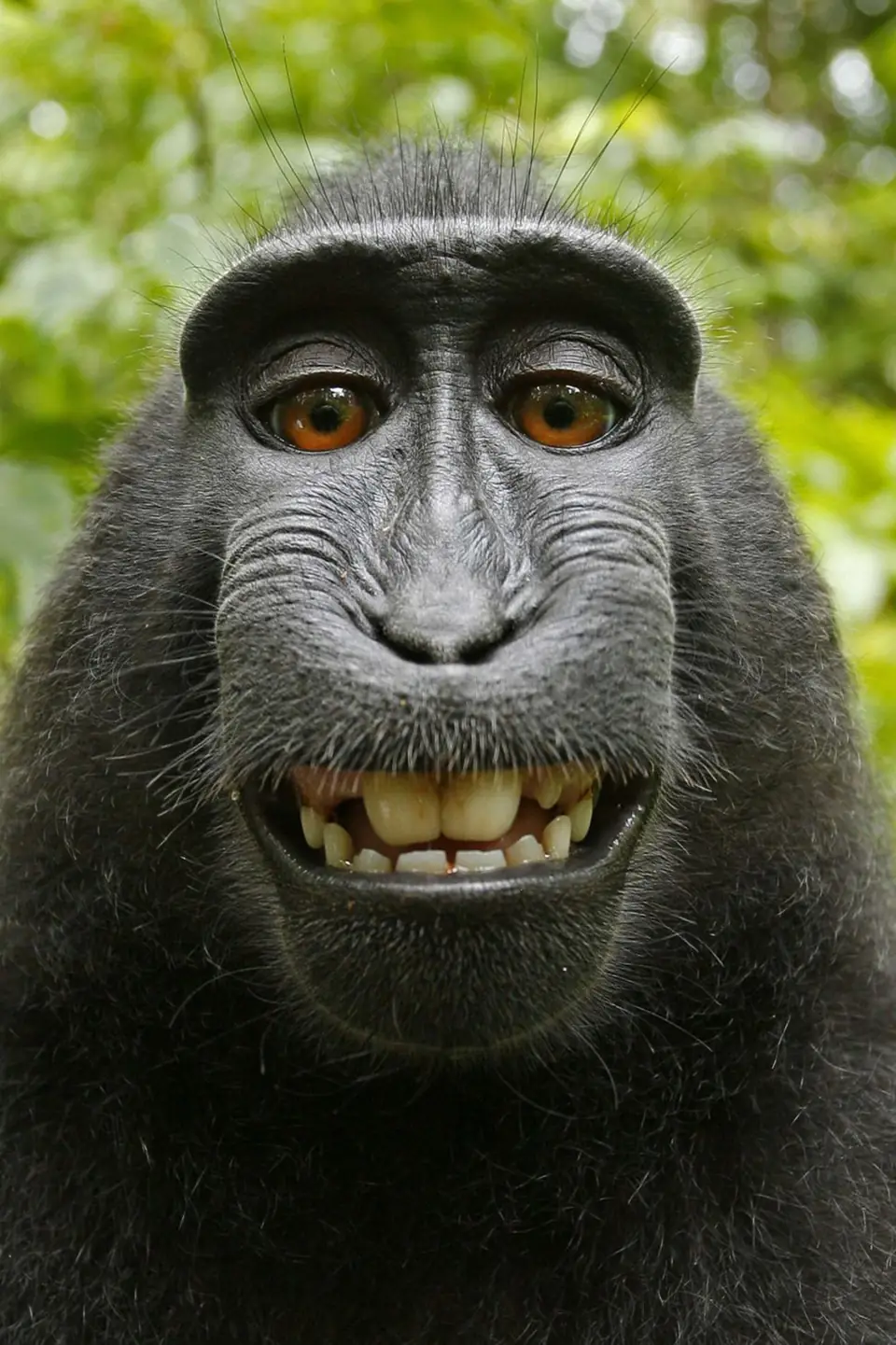
The monkey selfie: a crested black macaque grinning enormously into the camera lens it is holding.
A crested black macaque, self-portrait, Sulawesi, 2011, with equipment by David Slater. Public domain in the US: works without a human author cannot hold copyright. Wikimedia Commons.

No. 030 · The most litigated selfie in history

The photographer was a monkey, so nobody owns it. A court had to say so.

Wildlife photographer David Slater set up his camera in an Indonesian reserve; the macaques fired hundreds of frames, including this beam of pure id. Then it got weird. The US Copyright Office ruled works need human authors, literally listing "a photograph taken by a monkey" as its example, which dropped the image into the public domain.52 Then PETA sued Slater on the monkey's behalf, claiming Naruto owned the copyright. The Ninth Circuit, in an opinion you can feel the judges enjoying, held that animals lack standing to sue.52 Slater, meanwhile, went broke and considered becoming a dog walker. The monkey, sources report, has never commented.

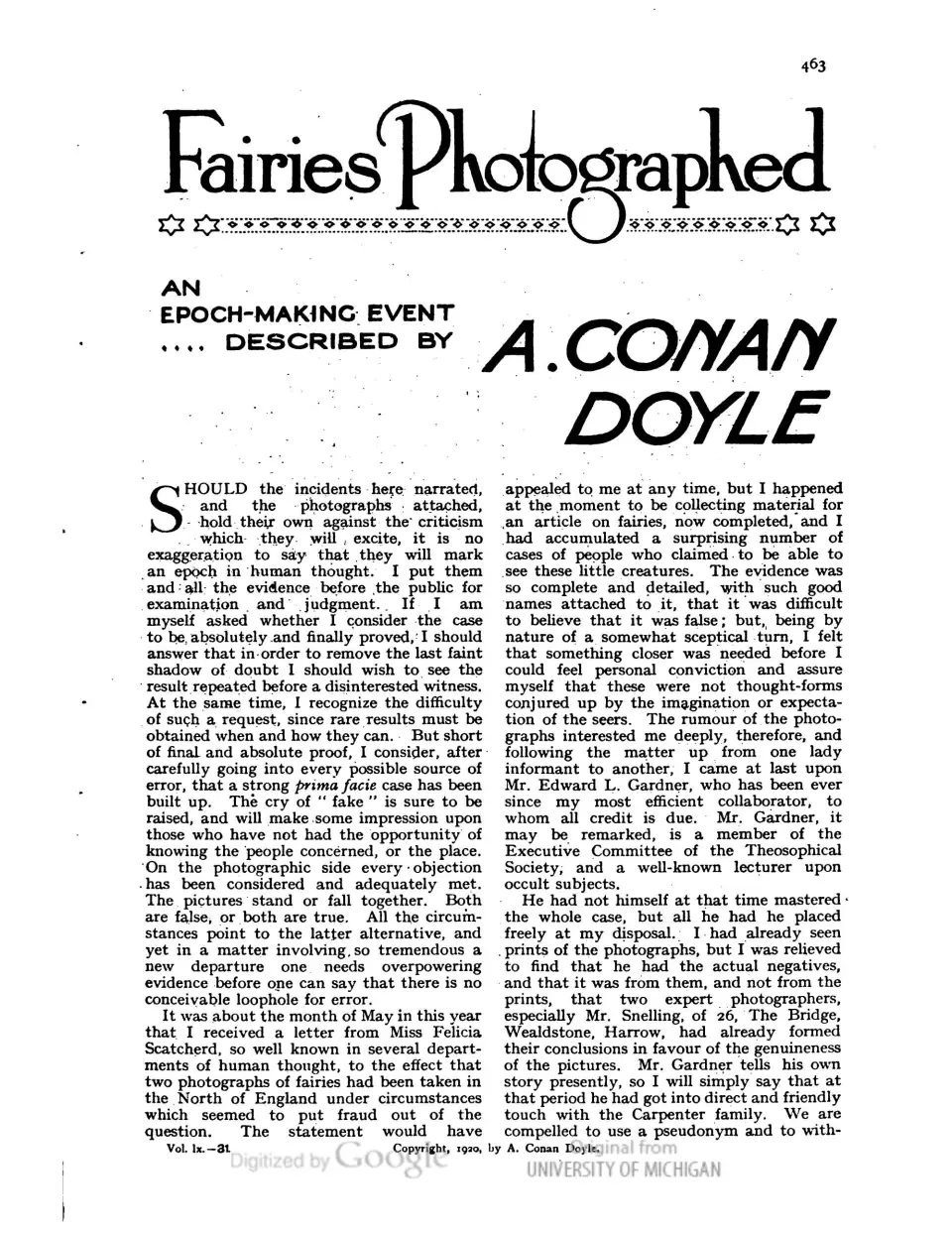
The Strand Magazine page from 1920 showing the first Cottingley fairy photograph: a girl with paper fairies dancing in front of her.
The Cottingley fairies as they fooled the world: The Strand Magazine, Christmas 1920. Wikimedia Commons, public domain.

No. 031 · Two kids vs. the inventor of Sherlock Holmes

Paper cutouts on hatpins. He believed them for the rest of his life.

In 1917, cousins Elsie Wright (16) and Frances Griffiths (9) photographed "fairies" by the stream behind the garden: illustrations copied from a children's book, cut out, and stood up on hatpins.53 Arthur Conan Doyle, creator of literature's greatest skeptic, published them as evidence of the spirit world and wrote a whole book on it. The cousins stayed quiet for 66 years. Elsie's explanation, confessing at last in 1983: "Two village kids and a brilliant man like Conan Doyle, well, we could only keep quiet."53 Frances went to her grave insisting the fifth photo was real.

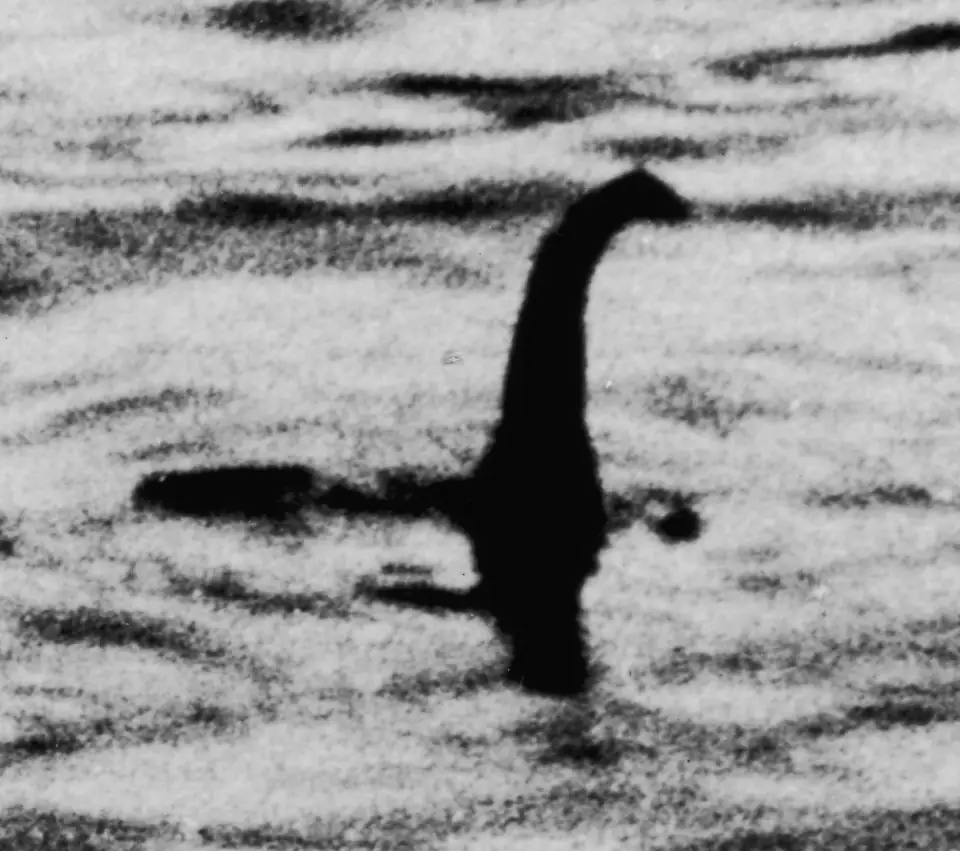
The 1934 Surgeon's Photograph: a grainy long neck and small head rising from the rippled water of Loch Ness.
The "Surgeon's Photograph," Loch Ness, 1934. Hosted as public domain (UK copyright long expired, US term not renewed). Wikimedia Commons.

No. 032 · The monster was a toy submarine

History's most famous monster photo was a tabloid revenge plot.

The "Surgeon's Photograph" ran in the Daily Mail in 1934, credited to a respectable London doctor to make it bulletproof. Sixty years later the truth surfaced: a Woolworths toy submarine wearing a neck sculpted from plastic wood, floated in a shallow bay by the family of Marmaduke Wetherell, a big-game hunter the Mail had publicly humiliated after his "Nessie footprints" turned out to be made with a hippo-foot umbrella stand.54 His stepson confessed in his nineties. Every blurry lake monster since swims in this photo's wake, which is impressive for fourteen inches of windup toy.

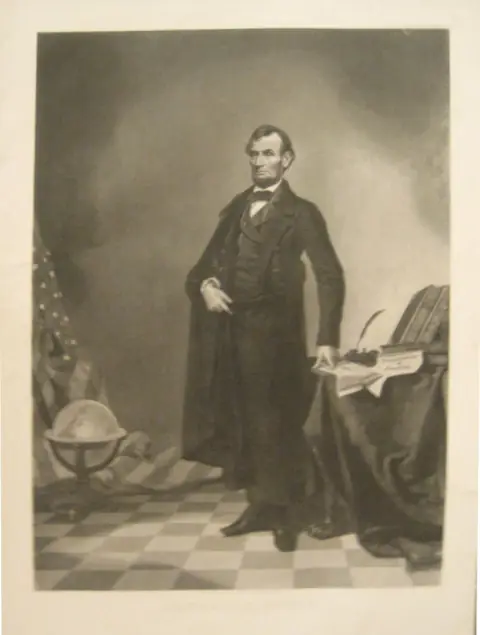
An 1860s heroic full-length portrait print of Abraham Lincoln that is secretly Lincoln's head on John C. Calhoun's body.
Older than you think: this grand 1860s "Lincoln" is Lincoln's head grafted onto the body of John C. Calhoun, slavery's fiercest defender. Nobody noticed for decades.55 Commons, public domain.
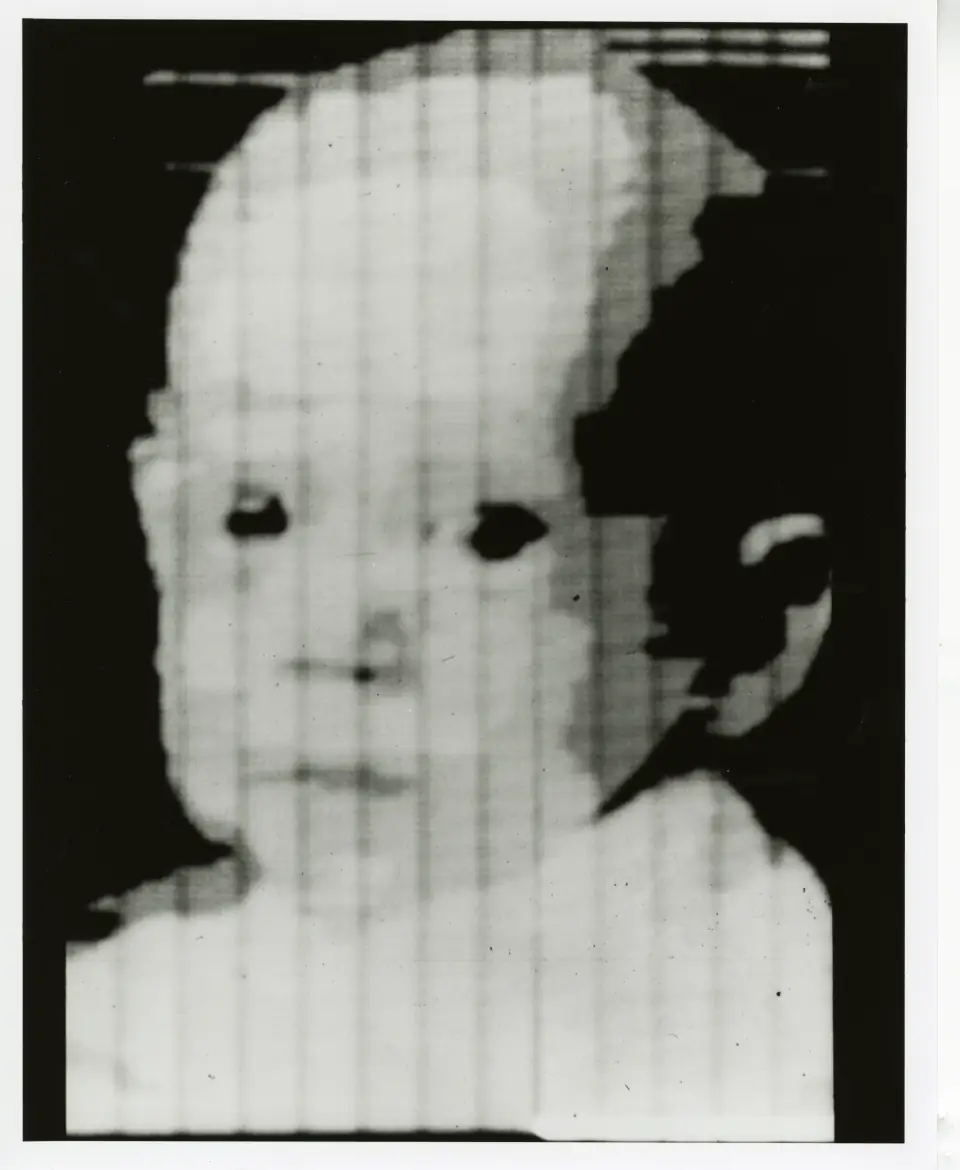
The first digital image, 1957: a coarse 176 by 176 pixel scan of a baby's face.
Russell Kirsch, scan of his son Walden, NBS (now NIST), 1957. The first digital image. Wikimedia Commons, public domain.

No. 033 · Pixel zero

Every digital image descends from one baby and 30,976 pixels.

In 1957, Russell Kirsch fed a 5-centimeter print of his three-month-old son into a drum scanner wired to America's first programmable computer. Its memory could hold exactly 176 by 176 pixels, one bit each.56 Every JPEG, every frame of every video call, every photo your phone has ever taken runs downhill from this baby. Kirsch also chose the square pixel that day, and spent his old age apologizing for it: "It was something very foolish that everyone in the world has been suffering from ever since."56

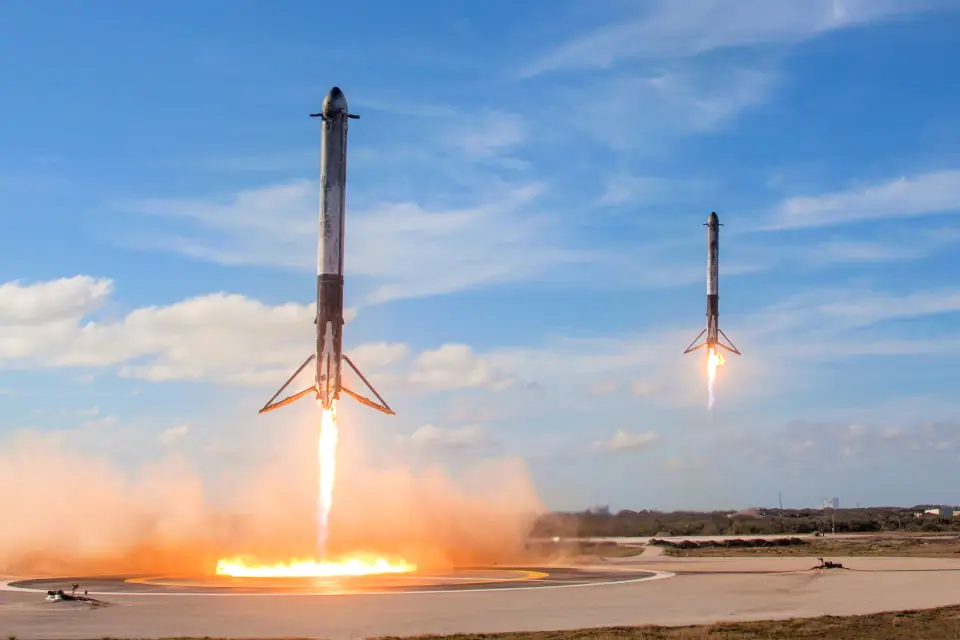
Two Falcon Heavy side boosters landing side by side at night on neighboring pads, twin pillars of flame under them.
Falcon Heavy's side boosters landing in unison, Cape Canaveral, February 6, 2018. SpaceX, dedicated to the public domain (CC0).

No. 034 · The most expensive photo shoot ever given away

Two 15-story rockets landed in step. The photos cost you nothing.

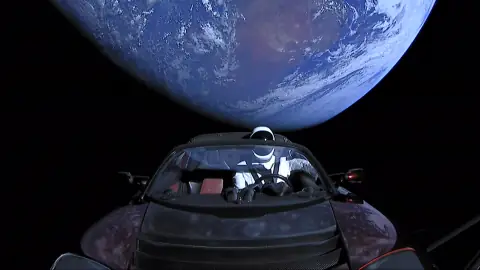
The first Falcon Heavy flight ended with both side boosters flying themselves home and touching down on neighboring pads within seconds of each other, like synchronized divers the size of office towers.57 The payload was sillier: the company launched a cherry-red Roadster with a spacesuited mannequin named Starman at the wheel, and broadcast him cruising away from Earth until the batteries died. The car is still looping the Sun.57 The relevant miracle for this gallery: SpaceX dedicated the whole shoot to the public domain, which is why 21st-century rocket photography hangs here free while most of the century's photojournalism cannot.

Starman: a spacesuited mannequin at the wheel of a red Tesla Roadster in space, Earth glowing behind the open car.
Starman leaving home, February 2018. The most surreal car photo ever taken. SpaceX, CC0.

Told, not shown · screenshot rights murky

The first webcam watched a coffee pot

Cambridge, 1991: researchers aimed a camera at the shared coffee machine so nobody would hike stairs to an empty pot, serving one grainy 128-pixel frame a few times a minute. Put on the web in 1993, it became the world's first webcam, and millions checked in on a British coffee pot for a decade.58 Switched off in 2001; the final image is a hand reaching in to press the off switch. Der Spiegel bought the pot at auction for £3,350 and had it refurbished, because journalism.58

Told, not shown · © Silvano de Gennaro

The first photo on the web was a doo-wop band

The first photographic image on the World Wide Web, 1992, was not a physics plot. It was Les Horribles Cernettes, CERN's in-house doo-wop parody act (initials: LHC), who sang love songs about colliders. Tim Berners-Lee wanted to prove his new web could carry images, asked for a picture, and an IT colleague scanned the band's promo shot and trimmed it in an early Photoshop.59 The web's photographic history opens not with a sunset but with sequins.

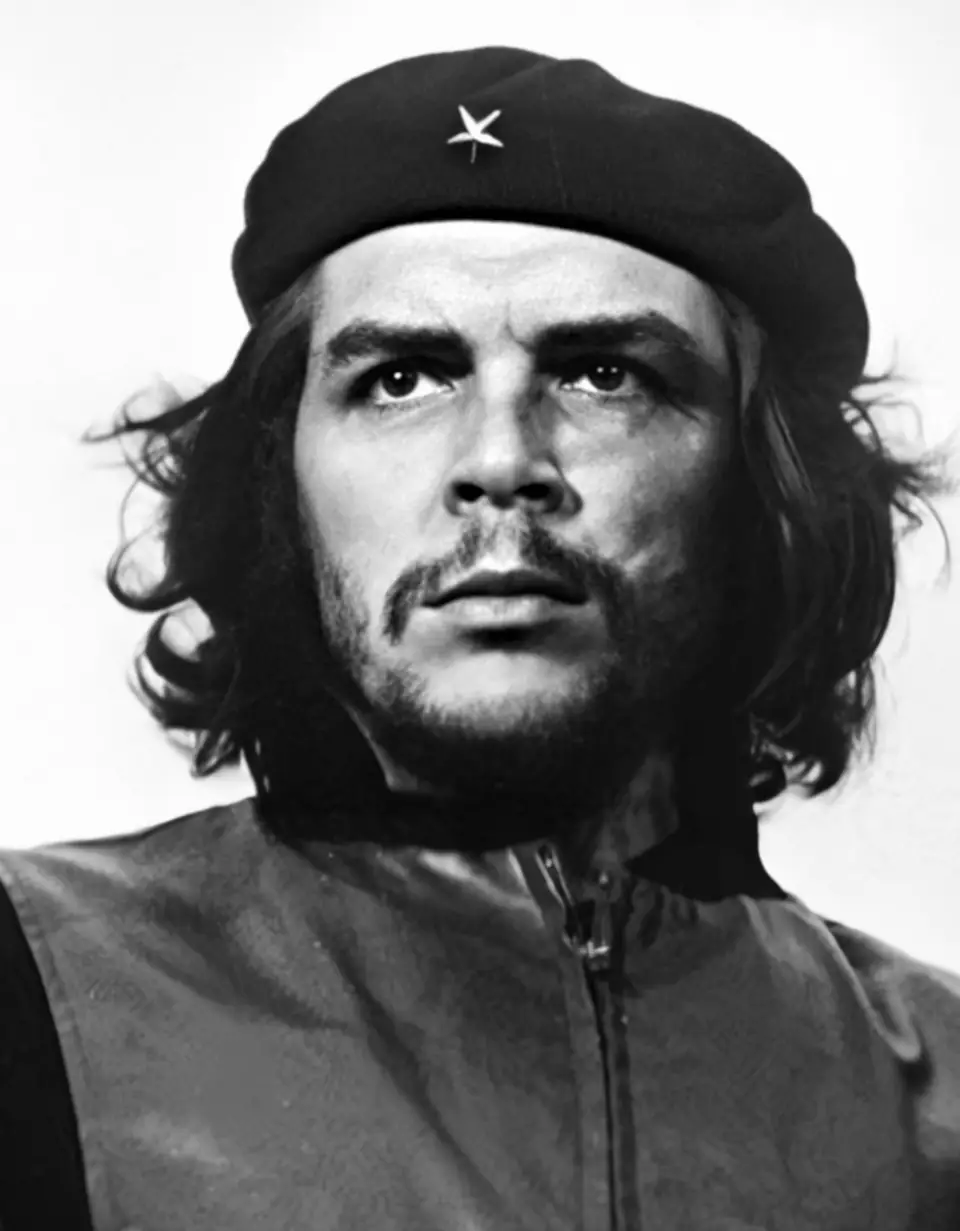
Guerrillero Heroico, 1960: Che Guevara in a beret looking past the camera into the distance.
Alberto Korda, "Guerrillero Heroico," Havana, March 5, 1960. Public domain under Cuban law (hosted as PD by Wikimedia Commons). Commons.

No. 035 · The most reproduced photograph on Earth

He never took a cent for it, until somebody put it on vodka.

Korda caught this in two frames at a Havana memorial service; his newspaper didn't even run it. It went on to be called the most reproduced photograph in history, on flags, murals, and roughly every dorm wall since 1968.60 Korda, loyal to the revolution, never collected a royalty for forty years, until Smirnoff used the face to sell spicy vodka. He sued, won about $50,000, and gave it to the Cuban healthcare system, saying Che would have done the same.60 The one invoice in history written by this photograph went to a liquor company.

Told, not shown · © Microsoft

"Bliss," the most-viewed photograph ever

The Windows XP hill. Shot in January 1996 beside a Sonoma highway on medium-format Velvia after winter rain, by a National Geographic veteran on his way to his girlfriend's house. Not staged, barely edited; the hill was only bare grass because a vine pest had forced the vineyard out.61 Microsoft paid a sum "in the low six figures," and when couriers refused to insure the original transparency, O'Rear flew to Seattle and hand-delivered it.61 Estimated views run into the billions, likely the most-seen photograph in history. The hill is a vineyard again; the view no longer exists, except on every computer that never got updated.

Field note · the one that got away

What we couldn't hang tonight

The 20th century's locked vault, told elsewhere in this page or worth your search: Edgerton's bullet and apple, Cartier-Bresson's puddle, "Moonrise, Hernandez," Lik's disputed Phantom, the Cernettes, Christina in her red swimsuit, "Bliss." Add nearly all of the last fifty years of photojournalism: every World Press Photo winner, every "Shot on iPhone" billboard, your favorite wildlife calendar. All still under copyright, all one click from their owners' sites. A century from now, most of them join this page for free. Public domain is just patience.

ROLL 06 · The peaks

Every Genre, Peaked

Macro, underwater, wildlife, astro, aerial, street.

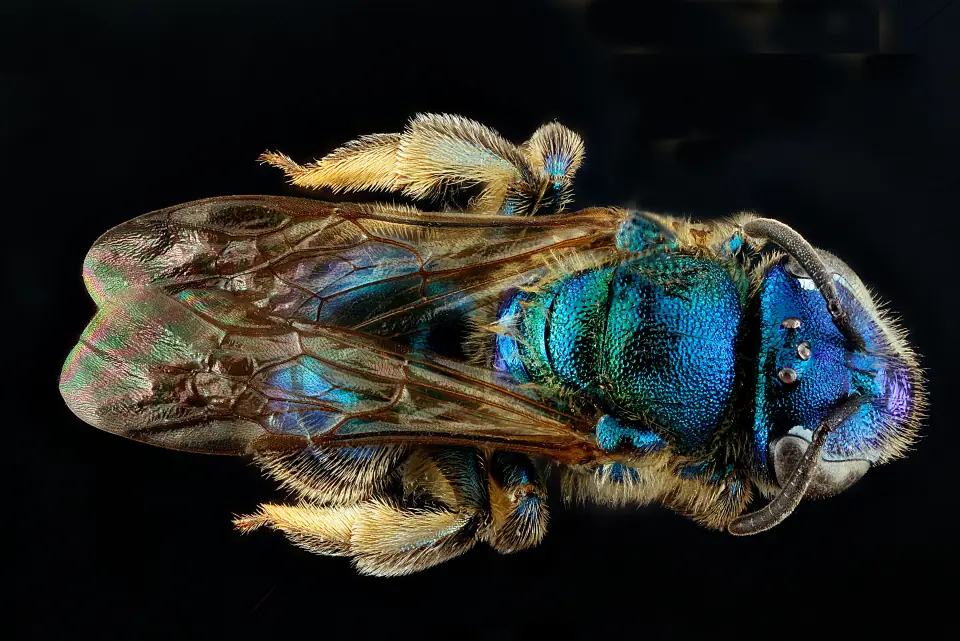
An extreme macro of a metallic green sweat bee, every hair and facet of its body in perfect focus.
Augochloropsis anonyma, a metallic green sweat bee. USGS Bee Inventory and Monitoring Lab (Sam Droege's team). Wikimedia Commons, public domain (US government work).

No. 036 · Macro, the current peak

No single photo can do this. It's dozens of them, fused.

At this magnification, physics allows a slice of focus thinner than a hair; the rest blurs. So the US Geological Survey's bee lab shoots dozens of frames, each focused a fraction of a millimeter deeper, and software fuses the sharp slivers into one impossible image.62 It is the old darkroom combination-print trick reborn as a stack; you will meet its 1857 grandfather in Roll 08. The lab posts thousands of these at full resolution, explicitly public domain, as a national bee inventory.62 Your tax dollars, at 5x magnification, are gorgeous.

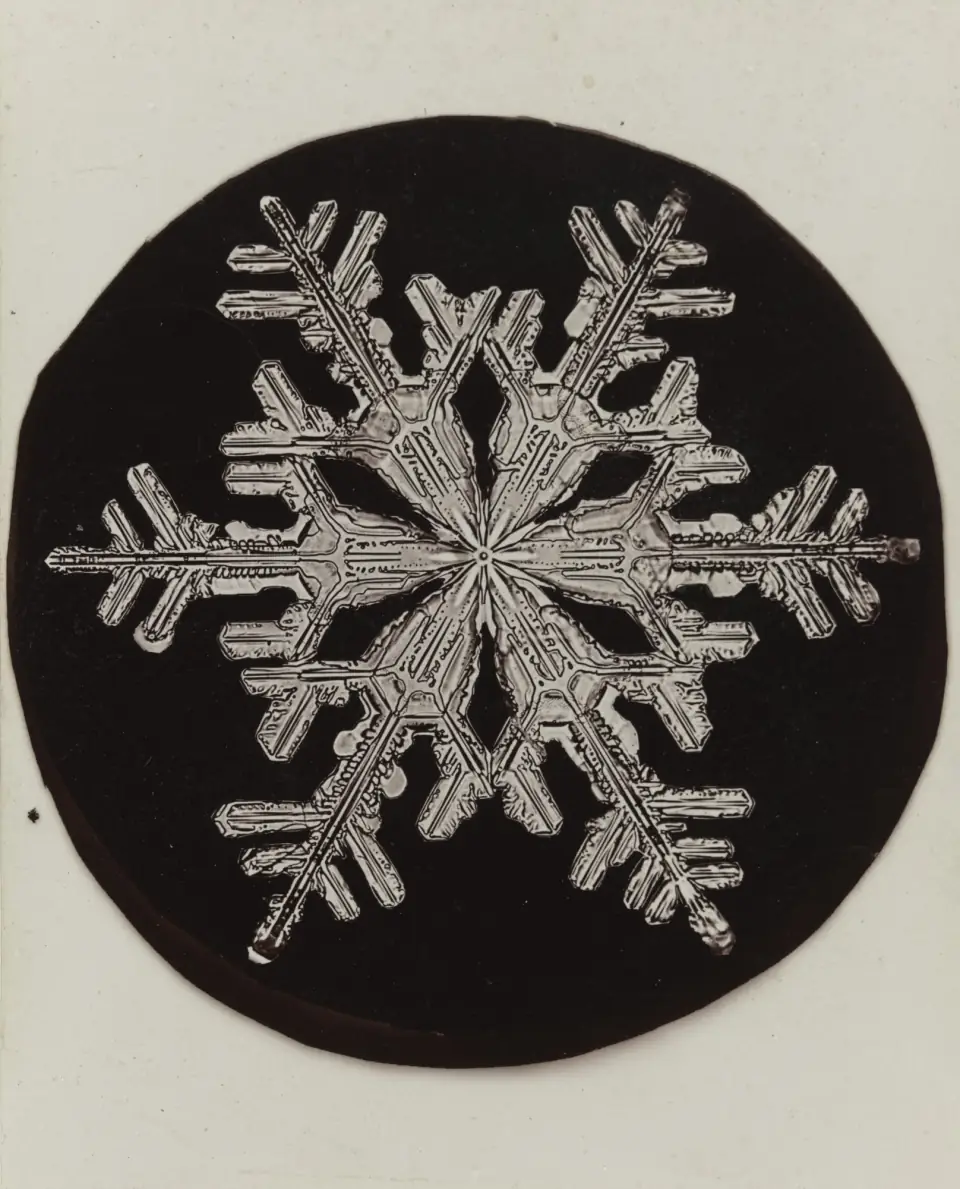
A Wilson Bentley photomicrograph of a single snowflake, a perfect six-armed crystal glowing against black.
Wilson Bentley, snow crystal, circa 1905. MoMA / Wikimedia Commons, public domain.

No. 037 · Macro, the founding father

A Vermont farmer caught snowflakes on velvet and moved them with a feather.

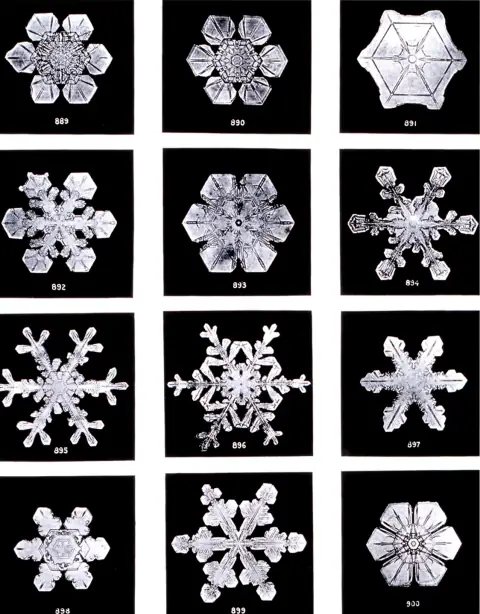
Wilson Bentley made the first successful photograph of a single snow crystal in January 1885, with a bellows camera bolted to a microscope, working outdoors in the cold so his subjects would survive the sitting. He caught flakes on black velvet and nudged them under the lens with a turkey feather, fast, before they sublimed away.63 Over 46 winters he photographed 5,381 of them, and "no two snowflakes are alike" is essentially his dataset talking. He died of pneumonia in 1931 after walking six miles home through a blizzard, which is either irony or devotion; probably both.63

A grid plate of many different Bentley snowflake photographs.
The catalogue: no two alike, 5,381 receipts. Commons, public domain.
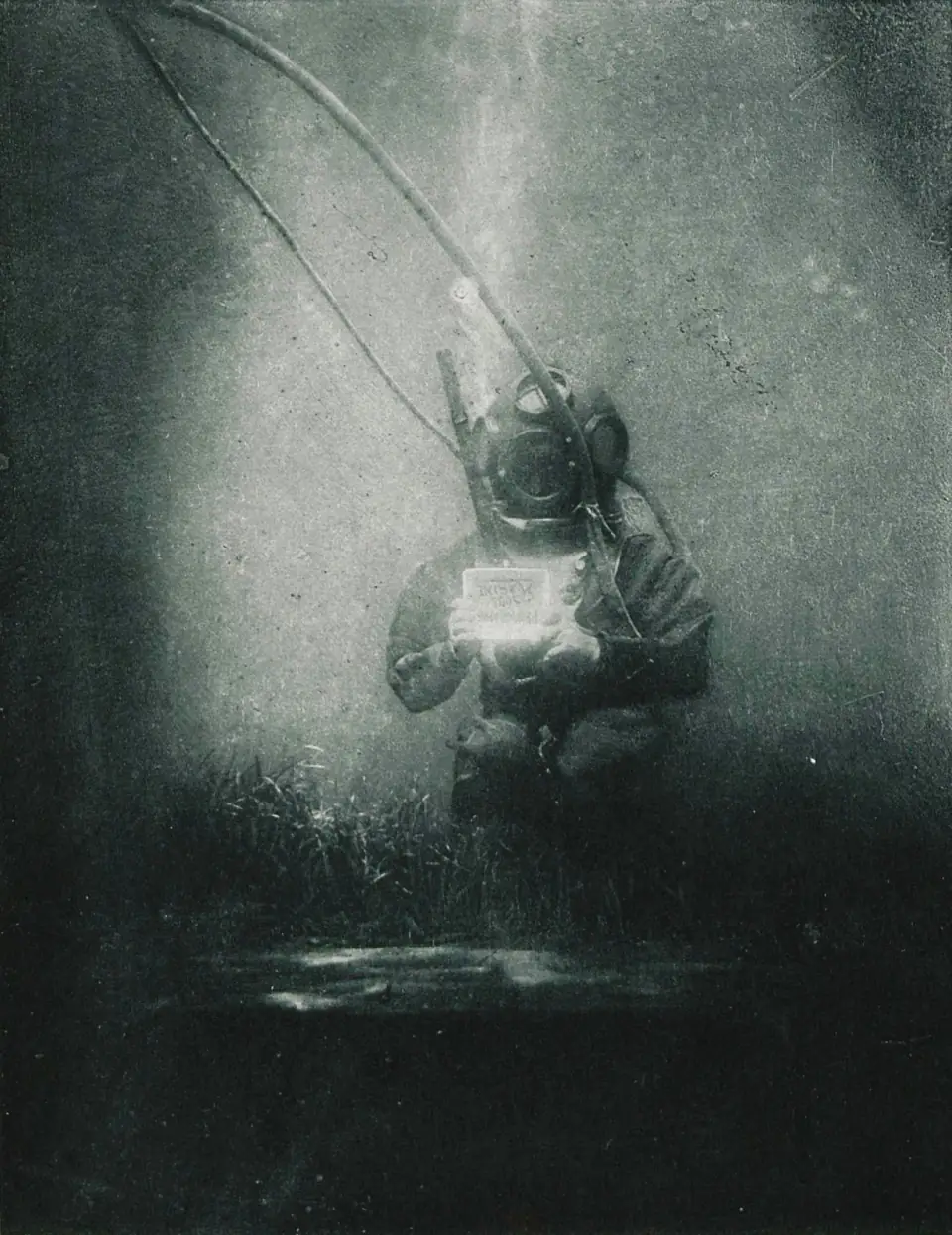
An 1899 underwater photograph: a diver in a hardhat suit standing on the seafloor holding a slate that reads Photographie Sous Marine.
Louis Boutan, biologist Emil Racovitza underwater at Banyuls-sur-Mer, 1899. Wikimedia Commons, public domain.

No. 038 · Underwater, the first portrait

The flash was a barrel of oxygen with a flame inside. Underwater. On purpose.

Louis Boutan started photographing beneath the Mediterranean in 1893 in a hardhat diving suit, with early exposures running up to thirty minutes of standing very still on the seabed.64 For light he built the most alarming flash in this entire post: an alcohol lamp burning inside an oxygen-filled barrel, with a rubber bulb puffing magnesium powder into the flame. It worked, mostly, and occasionally exploded.64 The sign his colleague holds says "underwater photography," because when you do something first, you get to caption it literally.

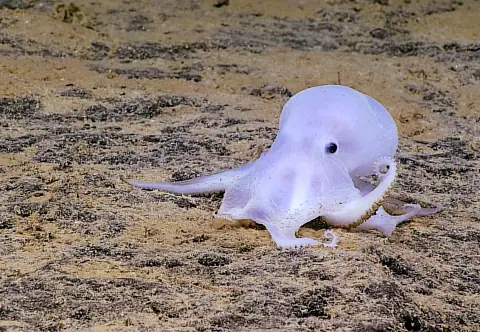
Casper the ghost octopus: a pale, almost translucent octopod sitting on the deep seafloor, photographed by a NOAA robot.
The genre now: "Casper," an octopus science had never seen, 2.7 miles down off Hawaii, found by a NOAA robot in 2016 and still awaiting a scientific name. The internet named it first.65 NOAA / Commons, public domain.
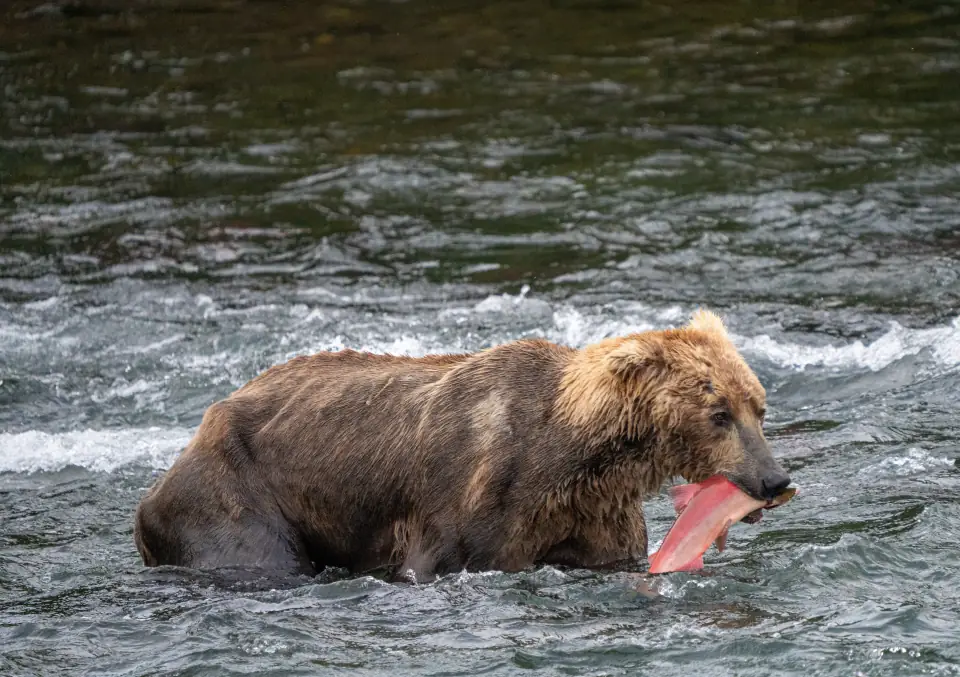
Brown bear 480 Otis sitting in the river at Brooks Falls with a salmon in his mouth.
Bear 480 "Otis" collecting a salmon, Brooks Falls, Katmai National Park, 2023. National Park Service. Wikimedia Commons, public domain.

No. 039 · Wildlife, with a leaderboard

The four-time Fat Bear Week champion wins by doing nothing.

Brooks Falls in July is wildlife photography's most reliable miracle: sockeye salmon hurl themselves up the falls directly into standing bears. This is Otis, bear number 480, four-time champion of Fat Bear Week, the National Park Service's annual single-elimination chubbiness bracket.66 His technique is to sit in one productive eddy, which rangers call his office, and let the river deliver. Younger bears chase and splash and burn calories; Otis sits, eats, wins. There is a photography lesson in there about choosing your spot and waiting, and Otis is its largest living professor.

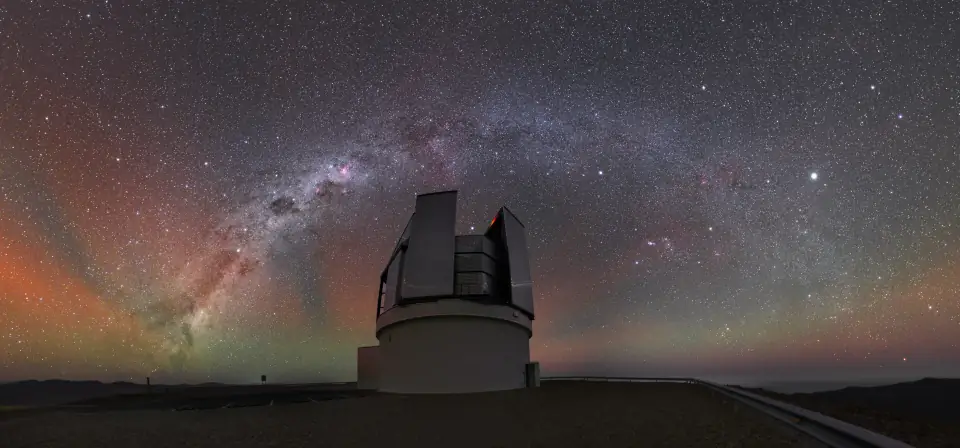
The full arc of the Milky Way over the VISTA telescope dome in the Chilean Atacama desert.
The Milky Way over the VISTA telescope, Paranal, Chile. ESO/Y. Beletsky, CC BY 4.0.

No. 040 · Astro, from the ground

This is what the sky looks like when you remove everything we added.

No telescope took this; a person with a camera stood at 2,500 meters in the driest desert on Earth, where the European Southern Observatory parks its instruments precisely because the air is this clean.67 The arch is our own galaxy seen edge-on from inside, the thing every human before electric light saw on any clear night. Photography's quiet public service: keeping proof that the sky is still under there, above the glow.

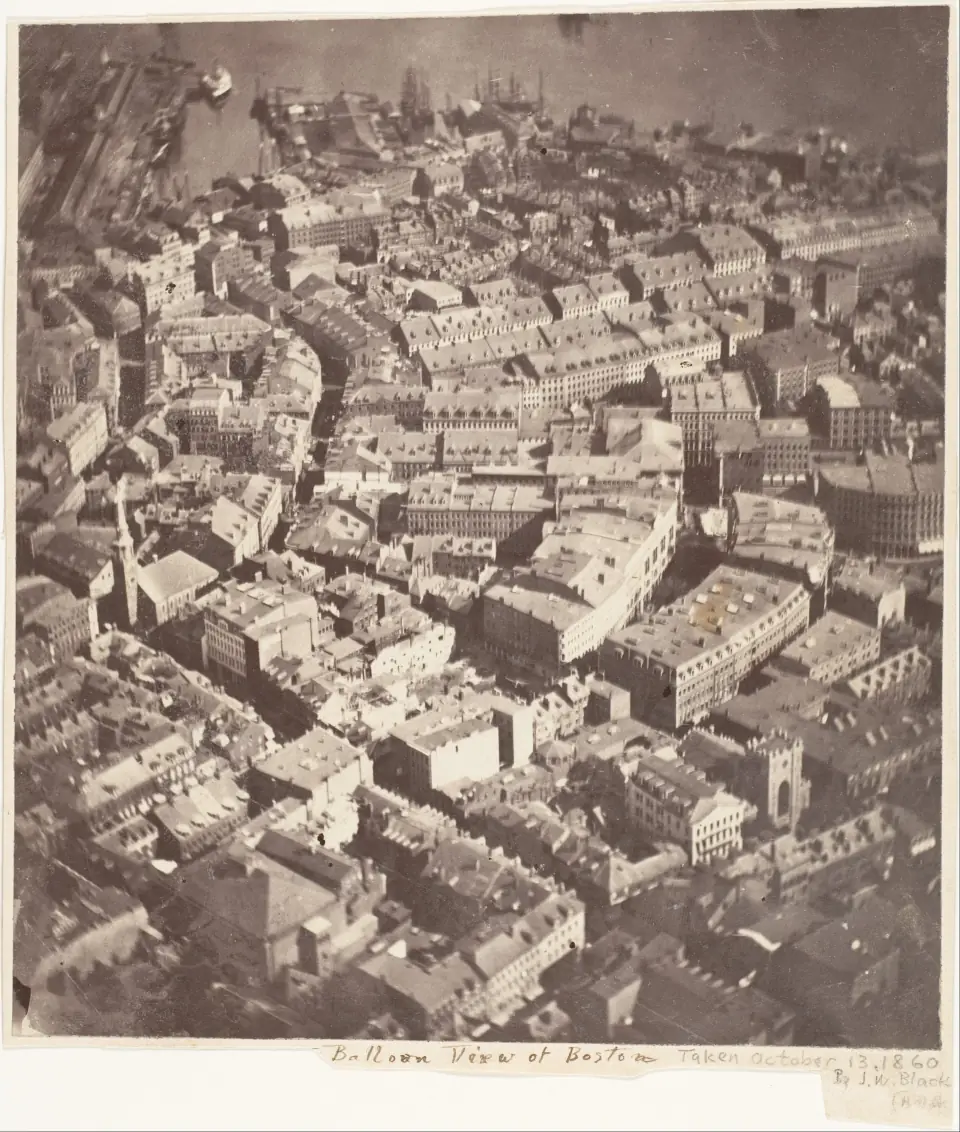
Boston from a balloon in 1860: rooftops, wharves and ships seen from twelve hundred feet, in a circular vignette.
James Wallace Black, "Boston, as the Eagle and the Wild Goose See It," October 13, 1860. The Met, public domain (Met Open Access).

No. 041 · Aerial, the survivor

Eight plates went up in the balloon. One came back alive.

The oldest surviving aerial photograph: Boston from 1,200 feet, shot from a tethered balloon while the photographer coated and developed wet plates in the basket, which is exactly as easy as it sounds; of about eight attempts, this is the one that worked.68 (Nadar photographed Paris from a balloon two years earlier, but his plates are lost, so Boston keeps the crown.) Oliver Wendell Holmes, reviewing it, marveled at "Boston, as the eagle and the wild goose see it." Drone photography is this picture with the balloon shrunk and the prayer removed.

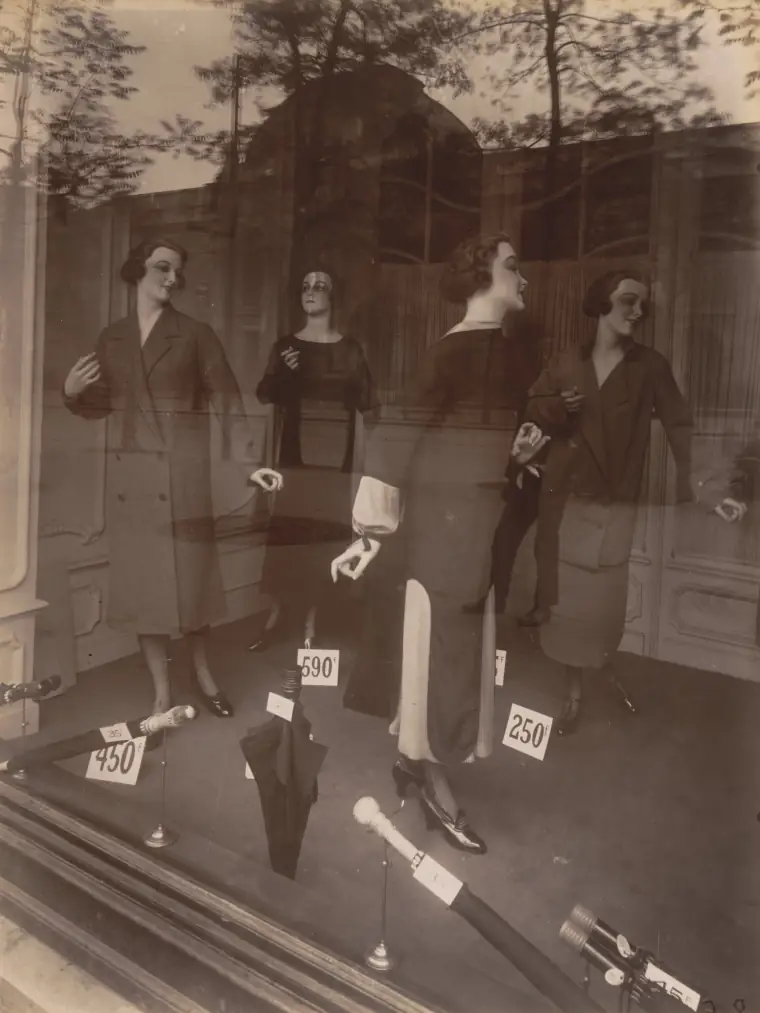
A 1925 Atget photograph of a Paris shop window: suited mannequins glowing behind glass, the street reflected over them.
Eugène Atget, "Magasin, avenue des Gobelins," 1925. Wikimedia Commons, public domain.

No. 042 · Street, the patron saint

His door said "Documents for artists." The documents turned out to be the art.

For thirty years Eugène Atget hauled a wooden view camera through Paris at dawn, photographing shopfronts, courtyards and vendors before the crowds came, eight to ten thousand plates of a city he could feel disappearing.69 He insisted he made reference documents, not art, and sold prints to painters for francs. The surrealists adored him anyway (these glowing mannequins explain why), and after his death in 1927, the young photographer Berenice Abbott bought his studio's contents for about $400 and spent four decades convincing the world.69 Final score: the world agreed. Portraiture's peaks are still ahead of you, by the way: Cameron's Herschel in Roll 08, Douglass and the cracked-plate Lincoln in Roll 07.

ROLL 07 · 1862 to 1945

Witness

Photographs that changed laws, and a few that bent the truth.

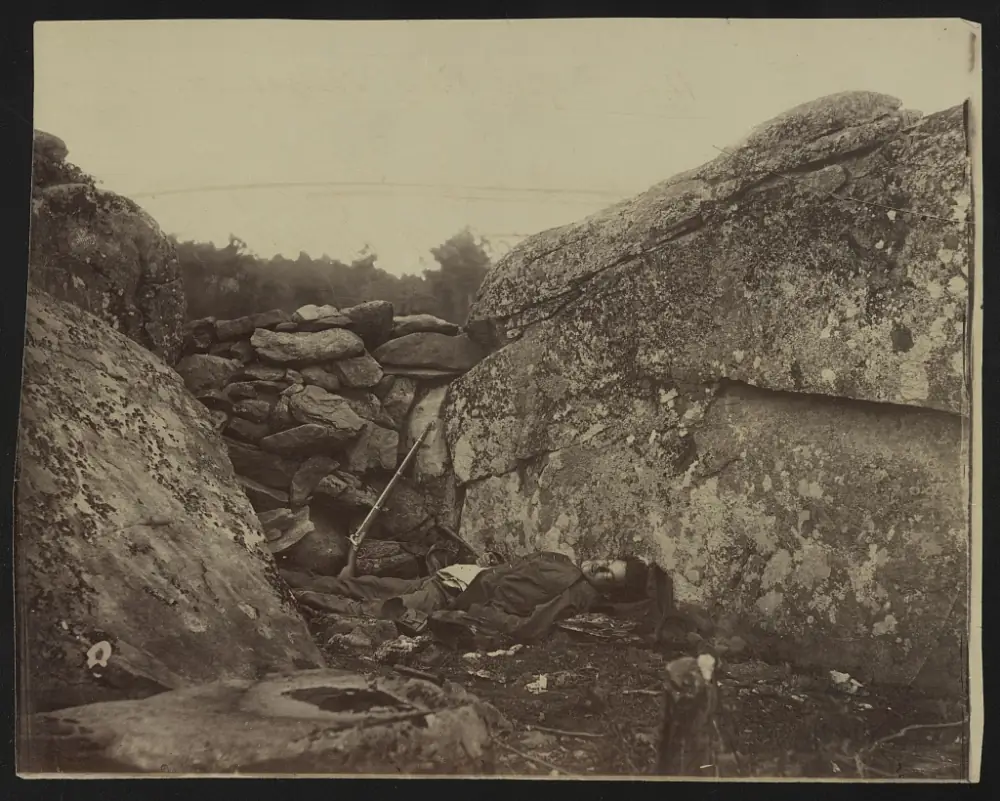
Home of a Rebel Sharpshooter, Gettysburg 1863: a dead Confederate soldier lying in a stone-walled rocky den, a rifle propped against the wall.
Alexander Gardner and Timothy O'Sullivan, "Home of a Rebel Sharpshooter," Gettysburg, July 1863. Library of Congress, no known restrictions.

No. 043 · War comes home, staged

America met its war dead in a gallery. This one was dragged into position.

In October 1862, Mathew Brady's New York gallery hung photographs of the dead at Antietam, and the New York Times wrote that if Brady "has not brought bodies and laid them in our dooryards and along the streets, he has done something very like it."70 The photos were Alexander Gardner's; Brady took the credit; Gardner quit. The next summer at Gettysburg, Gardner's team found this soldier, photographed him where he fell, then moved the body roughly 40 yards into a more dramatic stone den, propped a rifle that was not his against the wall, and shot again. A researcher matched the two corpses in 1961.71 The first war photography and the first war-photo scandal, same crew, one year apart.

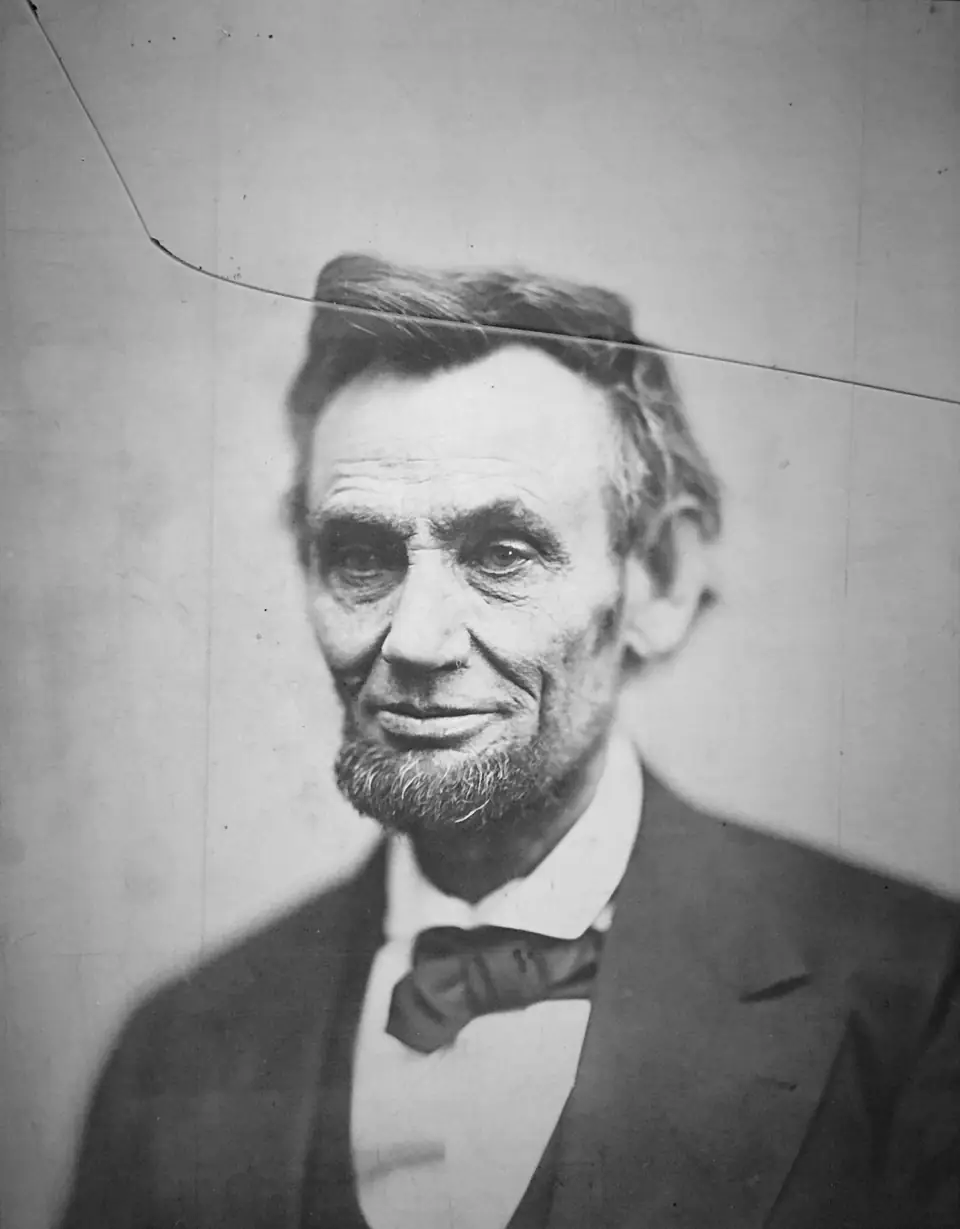
The cracked-plate portrait of Abraham Lincoln, 1865: a close, tired, faintly smiling Lincoln with a crack in the negative arcing across the top of the image.
Alexander Gardner, the "cracked plate" portrait, February 5, 1865. National Portrait Gallery. Wikimedia Commons, public domain.

No. 044 · One print, then the glass broke

The negative cracked. Gardner printed it once and threw the plate away.

Ten weeks before the assassination, Gardner moved in close for one last exposure of a visibly exhausted Lincoln, and got the warmest, most modern portrait of him that exists, the hint of a smile included. Then the glass negative cracked through the top. Gardner pulled a single print and discarded the plate.72 That one print, fissure arcing over Lincoln's head like an omen, is now at the National Portrait Gallery, and it is hard to look at without flinching at the calendar: February 5, 1865.

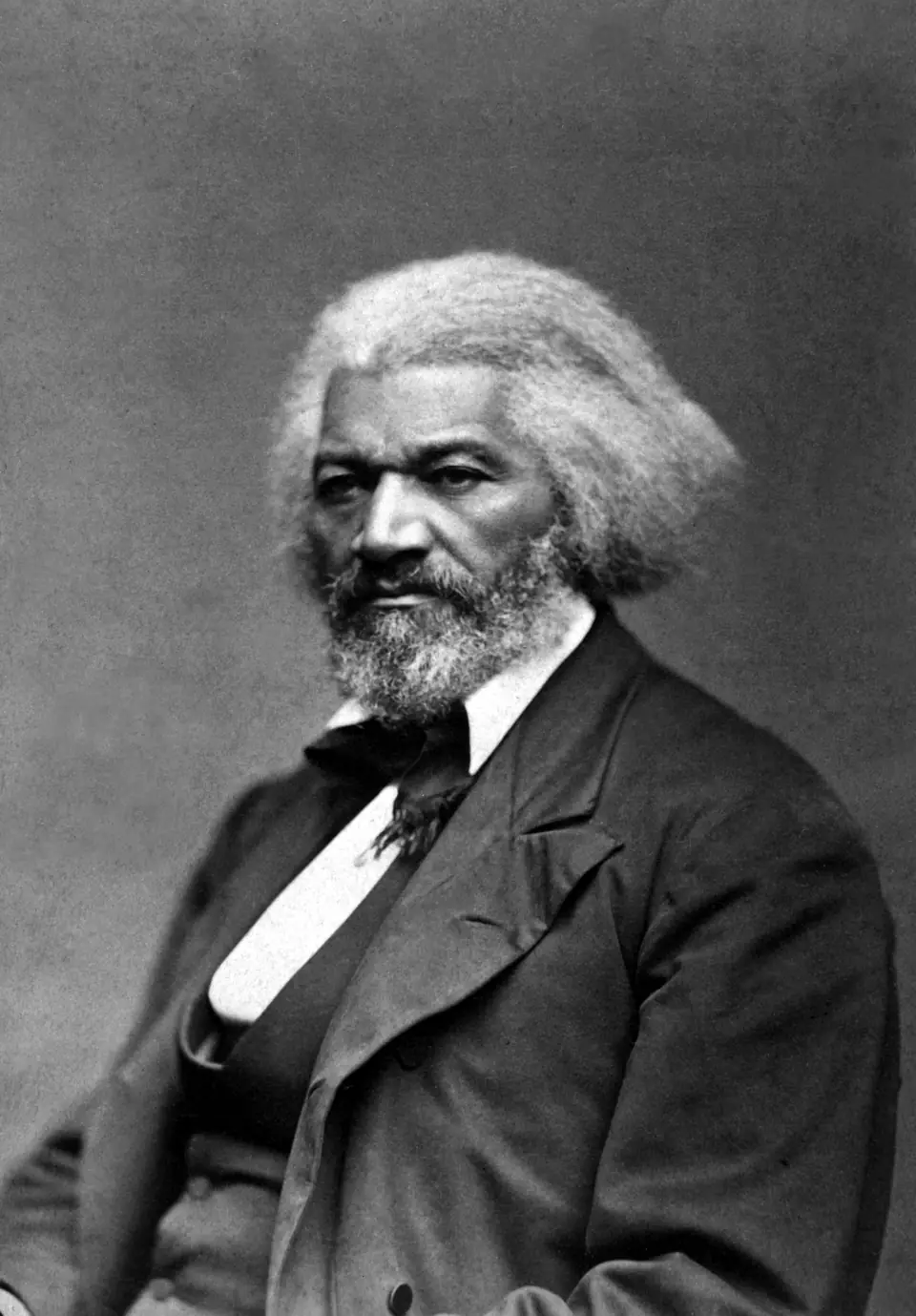
Frederick Douglass around 1879: a formal portrait of Douglass with white hair, set jaw, and a direct, unsmiling gaze.
Frederick Douglass, circa 1879, by George K. Warren. National Archives. Wikimedia Commons, public domain.

No. 045 · The most photographed American of his century

He out-sat Lincoln on purpose, and never once smiled.

Frederick Douglass sat for at least 160 separate portraits, more than Lincoln's 126, more than any American of the 1800s.73 None of it was vanity; it was strategy. He wrote four lectures on photography arguing that the camera, unlike the caricaturist's pen, rendered a Black man as he actually was, and that a cheap portrait in every pocket would democratize dignity itself. The unsmiling face was policy too: he refused to hand the world the grinning caricature it kept asking for.73 Every deliberate, level portrait was an argument, repeated 160 times.

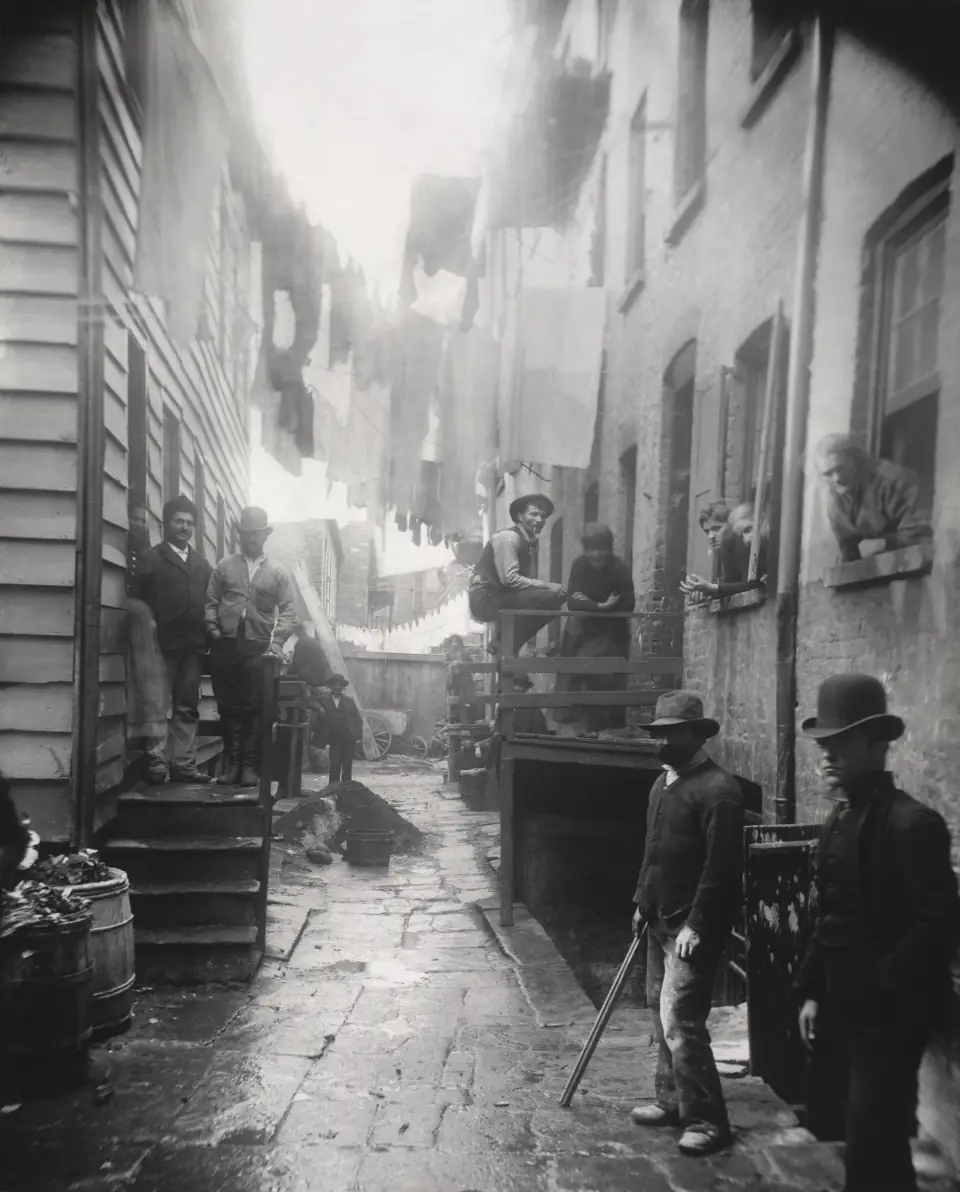
Bandit's Roost, 1888: men leaning in a narrow, laundry-strung Lower Manhattan alley, staring at the camera.
Jacob Riis, "Bandit's Roost, 59 1/2 Mulberry Street," 1888. Wikimedia Commons, public domain.

No. 046 · Flash powder as a crowbar

He lit the tenements with small explosions, and the law followed him in.

To photograph the unlit alleys and lodging rooms of 1880s New York, Jacob Riis fired magnesium flash powder, at first from a device like a revolver, later from a frying pan, which he said felt "more homelike."74 He set two rooms on fire, lit his own clothes once, and nearly blinded himself. The resulting book, "How the Other Half Lives" (1890), landed on the desk of the city's new police commissioner, who left a card at Riis's office: "I have read your book, and I have come to help." Signed, Theodore Roosevelt.74 The Mulberry Bend slum in this frame was razed into a park within a decade.

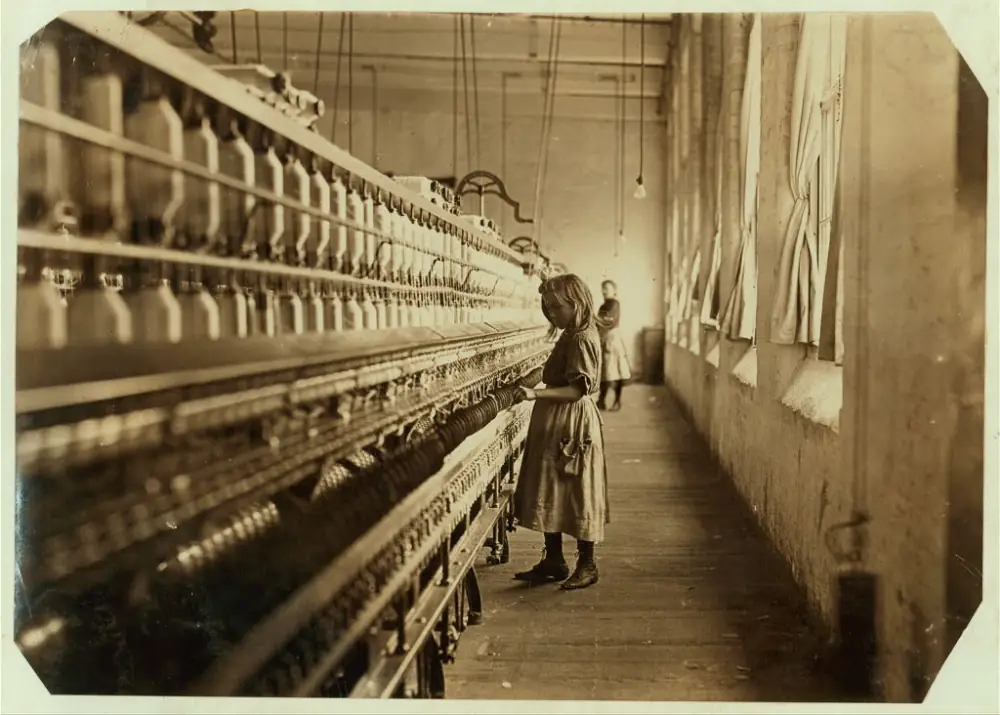
Sadie Pfeifer, a small girl in a work dress, standing at a towering cotton spinning frame in a 1908 South Carolina mill.
Lewis Hine, "Sadie Pfeifer, 48 inches high, has worked half a year," Lancaster, South Carolina, 1908. Library of Congress, no known restrictions.

No. 047 · The photos that ended an industry's habit

He measured children's heights against his coat buttons, and Congress blinked.

Mills did not admit reformers, so Lewis Hine arrived as a fire inspector, a bible salesman, a postcard photographer, whatever opened the door. Inside he shot fast and took notes with his hand hidden in his pocket, gauging kids' heights against the buttons of his own coat.75 His captions read like indictments because they were: Sadie here is logged as 48 inches high, half a year of mill work. Over 5,000 of these photographs armed the National Child Labor Committee, fed the first federal child-labor law in 1916, and shamed the states into the rest.75

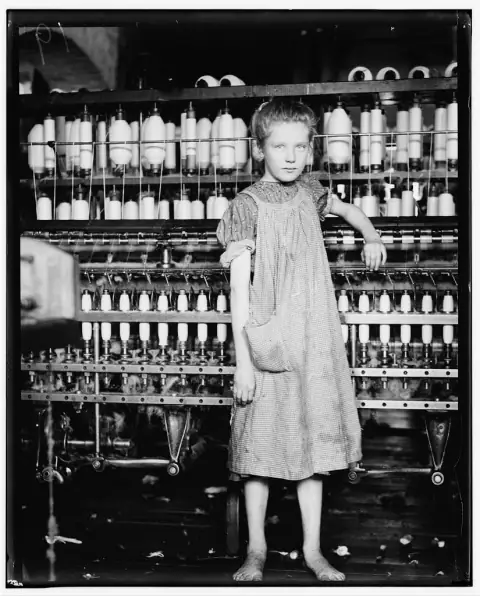
Addie Card, a barefoot twelve-year-old spinner, leaning on a spinning frame in a Vermont cotton mill, 1910.
Addie Card, 12, Vermont, 1910. In 1998 she ended up on a US postage stamp. Library of Congress, no known restrictions.
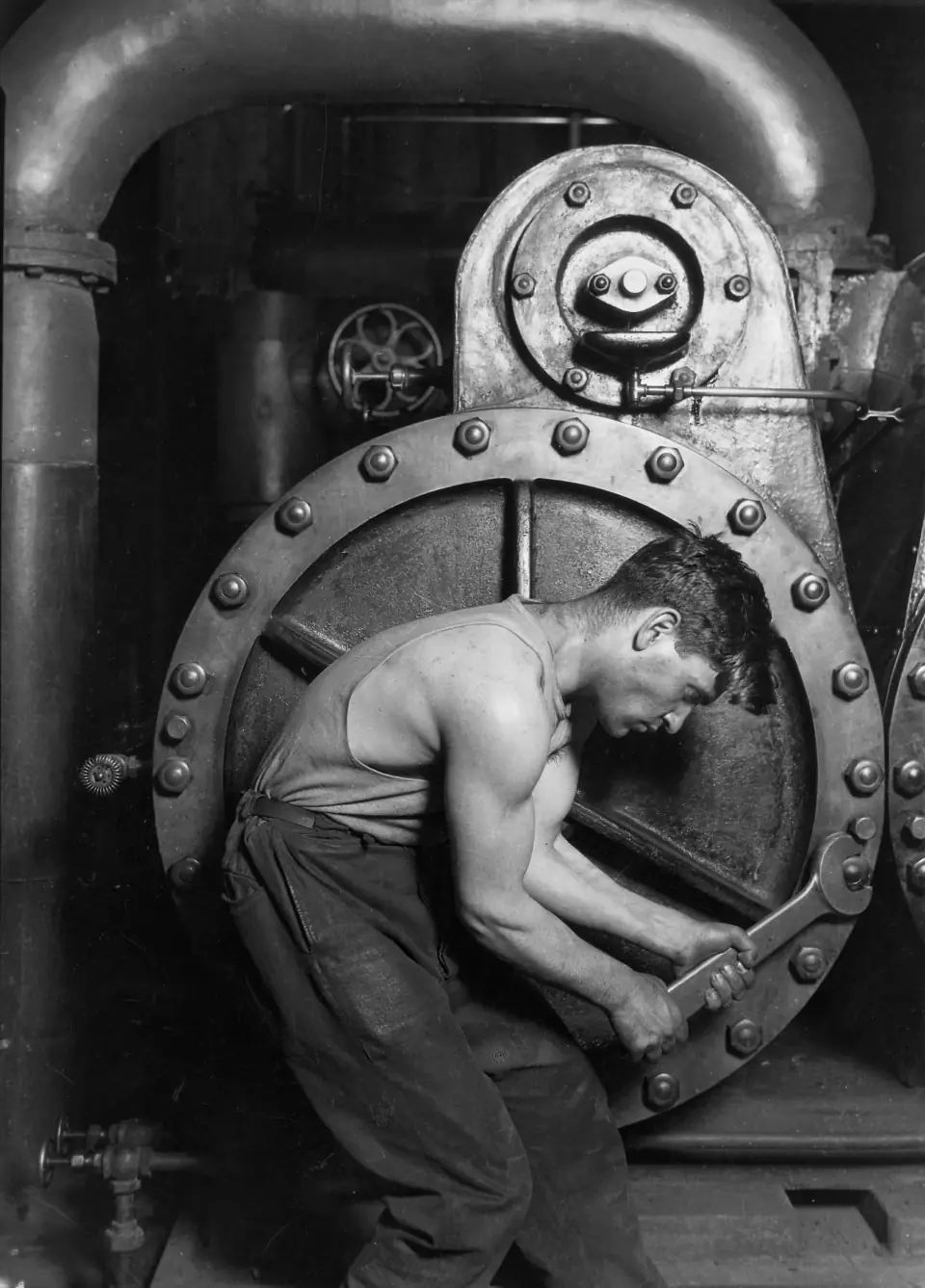
Powerhouse mechanic, 1920: a muscular worker curled into the circle of a huge steam pump wheel, wrench in both hands.
Lewis Hine, "Power house mechanic working on steam pump," 1920. National Archives. Wikimedia Commons, public domain.

No. 048 · The other side of Hine

After fighting machines for kids, he photographed a man as the machine's equal.

Same photographer, opposite sermon. In the 1920s Hine turned to "work portraits" celebrating skilled labor, and this is the one the century kept: a mechanic curved into the geometry of his pump like a figure off a coin.75 It is posed, proudly so. Hine spent the 1900s proving photography could shame industry and the 1920s proving it could ennoble the people inside it. Both worked.

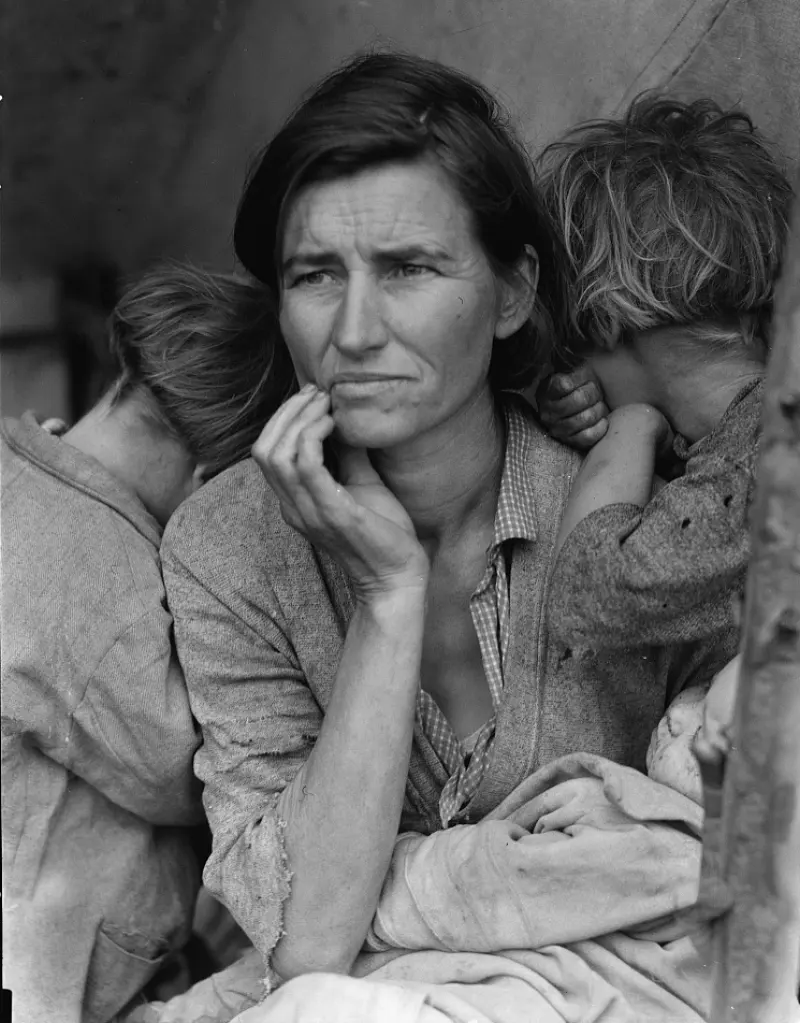
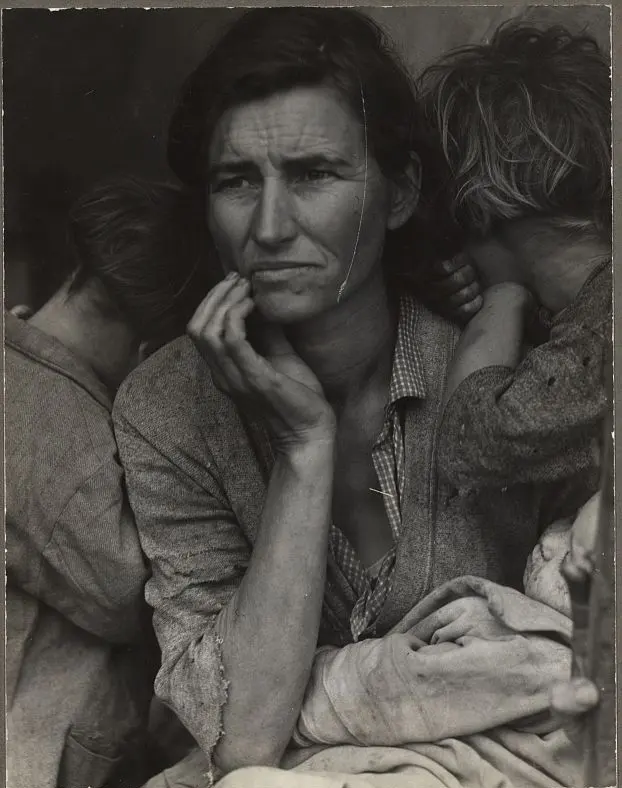
Migrant Mother, the famous retouched version: Florence Owens Thompson with two children turned away and a baby in her lap; the lower right shows no thumb. Migrant Mother, the unretouched file print: identical scene, but a thumb grips the tent pole at the lower right corner. 1936 print · thumb intact retouched negative
Dorothea Lange, "Migrant Mother," Nipomo, California, March 1936, unretouched file print (left) against the retouched negative (right). Drag the handle; watch the lower right corner. Library of Congress, FSA/OWI Collection, public domain.

No. 049 · The most famous photograph in America, lightly edited

Ten minutes, six exposures, one erased thumb.

Lange almost didn't stop. Twenty miles past the "PEA-PICKERS CAMP" sign she turned the car around, walked up to a mother of seven in a lean-to tent, and made her exposures in about ten minutes, "as if drawn by a magnet."76 The pea crop had frozen; thousands of pickers were stranded. When the photo ran, the government rushed 20,000 pounds of food to the camp. Florence Owens Thompson and her family had already moved on, and got none of it.77

Two codas. In 1939 Lange had Thompson's thumb retouched out of the negative's corner because it bothered her composition; her boss at the FSA, a documentary purist, never forgave the edit, and the Library of Congress keeps both versions, which is why you can drag a slider between them today.76 And Thompson stayed anonymous until 1978, when a reporter found her in a trailer park. Her review: "I wish she hadn't taken my picture."77

The wider first frame of the Migrant Mother session: the family's lean-to tent with children and belongings scattered around it.
Where the session started: the first, widest frame of the same ten minutes. Library of Congress, public domain.
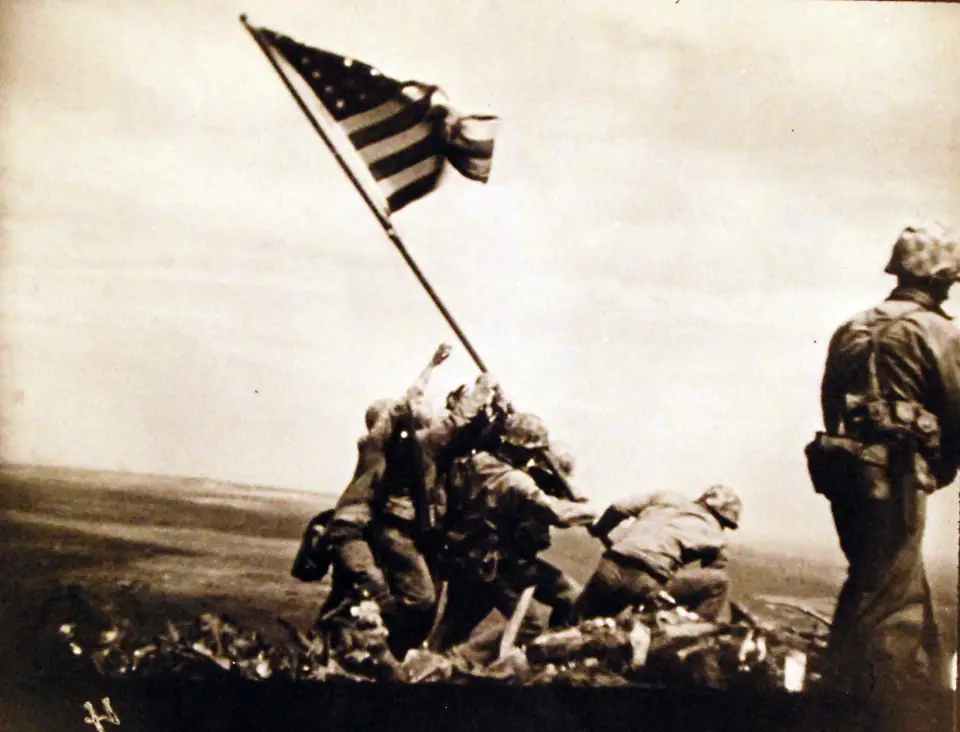
A color film frame of the second flag raising on Iwo Jima: Marines planting the flagpole on Mount Suribachi.
Sgt. Bill Genaust, USMC, film frame of the second flag raising, Mount Suribachi, February 23, 1945. U.S. Marine Corps footage, National Archives, public domain. Via Wikimedia Commons.

No. 050 · The same three seconds, from one step away

The most famous photo of the war is copyrighted. The proof it was real is not.

Joe Rosenthal swung his Speed Graphic up without aiming and caught the Iwo Jima flag raising at 1/400th of a second; it won the Pulitzer that same year and belongs to the AP.78 The "it was staged" rumor started when Rosenthal, asked about a different, posed group shot, answered "sure" to the wrong question, and a correspondent cabled the smear around the world.79 The rebuttal stands one step to his left: Marine Sgt. Bill Genaust filmed the identical moment in color, frame for frame, no rehearsal possible. This is one of those frames, free for anyone to see, because Marine photography belongs to the public. Genaust was killed in a cave on the island nine days later.79

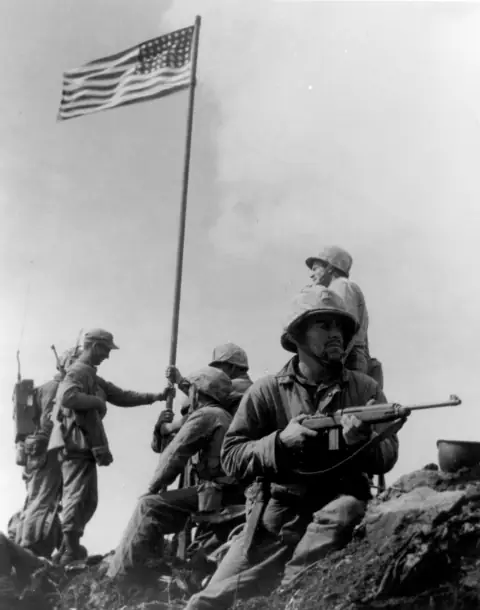
Marines around the first, smaller flag raised on Mount Suribachi a few hours earlier.
The forgotten first flag, raised hours earlier, by Sgt. Lou Lowery, USMC. Public domain.

Told, not shown · Magnum holds the rights

Cartier-Bresson and the puddle jumper

"Behind the Gare Saint-Lazare," Paris, 1932: a man leaps a flooded lot, heel one millimeter from his reflection, while a circus poster of a leaping dancer mirrors him on the wall behind. Cartier-Bresson shot it through a gap in a board fence so narrow it clipped the left edge of the frame; he could barely see what he was doing.80 He later gave the whole discipline its creed: the decisive moment, "the simultaneous recognition, in a fraction of a second, of the significance of an event" and the exact arrangement that expresses it. The most perfectly timed photograph ever made was half blind luck, swung on a lifetime of practice.

Told, not shown · estate copyright

The nanny in the storage locker

In 2007 a Chicago storage unit went delinquent and its contents sold at auction. A local historian paid about $380 for boxes of negatives by an unknown name: Vivian Maier, a nanny who had shot roughly 150,000 frames of mid-century street life on her days off and shown them to almost no one.81 She died in 2009, just before the world decided she was one of the great street photographers of the century. The copyright fight over a dead nanny's negatives took years of lawyers. She would probably have hated all of it.

ROLL 08 · 1856 to 1942

The Print Is the Performance

Darkroom tricks, mule trains, and the zone system.

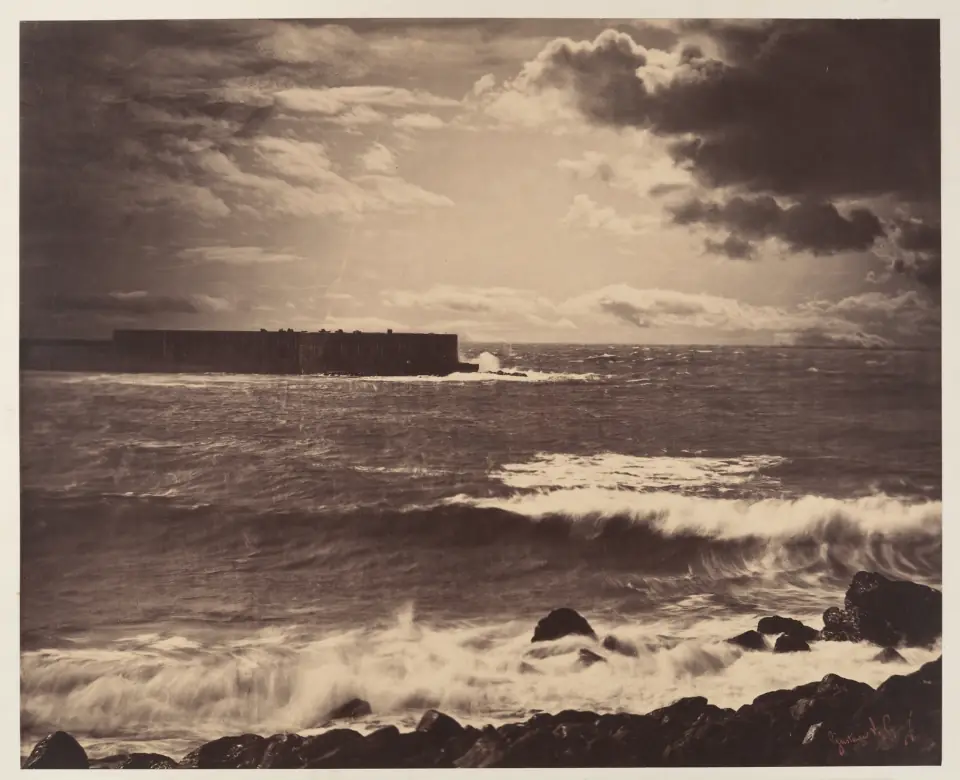
The Great Wave, Sete, 1857: a dramatic albumen seascape of waves breaking over rocks beneath a luminous clouded sky.
Gustave Le Gray, "The Great Wave, Sète," 1857. The Met, public domain (Met Open Access).

No. 051 · The first famous composite

That sky and that sea were never in the same photograph.

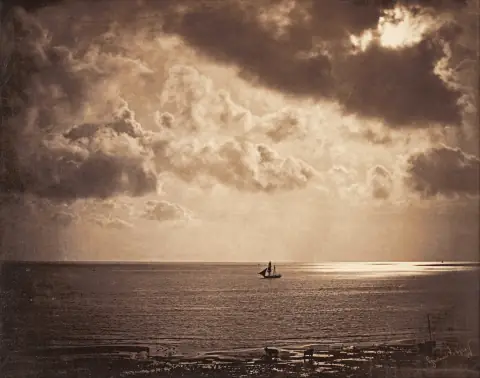
1850s film could expose for the sea or the sky, never both; one of them always burned to blank white. Le Gray's fix made him, for a few years, the most famous photographer alive: expose two negatives, one for water and one for clouds (sometimes shot on different days, occasionally over a different ocean), then print them together and hide the seam at the horizon.82 Crowds in London queued for prints. So the most celebrated sky in early photography is, technically, a sky transplant, done with glass and egg whites a century and a half before Photoshop. He died broke in Cairo anyway; fame had no royalties.82

Brig upon the Water, 1856: a small ship on a silvery sea under a vast glowing sky.
"Brig upon the Water," 1856, the print that started the frenzy. Commons, public domain.
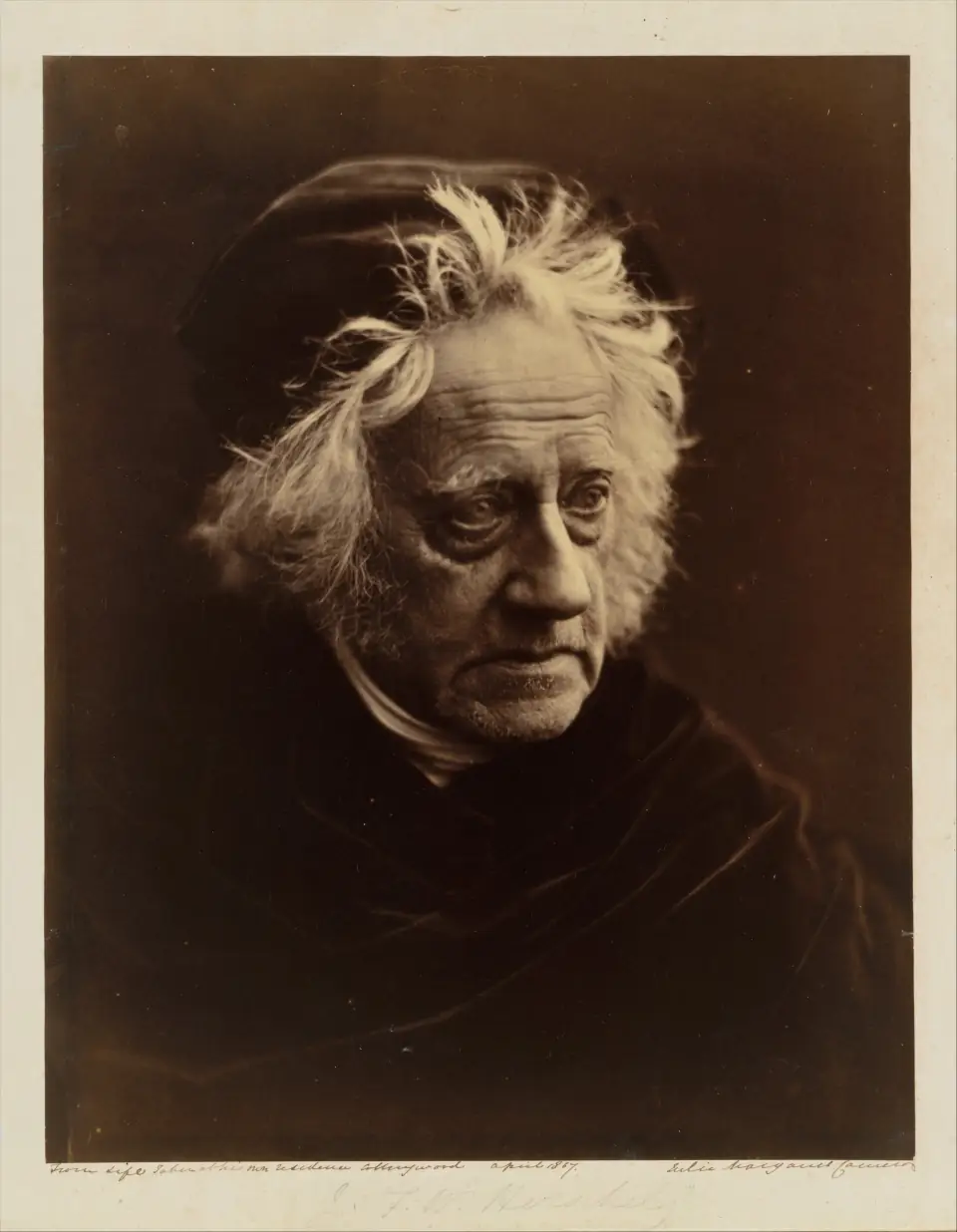
Julia Margaret Cameron's 1867 portrait of John Herschel: the astronomer's deeply lined face emerging from darkness under a halo of wild white hair.
Julia Margaret Cameron, "Sir John Herschel," April 1867. The Met, public domain (Met Open Access).

No. 052 · Soft focus, on purpose

She started at 48, broke every rule, and washed his hair first.

Julia Margaret Cameron got her first camera at 48, a gift from her daughter: "It may amuse you, Mother, to try to photograph."83 Within a few years she was making portraits like nobody since: huge, close, deliberately soft. Critics savaged the focus; one journal granted her "daring originality, but at the expense of all other photographic qualities."83 For this sitting she had her old friend Herschel, the astronomer who literally coined the word "photography," wash his hair so it would flare in the light like a nebula. The critics are footnotes now. This portrait hangs in museums.

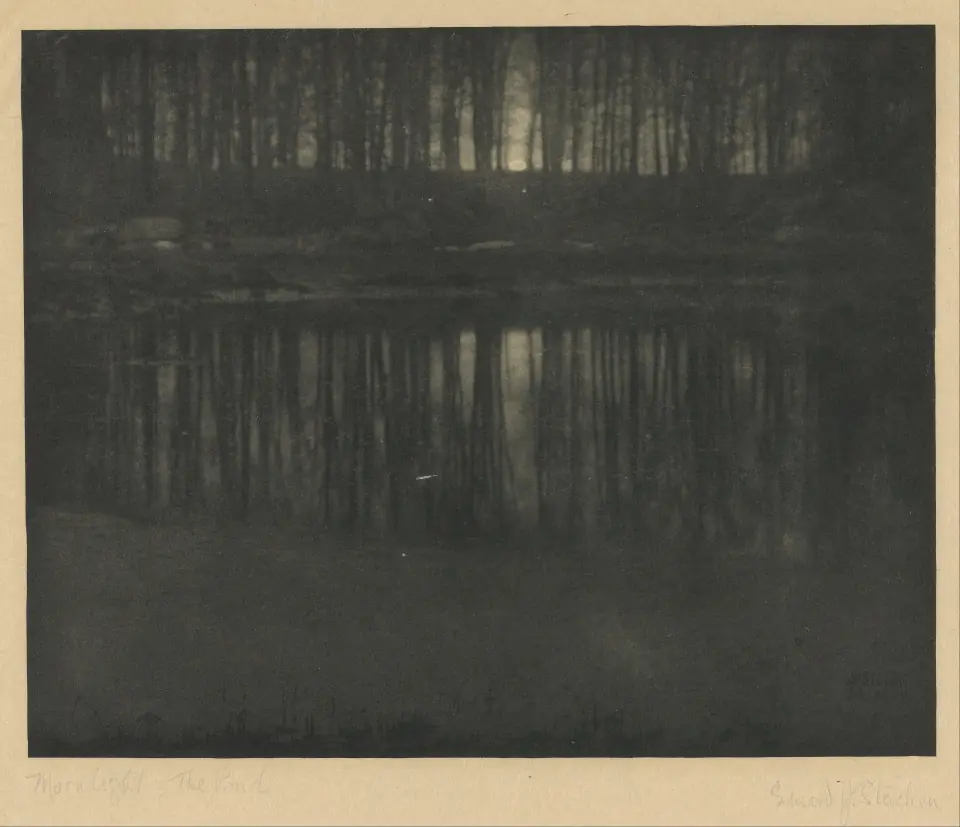
The Pond, Moonlight, 1904: a dark dreamlike pond between trees with a moonglow breaking through, in hand-applied blue-green tones.
Edward Steichen, "The Pond, Moonlight," 1904. Wikimedia Commons, public domain.

No. 053 · A photograph painted with light, then with hands

Three prints exist. No two are the same color. One sold for $2.9 million.

This is a photograph wearing a painting's clothes: Steichen coated the platinum print by hand with layers of light-sensitive gum, building that moonlit blue-green one wash at a time. Only three prints were ever made and each came out different, which makes each effectively unique.84 In 2006 one of them sold for $2,928,000, the world record for any photograph at the time.84 It held that record for five years, and it is the only record-holder you will meet tonight that was made by hand, in the dark, with a brush.

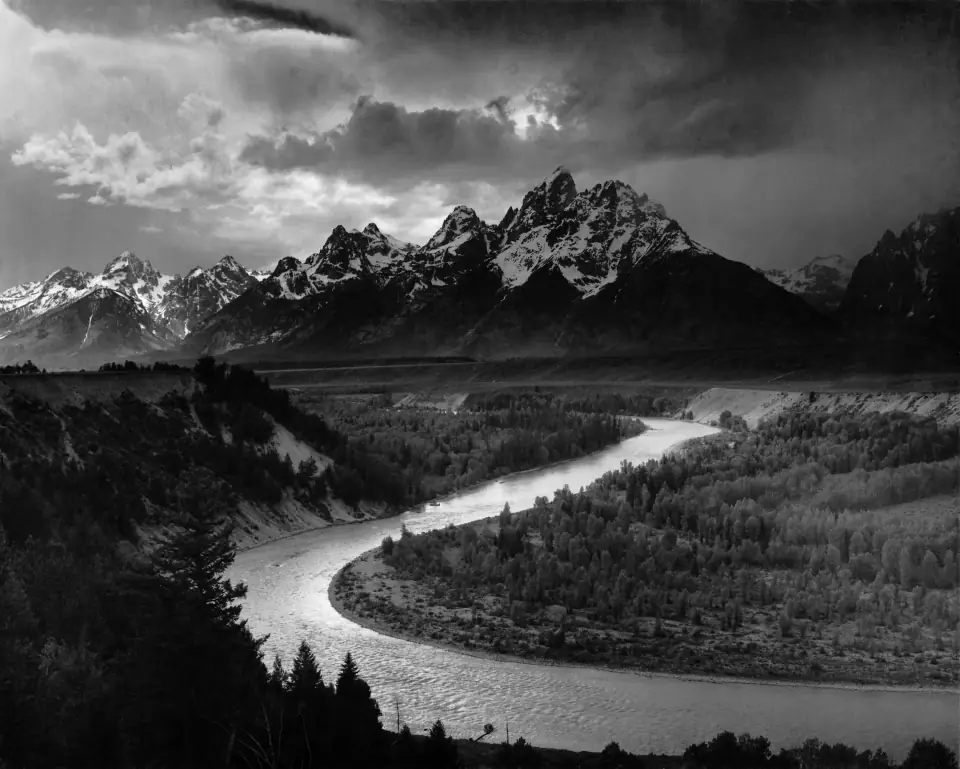
The Tetons and the Snake River, 1942: the river curving in silver S-bends toward jagged peaks under storm light.
Ansel Adams, "The Tetons and the Snake River," 1942, made for the Department of the Interior. National Archives (79-AAG-1). NARA, public domain as US government work.

No. 054 · The zone system

"The negative is the score, and the print the performance."

Adams was a concert pianist before he was a photographer, and he meant the line literally: the negative holds the notes, the darkroom is where you play them, hands dodging and burning light like phrasing.85 His zone system splits the world into eleven brightnesses, Zone 0 (pure black) to Zone X (paper white), one stop apart, so you can decide where every tone lands before you click. Run your finger across it:

Zone V · Middle gray, 18%: the meter's home. Tap a zone.

This Tetons print exists because Adams shot it for the federal government's mural project, which is why you may use it freely forever, and why it is also aboard both Voyager spacecraft, image 42 on the Golden Record, currently leaving the solar system.86

Field notes · the one he metered off the Moon

The story
"Moonrise, Hernandez, New Mexico," Nov 1, 1941, 4:49 p.m. Light dying, light meter lost somewhere in the car.87
The save
he knew the Moon's luminance by heart (250 candelas per square foot), placed it on Zone VII, and exposed. One frame. The light was gone before a duplicate.87
The payoff
he printed that negative more than 1,300 times over his life; a print sold for $930,000 in 2021. Copyrighted, so it lives at the link.87
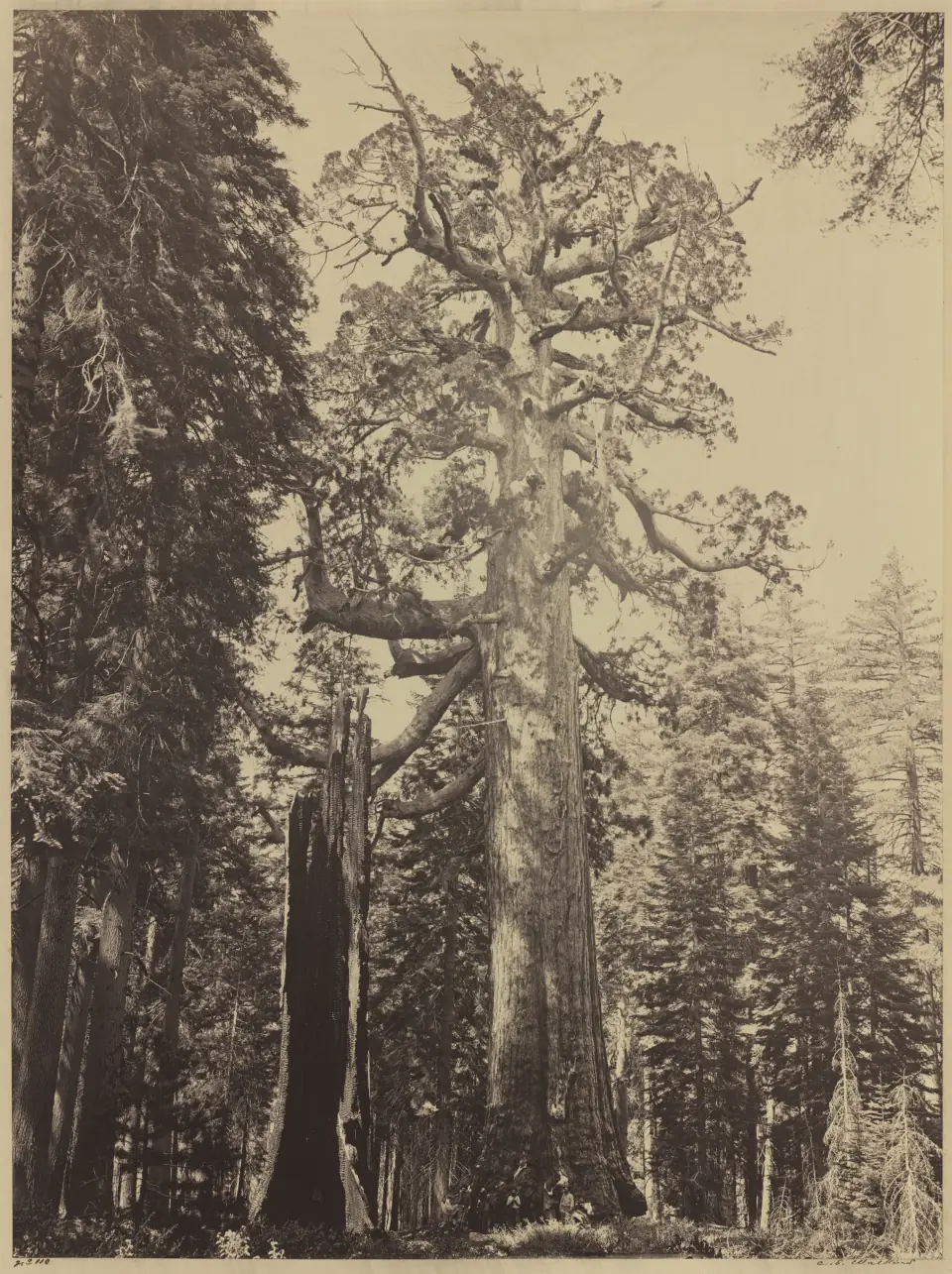
The Grizzly Giant sequoia, 1861: a colossal tree towering over the forest in a mammoth-plate photograph.
Carleton Watkins, "Grizzly Giant, Mariposa Grove," 1861. National Gallery of Art. Wikimedia Commons, CC0.

No. 055 · The photographs that invented the national park

A ton of glass by mule train, and Congress believed the tree.

In 1861 Carleton Watkins hauled roughly a ton of equipment into Yosemite by mule: a custom camera the size of a doghouse shooting 18-by-22-inch glass plates, plus the chemicals to coat and develop them on the spot in a tent.88 The prints went east, reached Congress, and in 1864, mid-Civil War, Lincoln signed the Yosemite Grant, the first time any government protected land purely because it was beautiful. The national park idea starts with these negatives. Watkins lost nearly all of them in the 1906 San Francisco fire, was committed to an asylum, and died there; the prints that had already left his studio did the surviving for him.88

Field notes · why a fine print glows

Silver gelatin
light passes through the image, bounces off a bright baryta base underneath, and comes back out through the tones. The print is backlit by itself.89
Platinum
no coating at all; the metal sits in the paper's fibers. Noble-metal image, century-plus lifespan, midtones like fog lifting.89
The point
"sharpness" was never the whole game. The masters were engineering how light leaves the paper.
ROLL 09 · 1827 to 1852

Where It All Began

The ancestors look like mud. Everything you just saw descends from them.

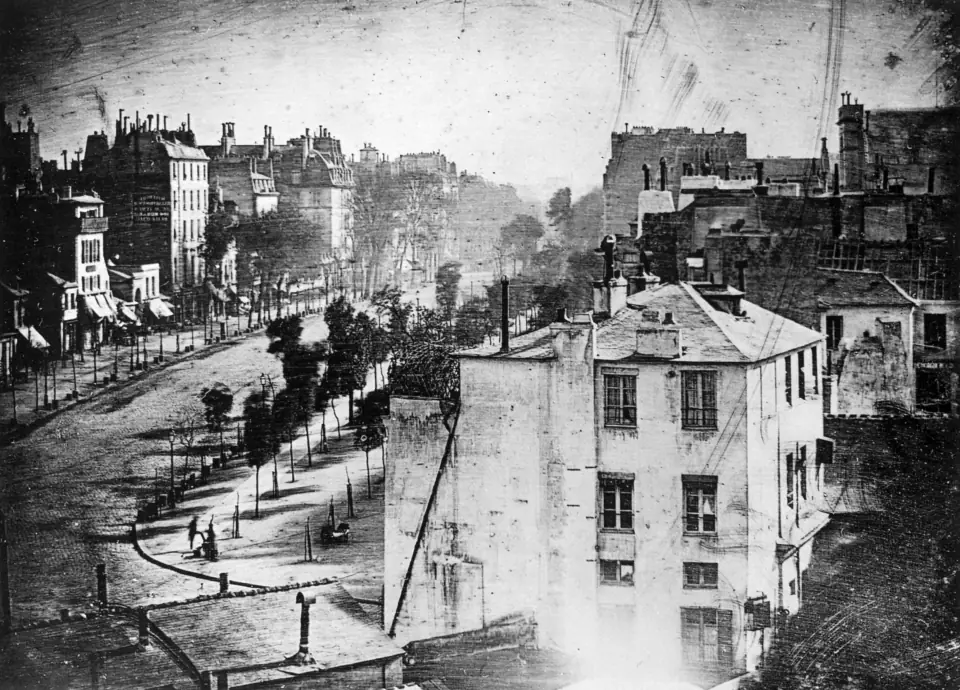
Boulevard du Temple, Paris, 1838: a long daguerreotype view of an empty-looking boulevard, with one tiny man standing at a shoeshine stand in the lower left.
Louis Daguerre, "Boulevard du Temple," 1838. Wikimedia Commons, public domain.

No. 056 · The first human in a photograph

A whole city of people, and the camera kept one.

This Paris boulevard was packed with carriages and pedestrians at 8 a.m. The exposure ran several minutes, so everything that moved simply evaporated from the record.90 The exceptions, lower left: a man who stopped to get his boots polished, and the crouching bootblack polishing them. He held still long enough to become the first human being ever photographed, then walked off without the faintest idea. The magnified circle finds him for you. The original plate, by the way, was destroyed in the 1970s by a museum cleaning gone wrong; every crisp version you have ever seen is a copy photograph made earlier.90

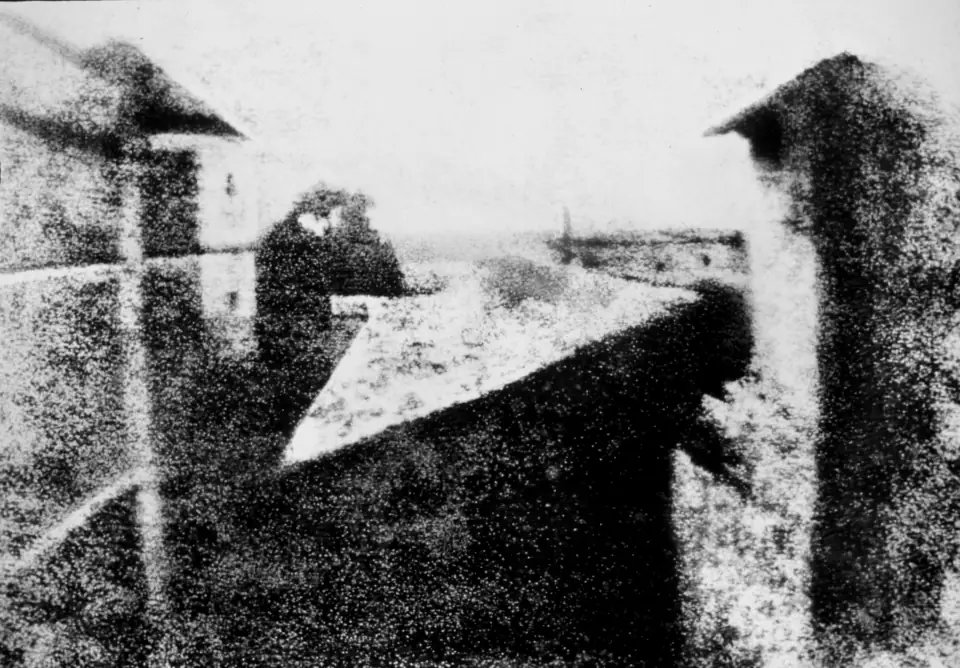
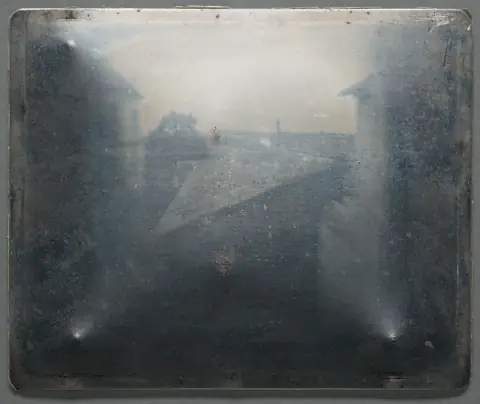
View from the Window at Le Gras, the first photograph: ghostly pale rooftops and a courtyard rendered in smeared gray tones on a pewter plate.
Joseph Nicéphore Niépce, "View from the Window at Le Gras," 1827. The 1952 enhanced reproduction. Wikimedia Commons, public domain.

No. 057 · The first photograph

The oldest photograph on Earth looks like nothing. Stare anyway.

Mud, ghosts, a roofline: this is the one that started everything, around 1827. Niépce coated a pewter plate with asphalt and let his Burgundy courtyard burn itself in for days, so long that sunlight hits opposite walls at once.91 The plate then spent half a century lost in English storage trunks until two historians ran it down in 1952.92 It now lives in Austin, Texas, sealed in an oxygen-free case like a tiny metal astronaut, the great-great-grandparent of every image above and of the two trillion photos humanity will take this year.91

The actual Niepce pewter plate photographed in raking light in 2020: a shiny gray metal rectangle with the faint image barely visible.
The actual plate, photographed in 2020. Tilt your head and squint; that is the first photograph in there. Commons, public domain.
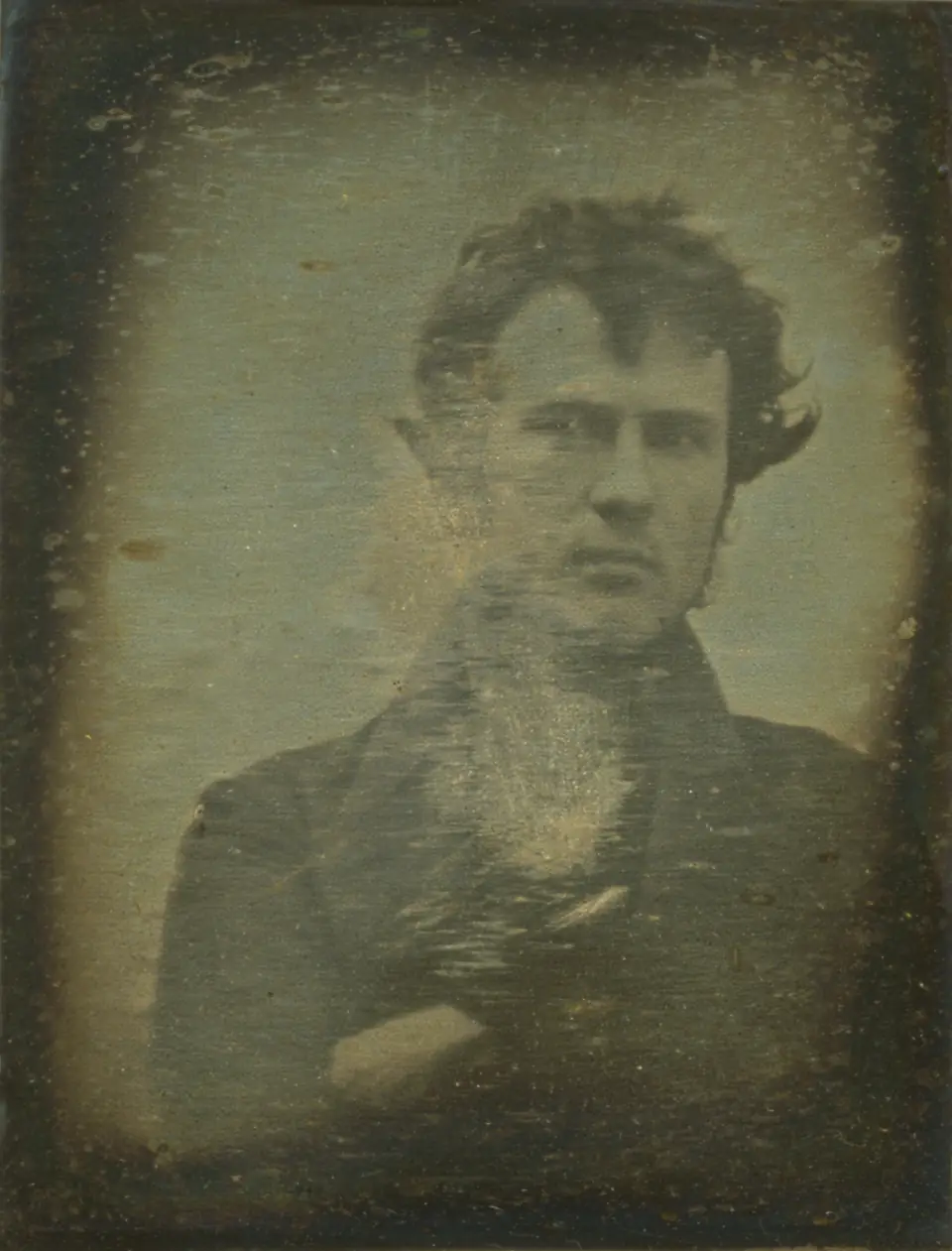
Robert Cornelius in 1839: a young man with windblown hair and crossed arms, looking warily at the camera, slightly off-center.
Robert Cornelius, self-portrait, 1839. Wikimedia Commons / Library of Congress, public domain.

No. 058 · The first selfie and the first fake

Vanity and lying: both invented within photography's first eighteen months.

Philadelphia, 1839: Robert Cornelius uncapped the lens, sprinted into frame, held that wary stare for about a minute, then wrote on the back, "The first light Picture ever taken. 1839."93 No viewfinder, no second take, hair doing whatever it wants. Every selfie since is a remake.

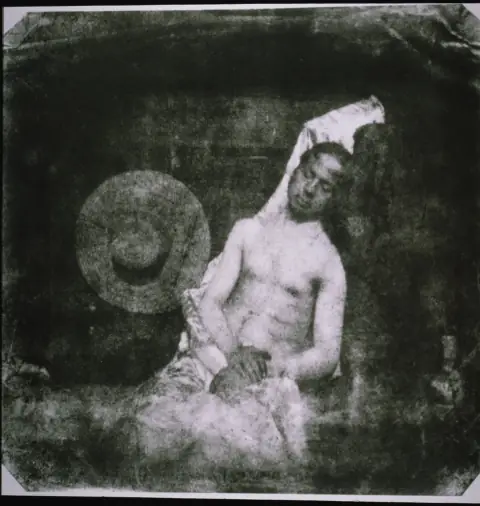
A year later in Paris, Hippolyte Bayard, an inventor of photography the government chose to ignore (Daguerre got a 6,000-franc-a-year pension; Bayard got 600 francs, once), staged his own drowned corpse and captioned it as the suicide of an unappreciated genius, warning that "the face and hands of the gentleman are beginning to decay."94 His suntan played the decay. The first fake photograph was a revenge prank, and it still lands.

Hippolyte Bayard posed shirtless and slumped as a drowned corpse, eyes closed, hands dark, in the first staged photograph.
Bayard, "Self Portrait as a Drowned Man," 1840. Commons, public domain.
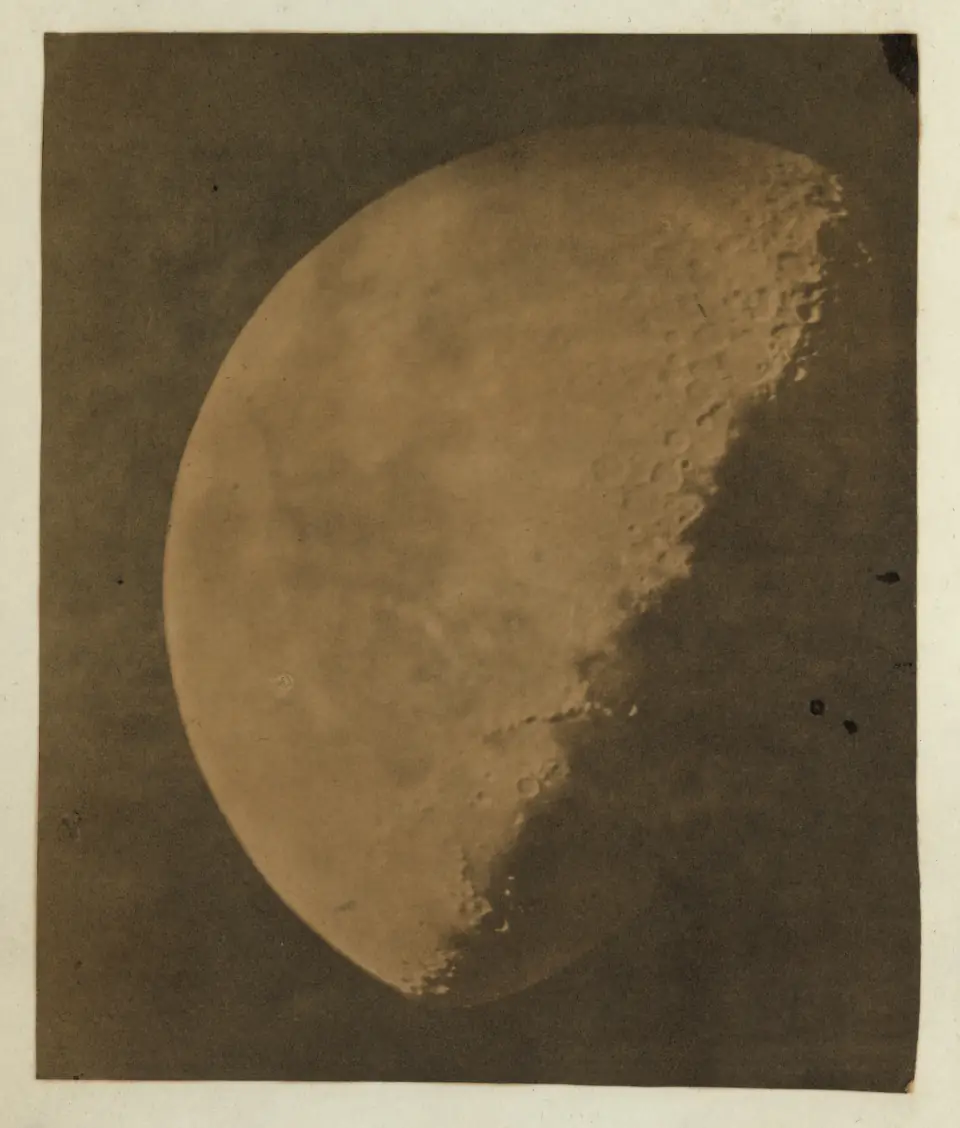
An 1851 daguerreotype of the Moon: a luminous gibbous moon floating in black, craters and seas faintly visible.
John Adams Whipple with William and George Bond, the Moon, March 1851, through Harvard's Great Refractor. Commons / Library of Congress, public domain.

No. 059 · The first great astrophoto

1851: the Moon sits for its portrait.

Whipple bolted a camera to the largest telescope in America, let Harvard's clockwork drive track the sky, and made the Moon hold still. The result won a medal at the 1851 Great Exhibition in London, where it was hailed as the start of "a new era in astronomical representation."95 A year earlier the same crew had caught Vega, the first star ever photographed, in an exposure of about 100 seconds.95 Every space photo you saw back in Roll 03 grew from this plate.

Field notes · what a daguerreotype actually was

The plate
silver on copper, buffed to a literal mirror. The image flips positive to negative as you tilt it.96
Developing
held over heated mercury vapor, around 75°C. Yes, the fumes. They knew. They mostly did it anyway.96
Posing
iron clamps hidden behind the neck to keep sitters still, which is one reason nobody in the 1840s is smiling.96
Price
a good portrait ran 2 to 5 days' wages. People paid it; it was a shot at outliving yourself.96
Resolution
the image is grainless silver-mercury nanoparticle. Modern researchers call single plates gigapixel-class.97

Cincinnati, September 24, 1848, at 1:55 in the afternoon

⟷ drag to pan

An eight-plate daguerreotype panorama of the 1848 Cincinnati riverfront: steamboats, warehouses, church spires and hills sweeping across two miles of shoreline.

Eight daguerreotype plates shot from a Kentucky rooftop, covering two miles of riverfront. This is the oldest surviving photograph of an American city at this scale, and the detail is absurd: under a microscope, conservators read the church clock (1:55 p.m.) and the names painted on steamboats. Researchers estimate each plate holds the equivalent of 140,000 megapixels.97 You are panning a 265-megapixel scan; the plates still have more to give.98

Charles Fontayne and William Porter, 1848. Wikimedia Commons / Public Library of Cincinnati and Hamilton County, public domain.

ROLL 10 · The machines

The Cameras

A dollar box, a folding miracle, and the phone that ate them all.

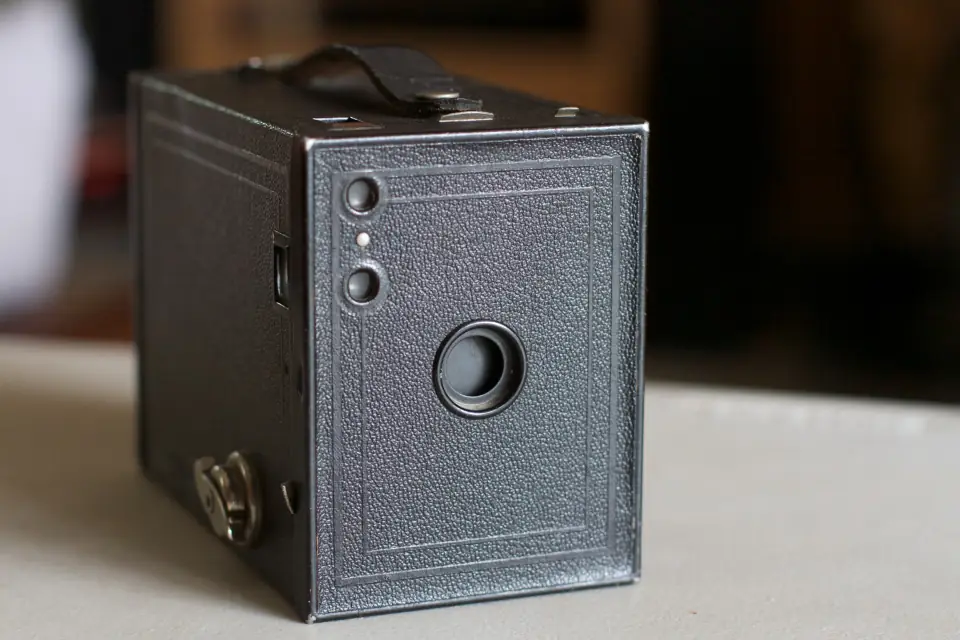
A simple black box Kodak Brownie camera with a small lens, sitting against a plain background.
The Kodak Brownie, the one-dollar camera, introduced February 1900. Wikimedia Commons, CC0.

No. 060 · The camera for everyone

One dollar, and photography stopped being for photographers.

Kodak's 1888 slogan promised "You press the button, we do the rest," but the camera still cost $25, a month's pay. The Brownie of 1900 finished the thought: one dollar for the camera, 15 cents a roll, named after a comic-strip elf to make clear children were welcome.99 Over 150,000 sold in the first year, and the family snapshot was invented more or less on the spot.99 Almost every photo in this gallery before 1900 was made by a specialist hauling a laboratory. Nearly everything after exists because a cardboard box made witnesses of everybody.

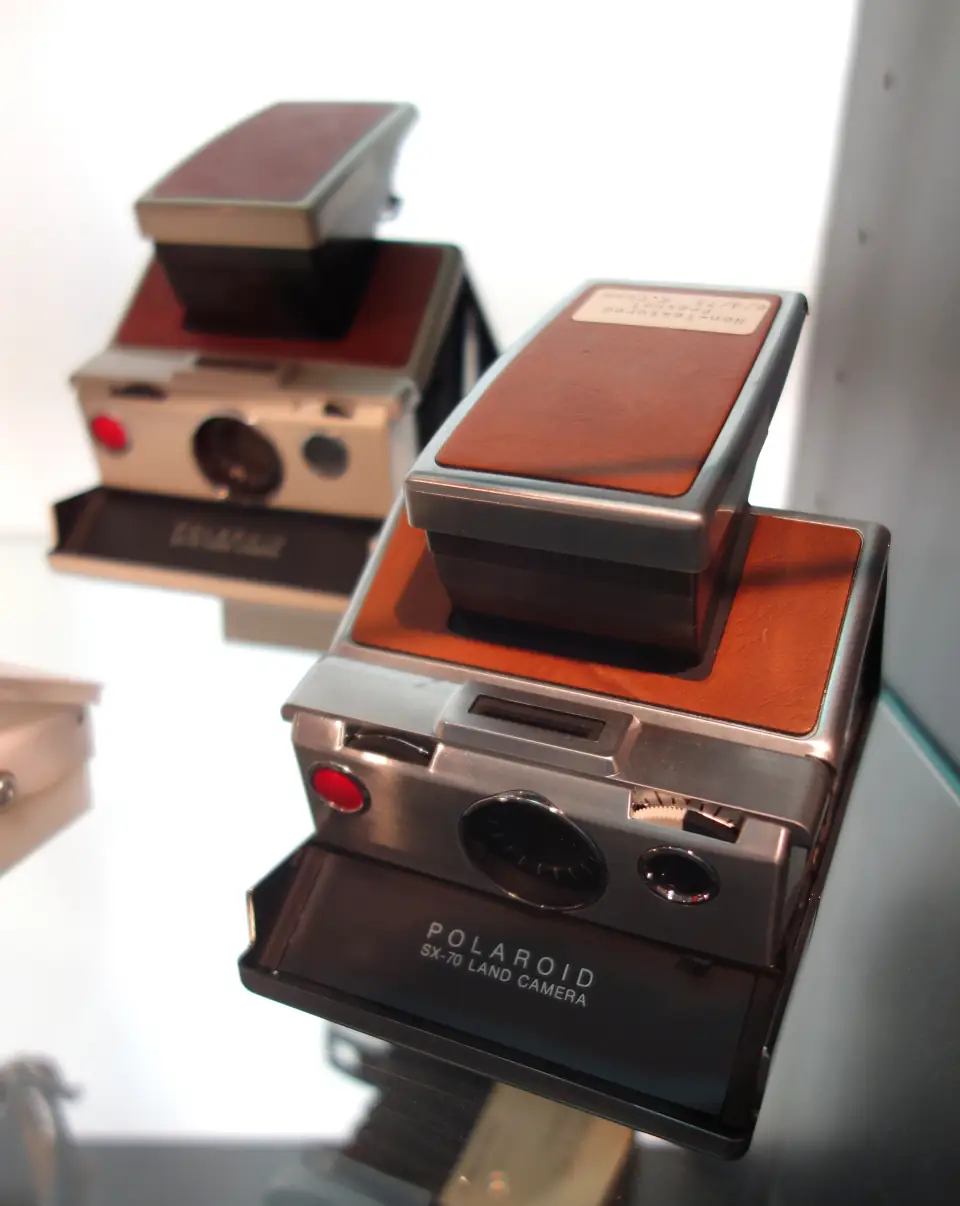
A Polaroid SX-70: the flat folding chrome-and-leather instant camera, opened into its angular shooting position.
The Polaroid SX-70, 1972. MIT Museum. Wikimedia Commons, CC0.

No. 061 · The minute-long darkroom

He pulled it from his jacket and shot five photos in ten seconds.

At Polaroid's 1972 annual meeting, Edwin Land produced a flat leather-and-chrome object from his suit pocket, unfolded it into a camera, and fired five exposures in ten seconds; each one developed itself in daylight, in his hand.100 The SX-70 was a folding single-lens reflex with a chemical darkroom inside every print, and the gasp it caused has only one modern equivalent, and you already own it. Quiet detail for this gallery: Ansel Adams, high priest of the perfect print, worked as a paid Polaroid consultant from 1949 until his death, mailing Land test photographs for decades.100

The pocket revolution, 1914

An asthmatic engineer shrinks the camera

UR-LEICA · 1914 · fits in a coat pocket

Oskar Barnack loved hiking and had asthma; plate cameras weighed like furniture. So in 1914 he built a pocket camera around 35mm movie film, running it sideways and doubling the cine frame to 24 by 36 millimeters.101 That accidental rectangle is still called "full frame" on cameras sold this morning. When Leica finally productized it in 1925, photography left the tripod and went walking; the candid, the street photo, the decisive moment all fit in a coat pocket now. In 2022 his personal prototype, 0-series No. 105, became the most expensive camera ever sold: 14.4 million euros.50

The afterthought, 1975

Kodak invents the digital camera, then looks away

A 24-year-old Kodak engineer named Steven Sasson wired a CCD sensor to a lens and a cassette deck and produced, in December 1975, the first digital camera: 8 pounds, the size of a toaster, 0.01 megapixels, 23 seconds to record one black-and-white frame to tape.102 Playback was on a TV. Management's response, as Sasson tells it, was that no one would ever want to look at their pictures on a television set, and please don't tell anyone about it; the film business was doing fine.102 Kodak filed for bankruptcy in 2012, the year the smartphone camera became the only camera most people own.

DEDICATED CAMERAS SHIPPED, WORLDWIDE millions of units · CIPA members 121.5M ~66M ~24M 15.2M 7.7M 2010 2013 2016 2019 2023 meanwhile: phones now take ~5,000,000,000 photos a day
Camera industry shipments, CIPA data. The phone did this in fifteen years.

No. 062 · The camera that ate the cameras

Two trillion photographs a year, and almost none of them by "a camera."

Dedicated camera shipments fell roughly 94 percent from their 2010 peak.103 Humanity now takes around two trillion photos a year, about 5 billion a day, an estimated 94 percent of them on phones.104 Photographers saw it coming and even gave it a blessing in advance: "The best camera is the one that's with you."105 Worth saying in this room: the Brownie pulled the same trick in 1900, and photography came out bigger, stranger and better. It usually does.

ROLL 11 · February 14, 1990

The Dot

The farthest portrait ever made of you.

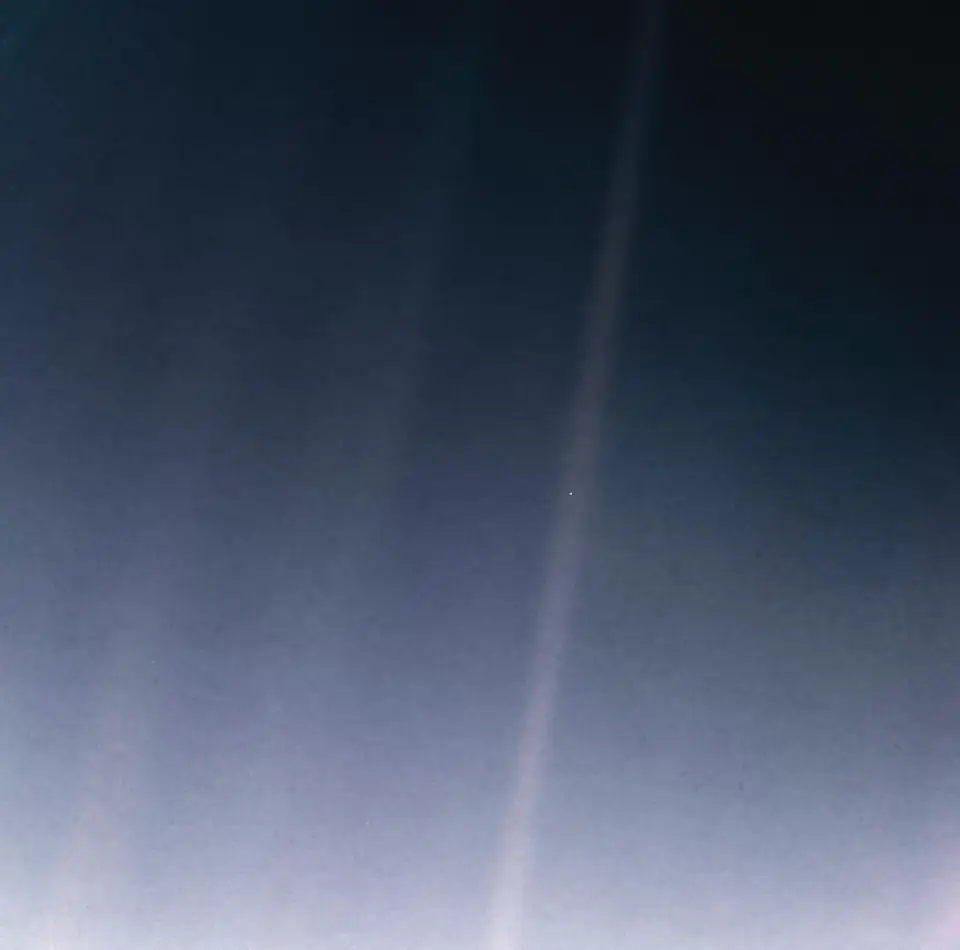
Pale Blue Dot: bands of scattered sunlight across darkness, with Earth as a single faint pale pixel suspended in one beam.
Voyager 1, "Pale Blue Dot," February 14, 1990, reprocessed 2020 (PIA23645). NASA/JPL-Caltech, public domain.

No. 063 · The farthest photograph of home

Earth, from 3.8 billion miles: smaller than one pixel.

Carl Sagan lobbied for years to turn Voyager 1's camera around before it was shut down forever; engineers resisted because pointing near the Sun risked the optics. On Valentine's Day 1990 they took the family portrait anyway, and Earth came out as 0.12 of a pixel, hanging in a stray sunbeam.106 The cameras were powered off soon after to save energy. This is among the last things they ever saw.

"Look again at that dot. That's here. That's home. That's us. On it everyone you love, everyone you know, everyone you ever heard of, every human being who ever was, lived out their lives... a mote of dust suspended in a sunbeam."Carl Sagan, "Pale Blue Dot," 1994107

Two hundred years, end to end. A pewter plate that needed days of sunlight; a camera that films light itself crossing a bottle. A man who got his boots shined into immortality; a planet that posed for a robot at Saturn because it was asked nicely. The equipment never stopped changing. The impulse never changed at all: this mattered, hold still, let me keep it.

You carry a better camera than almost everything in this gallery. The pictures above were made by people who hauled mule trains, flew kites into a ruined sky, sat in the snow with a turkey feather. The least you can do is photograph something you love today, carefully, like it might hang in a dark room two centuries from now. It might.

FIN · 107 SOURCES BELOW · EVERY IMAGE FREE TO KEEP LOOKING AT

Sources

  1. "List of most expensive photographs," Wikipedia. en.wikipedia.org
  2. "Not a Betting Man: Stanford, Muybridge, and the Palo Alto Wager Myth," California History (2017). muse.jhu.edu
  3. Stanford Magazine, "The Man Who Stopped Time"; Library of Congress, "The Horse in Motion." stanfordmag.org · loc.gov
  4. "People v. Muybridge," Wikipedia. en.wikipedia.org
  5. "Chronophotographic gun," Wikipedia; BIU Santé Marey dossier. en.wikipedia.org · numerabilis.u-paris.fr
  6. History of Information, Mach and Salcher photograph a supersonic projectile (1886-87). historyofinformation.com
  7. "Prandtl-Glauert singularity," Wikipedia (the 1999 Gay photograph and the vapor-cone mechanism). en.wikipedia.org
  8. A. M. Worthington, "A Study of Splashes" (1908), full text. archive.org
  9. MIT Museum, "Milk Drop Coronet"; "Rapatronic camera," Wikipedia. mitmuseum.mit.edu · en.wikipedia.org
  10. MIT News, "Trillion-frame-per-second video" (2011); Ramesh Raskar's TED talk. news.mit.edu · ted.com
  11. Caltech, "Ultrafast Camera Takes 70 Trillion Pictures Per Second" (2020). caltech.edu
  12. Library of Congress, Prokudin-Gorskii collection overview. loc.gov
  13. National Science and Media Museum, the "Christina" identification; "Autochrome Lumière," Wikipedia. scienceandmediamuseum.org.uk · en.wikipedia.org
  14. Natural History Museum, "Anna Atkins's cyanotypes: the first book of photographs." nhm.ac.uk
  15. SciHi blog on Maxwell's 1861 demonstration; the 1961 Kodak ultraviolet explanation. scihi.org · tbsnews.net
  16. Atlas Obscura on Röntgen's first X-rays; Harvard Countway Library on the 1895 hand. atlasobscura.com · collections.countway.harvard.edu
  17. The Franklin Institute, "Case Files: William Jennings." fi.edu
  18. Apollo 8 Flight Journal, day 4 onboard transcript. nasa.gov
  19. "Earthrise," Wikipedia (Galen Rowell's assessment). en.wikipedia.org
  20. "The Blue Marble," Wikipedia. en.wikipedia.org
  21. Hasselblad, "Hasselblad in Space"; NPR, "The Camera That Went To The Moon." hasselblad.com · npr.org
  22. NASA History, "Photos from STS-41B" (the McCandless quote). nasa.gov
  23. "Lunar Orbiter Image Recovery Project," Wikipedia; MoonViews, "McMoon's." en.wikipedia.org · moonviews.com
  24. National Geographic, "When Hubble Stared at Nothing for 100 Hours." nationalgeographic.com
  25. ESA/Hubble, the eXtreme Deep Field release (heic1214). esahubble.org
  26. "Webb's First Deep Field," Wikipedia; ESA/Webb SMACS 0723 image page. en.wikipedia.org · esawebb.org
  27. ESA/Webb, Pillars of Creation release (weic2216). esawebb.org
  28. JPL, "Famous Space Pillars Feel the Heat" (2007); "Pillars of Creation," Wikipedia (current status). jpl.nasa.gov · en.wikipedia.org
  29. NASA, "Hubble Traces Hidden History of Andromeda Galaxy" (the 2.5-gigapixel mosaic). science.nasa.gov
  30. Smithsonian Air & Space, "The First Photo From Space." smithsonianmag.com
  31. "The Day the Earth Smiled," Wikipedia. en.wikipedia.org
  32. "LSST Camera," Wikipedia (3,200 megapixels, Guinness largest digital camera, the romanesco test photo). en.wikipedia.org
  33. NSF-DOE Vera C. Rubin Observatory / NOIRLab, "First Imagery" release, June 23, 2025 (the Cosmic Treasure Chest, 1,100+ exposures, 2,104 new asteroids). noirlab.edu
  34. NASA, Perseverance's selfie with Ingenuity, PIA24542 (62 stitched frames). images.nasa.gov · jpl.nasa.gov
  35. "JPEG," Wikipedia (1992 standard; block transform and what it discards). en.wikipedia.org
  36. "PNG," Wikipedia (created 1995-96 after Unisys began enforcing the LZW patent used by GIF; "Burn All GIFs" protest). en.wikipedia.org · en.wikipedia.org
  37. "Bayer filter," Wikipedia (Bryce Bayer, 1976; RGGB and demosaicing). en.wikipedia.org
  38. NASA EPIC / DSCOVR (the camera at L1; the July 2015 lunar transit). epic.gsfc.nasa.gov · nasa.gov
  39. Google AI Blog, "Night Sight: Seeing in the Dark on Pixel Phones" (2018) and "Astrophotography with Night Sight" (2019). ai.googleblog.com
  40. "World Record Egg," Wikipedia. en.wikipedia.org
  41. The Value, "Man Ray's Le Violon d'Ingres sets photograph auction record at Christie's" (May 2022). en.thevalue.com
  42. Christie's, "The Surrealist World of Rosalind Gersten Jacobs and Melvin Jacobs," May 14, 2022 (lot result). christies.com
  43. "Untitled #96," Wikipedia (the Sherman sale). en.wikipedia.org
  44. Artnet News, "Is That $6.5 Million Peter Lik Photo Sale for Real? Probably Not!" news.artnet.com
  45. "Rhein II," Wikipedia (the sale and the Gursky quote). en.wikipedia.org
  46. Rob Roy's George R. Lawrence archive, the Mammoth camera; Atlas Obscura, "The World's Biggest Camera." robroy.dyndns.info · atlasobscura.com
  47. Library of Congress, "San Francisco in Ruins" item and panoramic-photography essay. loc.gov · loc.gov
  48. "The Great Picture," Wikipedia; Smithsonian press release on its display. en.wikipedia.org · si.edu
  49. Rijksmuseum, "717 gigapixel photograph of The Night Watch" (2022). rijksmuseum.nl
  50. Leica Camera, "Leica prototype sets new world record: 14.4 million euros" (June 2022). leica-camera.com
  51. Taschen, "Helmut Newton's SUMO." taschen.com
  52. "Monkey selfie copyright dispute," Wikipedia; Naruto v. Slater, 9th Cir. (2018). en.wikipedia.org · law.justia.com
  53. "Cottingley Fairies," Wikipedia. en.wikipedia.org
  54. "Surgeon's photograph," in "Loch Ness Monster," Wikipedia. en.wikipedia.org
  55. Museum of Hoaxes, "The Lincoln-Calhoun Composite." museumofhoaxes.com
  56. NIST, "Fiftieth Anniversary of First Digital Image"; PBS NewsHour, Kirsch obituary (the square-pixel quote). nist.gov · pbs.org
  57. "Falcon Heavy test flight," Wikipedia (synchronized booster landings; Starman and the Roadster). en.wikipedia.org
  58. "Trojan Room coffee pot," Wikipedia; the switch-off image at Cambridge. en.wikipedia.org · cl.cam.ac.uk
  59. "Les Horribles Cernettes," Wikipedia. en.wikipedia.org
  60. "Alberto Korda," Wikipedia (the Smirnoff suit and donation). en.wikipedia.org
  61. "Bliss (photograph)," Wikipedia; Artsy, "The Story Behind the World's Most Famous Desktop Background." en.wikipedia.org · artsy.net
  62. USGS Bee Inventory and Monitoring Lab (public-domain statement and methods). flickr.com/usgsbiml · usgs.gov
  63. Smithsonian Institution Archives, "Wilson Bentley: Pioneering Photographer of Snowflakes." siarchives.si.edu
  64. PetaPixel, "The World's First Underwater Portrait" ; Atlas Obscura on Boutan. petapixel.com · atlasobscura.com
  65. "Casper octopus," Wikipedia; NOAA Ocean Exploration, Hohonu Moana 2016. en.wikipedia.org · oceanexplorer.noaa.gov
  66. National Park Service, Brooks Falls brown bear cam and Fat Bear Week. nps.gov
  67. ESO, "The Milky Way arc over the VISTA in UHD" (image page and license). eso.org
  68. Smithsonian Magazine, "This Picture of Boston, Circa 1860, Is the World's Oldest Surviving Aerial Photo." smithsonianmag.com
  69. "Eugène Atget," Wikipedia; LA Review of Books on Abbott's rescue of the archive. en.wikipedia.org · lareviewofbooks.org
  70. Civil War Monitor, "The Dead of Antietam," with the October 1862 New York Times review. civilwarmonitor.com
  71. Library of Congress, "The Case of the Moved Body." loc.gov
  72. National Portrait Gallery, Lincoln "cracked plate" (NPG.81.M1). npg.si.edu
  73. NPR on "Picturing Frederick Douglass"; National Park Service, "Frederick Douglass and the Power of Photography." npr.org · nps.gov
  74. "Jacob Riis," Wikipedia; NPR demonstration of flash-powder photography. en.wikipedia.org · npr.org
  75. Smithsonian Magazine, "The Photographer Who Forced the U.S. to Confront Its Child Labor Problem"; Library of Congress NCLC collection. smithsonianmag.com · loc.gov
  76. Library of Congress research guide, "Migrant Mother" (Lange's 1960 account; the retouched thumb note). guides.loc.gov
  77. "Florence Owens Thompson," Wikipedia (the 1978 identification and quotes). en.wikipedia.org
  78. The Pulitzer Prizes, "Joe Rosenthal and the flag-raising on Iwo Jima." pulitzer.org
  79. American Heritage, "Was the Flag Raising on Iwo Jima Posed?"; "Raising the Flag on Iwo Jima," Wikipedia (Genaust). americanheritage.com · en.wikipedia.org
  80. "Behind the Gare Saint-Lazare," Wikipedia; TIME 100 Photos. en.wikipedia.org · 100photos.time.com
  81. Artsy, "How Collectors Made Vivian Maier Famous"; Center for Art Law on the Maier estate. artsy.net · itsartlaw.org
  82. The Met, Le Gray's "The Great Wave, Sète" (object 261941); "Gustave Le Gray," Britannica. metmuseum.org · britannica.com
  83. The Met, "Julia Margaret Cameron (1815-1879)"; V&A, Cameron's working methods. metmuseum.org · vam.ac.uk
  84. "The Pond, Moonlight," Wikipedia (the 2006 $2,928,000 sale). en.wikipedia.org
  85. "Zone System," Wikipedia; Adams' "the negative is the score" from The Print. en.wikipedia.org
  86. National Archives, "The Tetons and the Snake River"; Voyager Golden Record image list. archives.gov · en.wikipedia.org
  87. "Moonrise, Hernandez, New Mexico," Wikipedia. en.wikipedia.org
  88. Smithsonian Magazine, "Carleton Watkins: The Photographer Who Helped Save Yosemite"; SFMOMA on his 1906 losses. smithsonianmag.com · openspace.sfmoma.org
  89. Gawain Weaver, "A Guide to Gelatin Silver Prints"; "Platinum print," Wikipedia. gawainweaver.com · en.wikipedia.org
  90. "Boulevard du Temple (photograph)," Wikipedia. en.wikipedia.org
  91. Harry Ransom Center, "The Niépce Heliograph." hrc.utexas.edu
  92. "View from the Window at Le Gras," Wikipedia. en.wikipedia.org
  93. Public Domain Review, "Robert Cornelius' Self-Portrait: The First Ever 'Selfie' (1839)." publicdomainreview.org
  94. "Hippolyte Bayard," Wikipedia; JSTOR Daily on the drowned-man caption. en.wikipedia.org · about.jstor.org
  95. Harvard College Observatory daguerreotypes; Astronomy.com on the 1850 Vega photograph. preserve.harvard.edu · astronomy.com
  96. "Daguerreotype," Wikipedia; American Daguerreotypes price survey. en.wikipedia.org · americandaguerreotypes.com
  97. University of Rochester, microscope study of the 1848 Cincinnati plates. rochester.edu
  98. Public Library of Cincinnati and Hamilton County, the 1848 panorama. 1848.cincinnatilibrary.org
  99. The Franklin Institute, "Kodak Brownie Camera"; EBSCO research starter on the Brownie's launch. fi.edu · ebsco.com
  100. "Polaroid SX-70," Wikipedia; Harvard Library, the Adams-Polaroid correspondence (1949-1984). en.wikipedia.org · library.harvard.edu
  101. "Oskar Barnack," Wikipedia; Leica, "The History of the Leica I." en.wikipedia.org · leica-camera.com
  102. "Steven Sasson," Wikipedia; National Inventors Hall of Fame profile. en.wikipedia.org · invent.org
  103. PetaPixel, "The Rise and Crash of the Camera Industry in One Chart" (CIPA data). petapixel.com
  104. Photutorial, photo statistics (photos taken per year and share on smartphones). photutorial.com
  105. Chase Jarvis, "The Best Camera Is The One That's With You" (2009). en.wikipedia.org
  106. NASA, "Pale Blue Dot Revisited" (PIA23645). images.nasa.gov
  107. The Planetary Society, the full "Pale Blue Dot" passage. planetary.org

License notes, kept honest: every image embedded on this page is public domain, CC0, or CC BY as credited beneath it. Three carry asterisks worth naming. "Le Violon d'Ingres" is public domain in the United States (published 1924) but remains under copyright in France until 2047. "Guerrillero Heroico" is public domain under Cuban law and hosted as such by Wikimedia Commons. The Loch Ness "Surgeon's Photograph" is hosted by Commons as public domain (UK term expired, US term not renewed). ESA/Hubble, ESA/Webb and ESO images are CC BY 4.0 with the credit lines shown. Library of Congress items are used per their "no known restrictions" statements. NASA, USGS, NOAA, NPS, USMC, US Navy and NIST images are US government works. NSF-DOE Vera C. Rubin Observatory imagery is CC BY 4.0 via NOIRLab. SpaceX dedicated its 2018 Falcon Heavy photography to the public domain (CC0). The stand-in egg is by Ren West, CC BY 2.0.